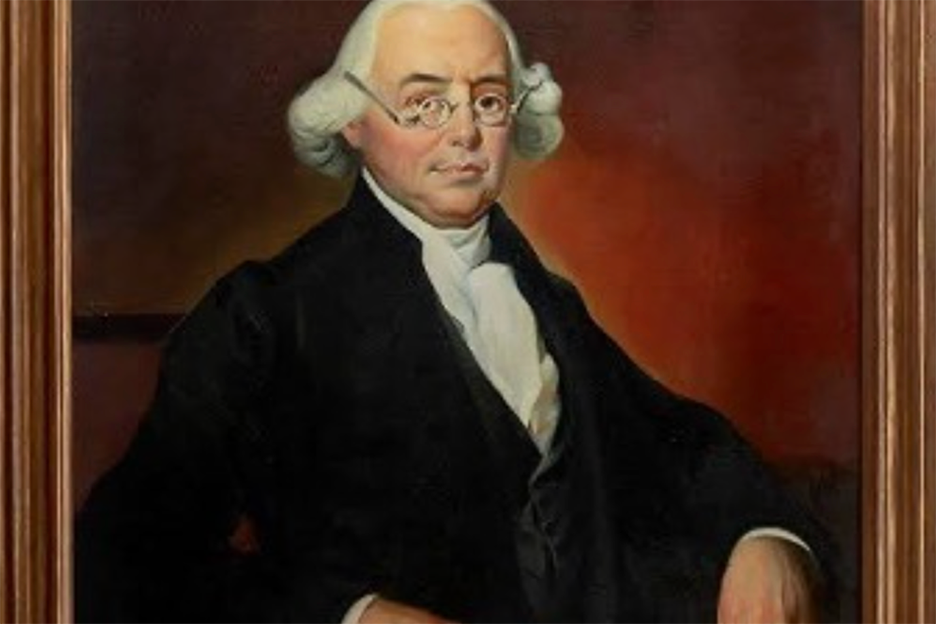
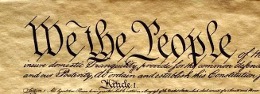
If you ask most Americans who were the most important “Founding Fathers,” chances are that only a tiny fraction will name the man who at the time was considered perhaps the most important of them. He was the only man to have signed the Declaration of Independence and the Constitution, and to serve as a U.S. Supreme Court justice. The man was James Wilson, born this day on September 14, 1742. His life story is one of the most compelling of the Revolutionary War era. We honor him as a truly forgotten Founding Father, a man who dedicated his life to the principle that all power in government derives from the people. It was Wilson who is credited with those three iconic opening words of the Constitution: We the People.
Background
James Wilson’s story begins far from Philadelphia, where the Constitution was approved in September 1787. Unlike almost all of our Founding Fathers, he was not American-born, he was an immigrant Scotsman. His family lived on the rolling farmland in Fife, Scotland, where Wilson was born, the fourth of seven children. He received his education at schools in St Andrews, Glasgow, and Edinburgh, where he absorbed the ideas of Enlightenment philosophers such as Hutcheson, Hume, and Adam Smith. His studies left him with the abiding belief in the “rights of man,” that famous doctrine that drove the Founding Fathers’ thinking about what form of government America should adopt.
The Pre-War Years
Wilson arrived in Philadelphia in 1765, two years after the end of the French and Indian War. With letters of introduction, he found work tutoring at the College of Philadelphia and soon began reading law John Dickinson, who also was to become a Founding Father, and originator of the infamous “Olive Branch Petition” in July 1775. By 1767 Wilson was admitted to the bar and, in short order, built a successful law practice, and soon had generated sufficient wealth to purchase land—indeed, over time, more land than any one man should ever imagine. His land speculations would be his ultimate downfall.
Wilson’s first major act of public advocacy for the rebel cause was a tract entitled Considerations on the Nature and Extent of the Legislative Authority of the British Parliament. Published in 1774, this tract asserted that Parliament had no rightful authority over the colonies because the colonists had no representation there. Historians believe that Wilson actually wrote the tract in 1768, but persuaded himself that the timing was not right to publish it. By 1774, however, the rebel cause was well underway, and his arguments were met with wide-spread support.
The War Years
Although not a soldier by training, like many colonists Wilson took up arms when the Revolutionary War broke out in April 1775. That same year he was commissioned a colonel in the Pennsylvania militia, ultimately rising to the rank of brigadier general.
On the political front, almost immediately Wilson became a member of the 2nd Continental Congress in May 1775. He was a champion of the movement for independence. Yet, when the question of independence came to a vote in June 1776, Wilson took a cautious approach, and did not immediately vote in favor of it. Instead, Wilson declared that he needed to receive the support of his constituents before casting his vote, believing that his vote must reflect the will of the people. Once assured, he voted for independence and signed the Declaration.
Also in June 1776, Wilson served on the little-known “Committee of Spies,” a five-person committee that was tasked with determining “what is proper to be done with persons giving intelligence to the enemy or supplying them with provisions.” He was in good company on this committee: Thomas Jefferson and John Adams were also members. The Committee issued a “Resolve” that created an expansive definition of treason that swept many Loyalists into its net, with an estimate of more than 8,000 prosecutions for treason before the end of the War.
One legal matter Wilson took up during the War became a stain on his reputation. Notwithstanding the 1776 “Resolve” he had helped draft, which targeted Loyalists for prosecution, in 1779 Wilson defended Loyalists against a legal effort to confiscate their property and exile them. The public’s anger over his defense of accused traitors sparked the “Fort Wilson Riot,” a colorful name for the violent attack made by rabble-rousing colonists on Wilson’s home. On October 4 the mob besieged his Philadelphia home until cavalry units intervened. Before their arrival, however, the mob had broken into Wilson’s house, shots were fired, and six men were killed. The rioters were later pardoned and released. It was a stark reminder that Wilson’s unwavering commitment to the rule of law often placed him at odds with the passions of the moment.
Post-War Years, and the Making of the U.S. Constitution
Several years passed after the end of the War in 1783 before a Constitutional Convention was convened in the summer of 1787. The “Articles of Confederation,“ then the governing instrument under which the federal government was operating, was not working, and all agreed it needed amending. The delegates to the Convention quickly decided the Articles needed to be entirely replaced, and in the summer of 1787, the process began. Inside the sweltering chamber of the State House (later renamed Independence Hall), Wilson’s intellect blazed brightest. Madison’s notes of the Convention record Wilson speaking 168 times, and his words helped shape nearly every major debate of the Constitutional Convention. He championed a strong national government, proportional representation, and broader suffrage, arguing that the people should hold as much direct power as possible.
Today, historians give major credit to James Madison and Alexander Hamilton for authorship of the Constitution, and for their advocacy of the main principles that were embodied in the document—the so-called “Federalist” theory of a powerful central government. Yet it was Wilson who stood among the drafters as the most learned and skillful. Wilson was thus appointed to serve on the Committee of Detail, and took a leading role in the creation of the Constitution’s first full draft. Wilson’s fingerprints are everywhere on the document. He was a principal architect of the executive branch, advocating for a single, energetic president accountable to the public rather than a committee lost in deliberation. He favored direct election of the president and, when that proved untenable, proposed the framework that evolved into the Electoral College. And on a sour note, he was the man who proposed the infamous “three fifths” solution to dealing with the thorny issue of how to account for the huge population of enslaved persons in the country, primarily in the Southern states.
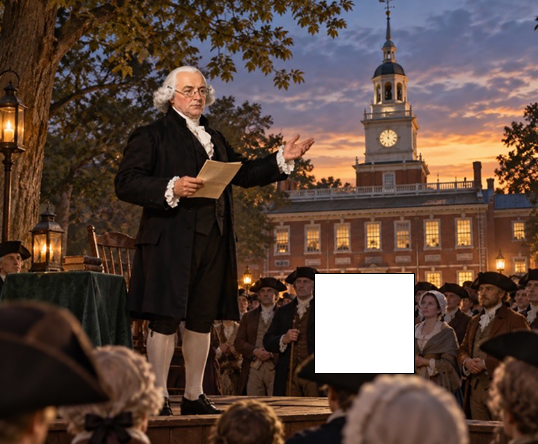
The delegates to the Constitutional Convention signed off on the Constitution on September 17, 1787. The ratification process required each state to elect representatives to vote upon the document at their own convention. Wilson was named to Pennsylvania’s convention, which first began meeting on November 21, 1787. Before that, Wilson gave a public speech in support of the just-approved Constitution before “a very great concourse of people” assembled in the State House Yard outside the since-renamed Independence Hall. His speech has gone down in history as the “State House Speech.” In his speech he argued that while the text of the Constitution had been the subject of vigorous debate, and parts of it he had himself opposed, members of the public should support it: “I am satisfied that anything nearer to perfection could not have been accomplished.”
On December 12, 1787, the Pennsylvania delegates ultimate voted to approve the Constitution by a vote of 46 to 23. Pennsylvania was the first large state to ratify the Constitution, which ultimately was approved by the required nine states on June 21, 1788, when New Hampshire became the 9th state to ratify.
Ironically, one of Wilson’s very public fights over the Constitution dealt with the absence of a Bill of Rights. His view was that the Constitution granted only certain “enumerated powers” to the federal government, none of which impinged on the rights that were being argued for. Thus, in his mind, no Bill of Rights was needed to counteract the non-existent interference with those rights supposedly to be found in the Constitution. For this stance, he was excoriated. Fortunately, he was no longer a member of Congress when the Bill of Rights was voted upon in 1789, and so he was spared having to vote “no” on one of the most important documents in American history.
The Final Years
Despite all his accomplishments, and all his fame, Wilson continued to engage in financial investments that were to be his ruin. His aggressive land speculation collapsed during the Panic of 1796–97, casting him into debt and even debtor’s prison on two occasions. Even while serving as a Supreme Court justice, he was literally on the run, hiding from his many creditors and shirking his duties on the Court. In 1798, he and his wife were found hiding at a friend’s home in Edenton, North Carolina,
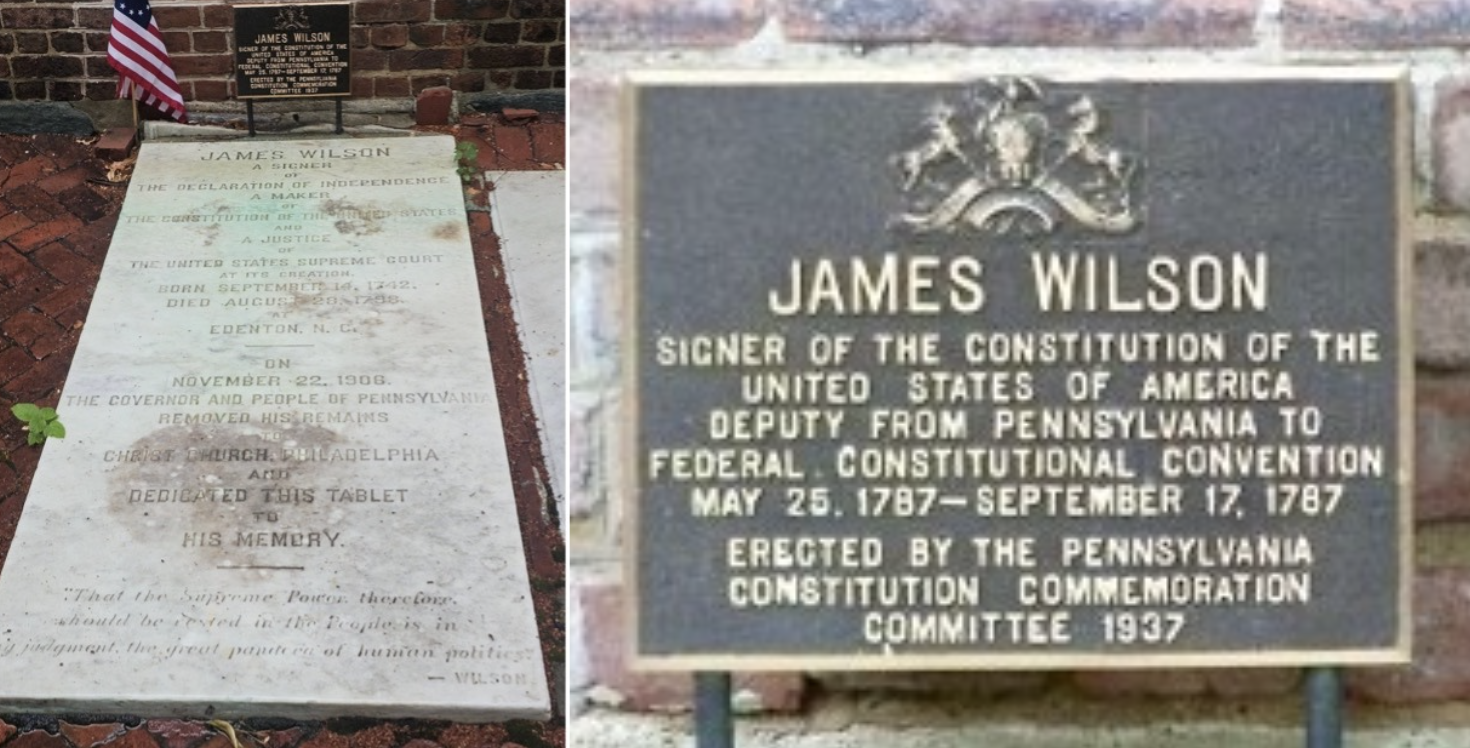
The final year of Wilson’s life was tragic. He was the personification of a man who had reached for the stars, but who had come crashing back to earth. In 1798, while living in Edenton, he suffered a stroke and died at just 55 on August 21, 1798. He was still a member of the Supreme Court at the time of his death, but he was buried without ceremony in the Johnston cemetery on Hayes Plantation near Edenton, a discredited man whose many contributions to the cause of liberty were dwarfed by his business failures. It wasn’t until a century later that students of American history concluded that he should be properly honored. In 1906, an effort was mounted to have his body reinterred in at Christ Churchyard in Philadelphia, where Benjamin Franklin and other luminaries were buried. The burial ceremonies included having his casket lay in state in Independence Hall. On his gravestone, the following words are engraved:
“That the Supreme Power, therefore, should be rested in the People is in my judgment, the great panacea of human politics.”
Wilson’s Legacy
James Wilson’s legacy is complex. He was a visionary, but also a greatly flawed and sometimes hypocritical person. He believed deeply in popular sovereignty, in the capacity of ordinary citizens to govern themselves wisely, but he was mute when it came to the rights of African-Americans. His ideas shaped the presidency, the courts, and the very opening words of the Constitution, and yet he opposed the Bill of Rights. His statesmanship in the making of the Constitution was of the highest order, and yet his personal life was a shambles, despite the many warnings my his friends that he was imperiling his career with his speculative land schemes and other financial shenanigans.
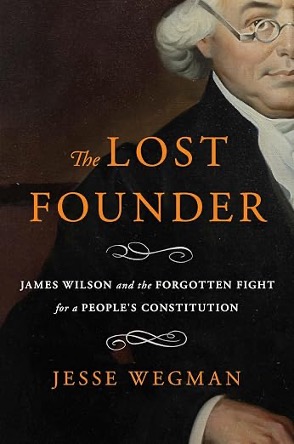
As we commemorate the 250th anniversary of the signing of the Declaration of Independence, historians are finally beginning to give Wilson his due. In a book published earlier this year by Jesse Wegman, “The Lost Founder,” the author argues that James Wilson should rightly be held in the highest possible esteem for his many contributions to our country. We agree.