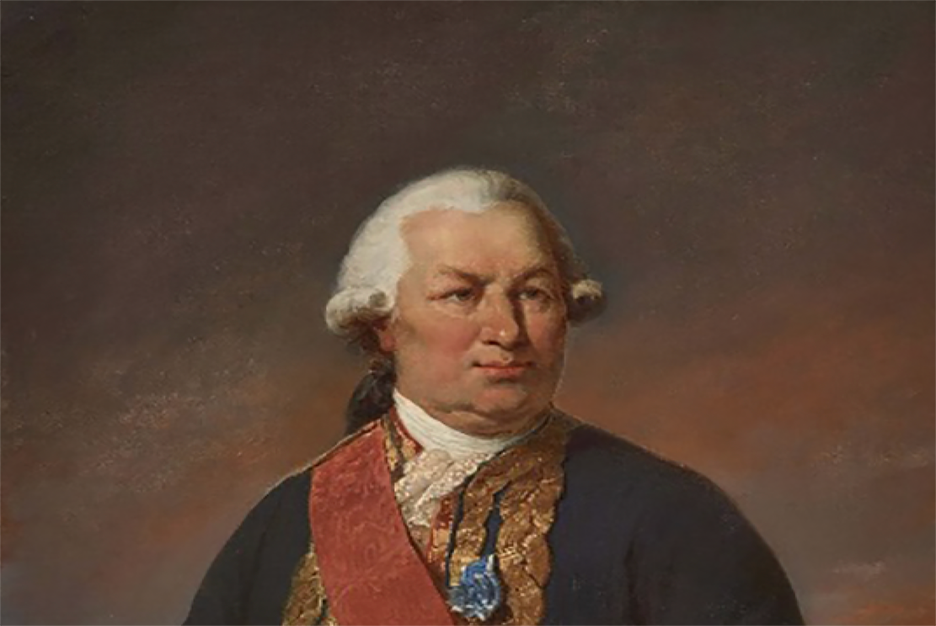
We’ve written about the famous “Battle of the Chesapeake” that took place on September 5, 1781, in which a French fleet defeated a smaller British fleet in a fierce sea battle that took place at the entrance to Chesapeake Bay, paving the way for the Americans’ victory at Yorktown just days later. The commander of the French fleet was Lt. General Francois Joseph Paul de Grasse, who we honor today on the anniversary of his birth on September 13, 1722.
If one talks to any Frenchman who knows his Revolutionary War history, he will tell you that the two greatest heroes of the Revolution were General Jean-Baptiste Donatien de Vimeur, otherwise known as the Compte de Rochambeau, and Lt. General de Grasse. Those two men continue to be honored today in France, much as we honor our Revolutionary War patriots such as General Washington, Henry Knox, Nathanael Greene, and other well-known soldiers. Undoubtedly, without the French victory in the Battle of the Chesapeake, many historians will tell you that the Battle of Yorktown may not have been won, and America’s prospects of winning the war would have been greatly diminished.
What do we know about de Grasse? Born in 1722, he was over 50 years old when the American Revolution got underway in 1775. His father was the Marquis de Grasse, a nobleman, so it’s fair to say that de Grasse came from an elite family background. Before the war, he had married Antoinette Accaron in 1764, and together they had six children. Antoinette died young, and de Grasse ended up marrying twice more.
De Grasse’s military service was long and distinguished. He first joined the Navy in the 1730’s, and was involved in naval operations in India during the 1760’s and 70’s, right up to the time of the American Revolution. When France officially entered the conflict in 1778, de Grasse commanded naval fleets in a series of sea battles in the English theatre of war, as well as in the West Indies, where he fought against the noteworthy British admirals George Rodney and Samuel Hood. Fate would have it that Admiral Rodney missed the Battle of the Chesapeake. Many historians believe that had he been present, the outcome might have been different—Rodney was an exceptional seaman, and a true warrior.
It was the Battle of Chesapeake that made de Grasse famous. His tactical brilliance led to a shocking British retreat to New York, and the game was over: Lord Cornwallis, the commander of the British army, was trapped at Yorktown with no escape, and he was forced to surrender to the Americans in a humiliating end to his military command in America.
After the Battle of the Chesapeake, de Grasse continued to wage war, but in 1782 he was defeated by Admiral Hood in the Battle of St. Kitts, and later captured by Admiral Rodney at the Battle of the Saintes. He was not released until after the war was concluded by the Treaty of Paris. Despite his great success in the Battle of the Chesapeake, he was roundly criticized at home for his losses in the West Indies. He was exonerated, however, in 1784, and all charges against him were dropped.
De Grasse died in 1788. A monument in his honor was erected in Virginia Beach, Virginia, and a statue placed at Yorktown. Other honors have been conferred upon him posthumously, a testament to his major contributions towards the cause of liberty in America.
And so we honor Lt. Admiral Francois Joseph Paul de Grasse on this day, the anniversary of his birth on September 13, 1722. Long may he be remembered.