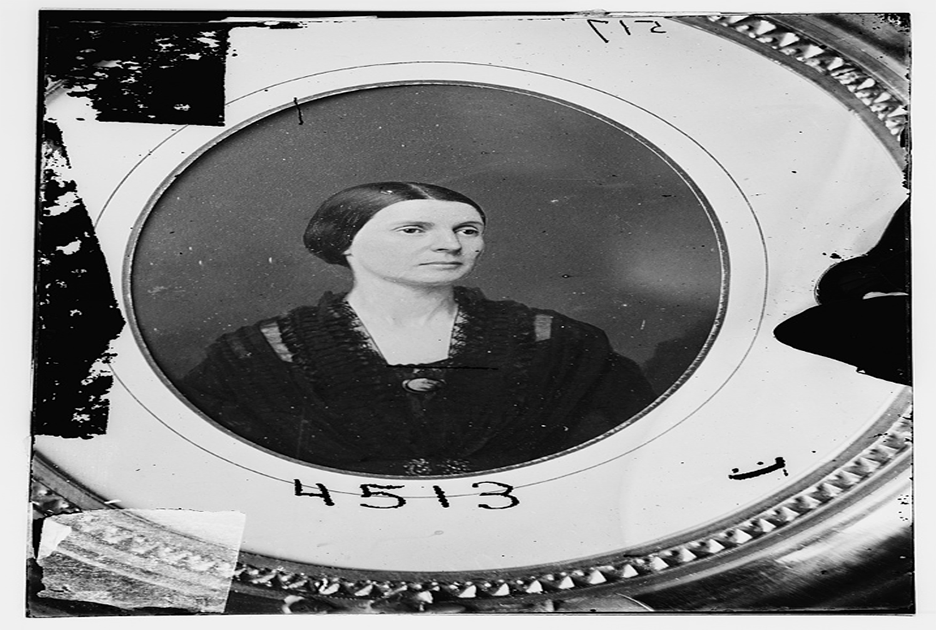
The Civil War produced a war machine that had never been thought possible in the early decades of the American military —massive production of armaments and equipment, extensive use of a network of rail lines to transport provisions to the front lines, a fleet of armored naval vessels, and major advances in the organization of battlefield medicine and evacuation. Also supporting the war effort was a network of spies, some of whose names have never been revealed, and others who have achieved a level of public fame. One such spy was Rose O’Neal Greenhow, a well-heeled socialite who circulated in elite circles in Washington D.C. but was also secretly feeding information to the leaders of the Confederacy. She was one of the most effective spies—male or female—for the Confederacy. We remember her today on the anniversary of her death by drowning on October 1, 1864.
Born in Maryland around 1813, Rose was raised by her widowed mother, Eliza, along with three other sisters. Soon Rose was sent to live with her aunt Maria Ann Hill, who was the owner of a posh boarding house in Washington D.C. In her 20s, Rose met and married Robert Greenhow. His work took them to live in Mexico City for a spell, then San Francisco, where Robert died in 1854. Rose took up the life of a merry widow back in Washington, and was a frequent guest at various social gatherings attended by important political and military leaders.
In the years leading up to the Civil War, Greenhow became a committed Southern secessionist. After the war began in 1861, she was recruited into a Confederate spy network in Washington, D.C., and began passing along intelligence she gathered through her connections with political and military leaders. Greenhow passed information about Union troop movements to Confederate officials before the First Battle of Bull Run. Confederate President Jefferson Davis later credited her intelligence with helping the South secure its victory. Her successful spying led to her receiving the nickname “Rebel Rose.”
Union Army leaders quickly suspected Rose of spying, and they tracked her movements. It did not take long for them to conclude that there was enough evidence to arrest her. She was placed under house arrest just weeks after the Battle of Bull Run. A search of her house uncovered incriminating evidence of her espionage, some of which suggested that one of her sources was a U.S. Senator. Yet she continued to be allowed to live at her home, and she continued to pass information along to her Confederate contacts.
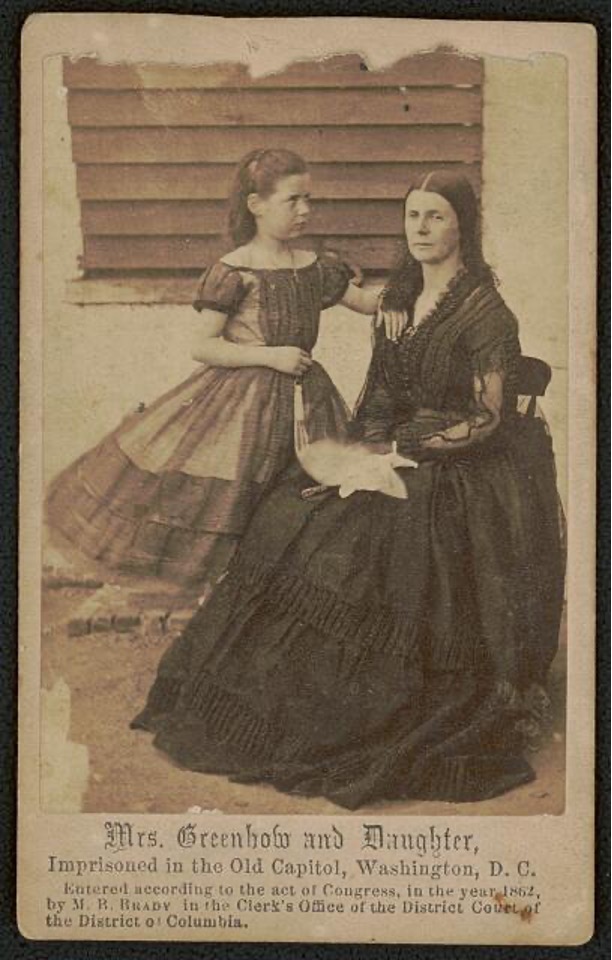
Public outcry over her lenient treatment caused the Army to imprison her in January 1862 at the Old Capitol Prison. She was never tried in a civilian or military court, although she appeared before a commission reviewing political prisoners. She finally was released on the condition that she live within the Confederacy, and stay away from Washington D.C. She went to live in Richmond, Virginia, the heart of the Confederacy, where she was greeted as a heroine.
Rose was so well regarded for her exploits that the President of the Confederacy, Jefferson Davis, commissioned her to travel to Europe as an emissary for the rebel cause. Her travels during the period 1863-64 took her to Great Britain and France. While in London, she penned her memoirs – My Imprisonment and the First Year of Abolition Rule at Washington – a rare first-person account written by a Civil War spy. In 1864, she agreed to return to America with important correspondence for the Confederacy, but she never made it. On October 1, 1864, she was aboard the Confederate blockade runner Condor when it ran aground while attempting to evade Union forces. Rose escaped in a rowboat, only to capsize and drown. Among Greenhow’s belongings recovered after her death was a copy of her published memoir, personally inscribed to her daughter. The water-damaged volume eventually made its way to the Library of Congress, where it remains today. Her life may have been cut short, but her story lives on today.
Recommended Reading