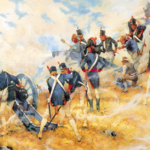
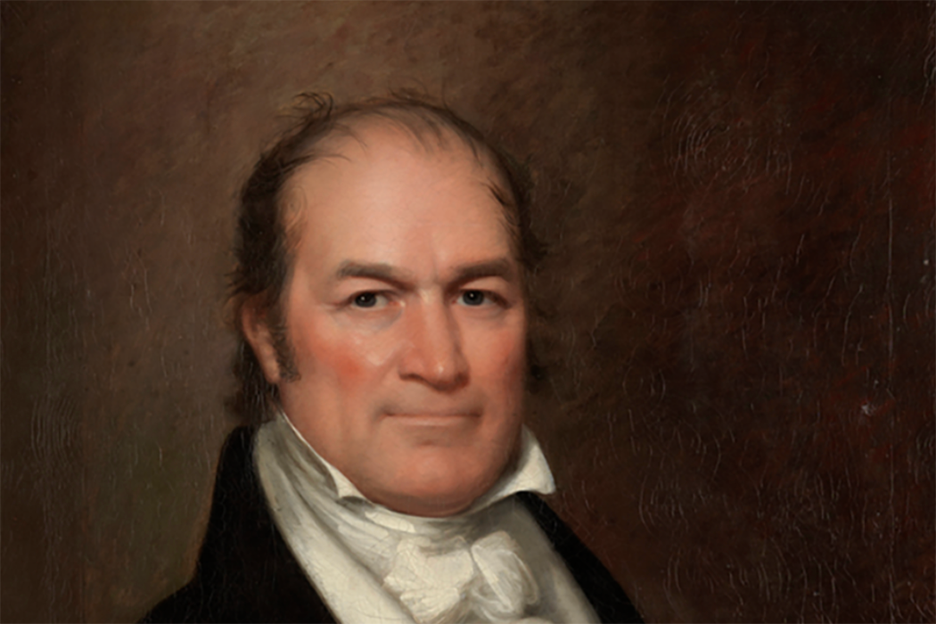
The presidency of Thomas Jefferson was the start of the two-party system in America, and during the next two decades, it was “no holds barred.” Under Jefferson’s successor, President James Madison, the country became embroiled in the War of 1812— a black mark on Madison’s presidency—and the anti-Madison faction did what it could to destroy the remainder of Madison’s presidency. During that period, one of the leaders of the U.S. Senate was William H. Crawford, a Virginian who joined Madison’s administration in 1813. Crawford was a highly respected leader of the Senate and soon was appointed to serve in President Madison’s administration. Crawford had higher aspirations, however. As we shall see, he fell short of the mark, but he continued to serve his country in other ways.
Background
Crawford was born on February 24, 1772, in Amherst County, Virginia. He was the son of Joel Crawford and Fanny Harris. He was educated at private schools in Georgia, and at Richmond Academy in Augusta. After his father’s death, Crawford became the family’s main provider and worked on the Crawford family farm. He later studied law, was admitted to the bar in 1799, and began to practice in Lexington.
Crawford was a descendant of John Crawford (1600–1676), who had come to Virginia in 1643, but participated and died in Bacon’s Rebellion. John’s son David Crawford I (1625–1698), was a member of the Virginia House of Burgess (1682-1684). The Crawford family was a force in Virginia politics, and William was soon to enter politics himself.
Crawford also found time to raise a family. He married Susanna Gerardine on April 28, 1804, and they had 8 children and 6 grandchildren. His eldest Caroline was born in March 1805, while his youngest, William, was born in 1821.
Crawford’s Early Political Career
In 1799, the same year in which he was admitted to the bar, Crawford began his political career when he was appointed by the state legislature to prepare a digest of Georgia’s statutes. He then won election to the Georgia House of Representatives in 1803, where he aligned himself with the Democratic-Republican Party. In 1807, the Georgia legislature elected Crawford to the U.S. Senate, where he served until 1813.
Crawford’s Career as a Member of the Presidential Cabinets of James Madison and James Monroe
President Madison appointed Crawford as the minister to France in 1813, and Crawford held that position for the remainder of the War of 1812. After the war, Madison appointed him to the position of Secretary of War. In October 1816, Madison chose Crawford for the position of Secretary of the Treasury. Crawford would remain in that office for the remainder of Madison’s presidency and for the entire duration of James Monroe‘s two-term presidency.
Crawford’s service as Monroe’s Secretary of the Treasury was marked by controversy. Crawford has been described as having “the faults of a strong nature-he was overbearing, high-tempered, and his ambition did not spurn what his enemies called intrigue.” Indeed, Crawford was often engaged in some form of intrigue during Monroe’s two terms in office. Some of the ill will may have stemmed from the fact that Crawford had wanted to be nominated for president back in 1816, but Madison had favored Monroe for the job, and Monroe got the nomination, with 65 votes to Crawford’s 54 votes. Monroe went on to win the election, defeating Federalist Rufus King. Historians have written that Monroe and Crawford were sometimes at odds with each other, to the point that at one private meeting between the two of them, Crawford is said to have shouted at Monroe, “you damned infernal old scoundrel!” Crawford brandished a cane, in response to which Monroe grabbed the tongs from the fireplace and threatened Crawford. Crawford apologized and quickly left the room. Despite the confrontation, Monroe did not fire him, and Crawford continued to serve as Secretary of the Treasury for the rest of Monroe’s presidency.
At the end of Monroe’s two terms, Crawford sought to succeed Monroe in the 1824 election. Because of his roots in Virginia, Crawford received the support of the Virginia dynasty, but his presidential ambitions foundered. During the election of 1824, the Democratic-Republican Party splintered into factions, as several others also sought the presidency. Ultimately the election came down to a three-way race between Andrew Jackson, John Quincy Adams, and Crawford. The House selected Adams, who asked Crawford to remain as Treasury Secretary. Crawford declined Adams’s offer and returned to Georgia and accepted an appointment to the state superior court.
Back in Georgia, Crawford continued to engage in politics. He was nominated for vice president by the Georgia legislature in 1828 but withdrew after support from other states was not forthcoming; Andrew Jackson won the election. Crawford also considered running for vice president in 1832 but decided against it; Martin Van Buren got the job. Crawford also considered running for president again, but dropped the idea when Jackson decided to seek a second term.
Legacy
Crawford died on this day on September 15, 1834. At the time of his death, Crawford was still in public service as a judge on the Georgia State Superior Court, He is interred in his own burial ground, adjacent to the former site of his mansion, Woodlawn, about half a mile west of the current town of Crawford’s city limit. His wife Susannah outlived him by almost 30 years, passing away in 1863 at the about of about 82. Today, Crawford is remembered in many ways. Countless counties, cities and towns are named after him. His likeness also graces U.S. currency first issued in 1875, the centennial of the start of the American Revolution.
And so, we honor William H. Crawford today on the anniversary of his death in 1834. He was one of the country’s most important political figures in the first decades of the 19th century and has left a legacy.