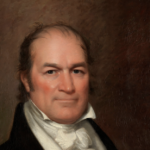
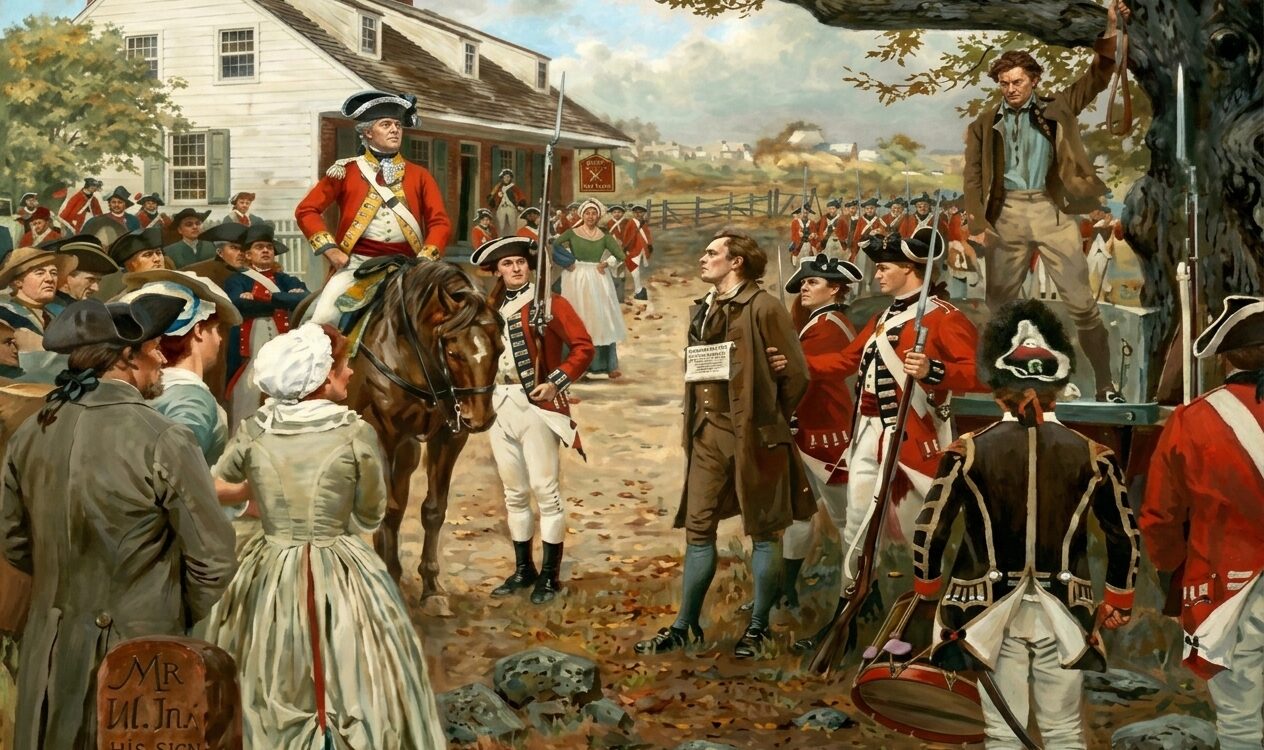
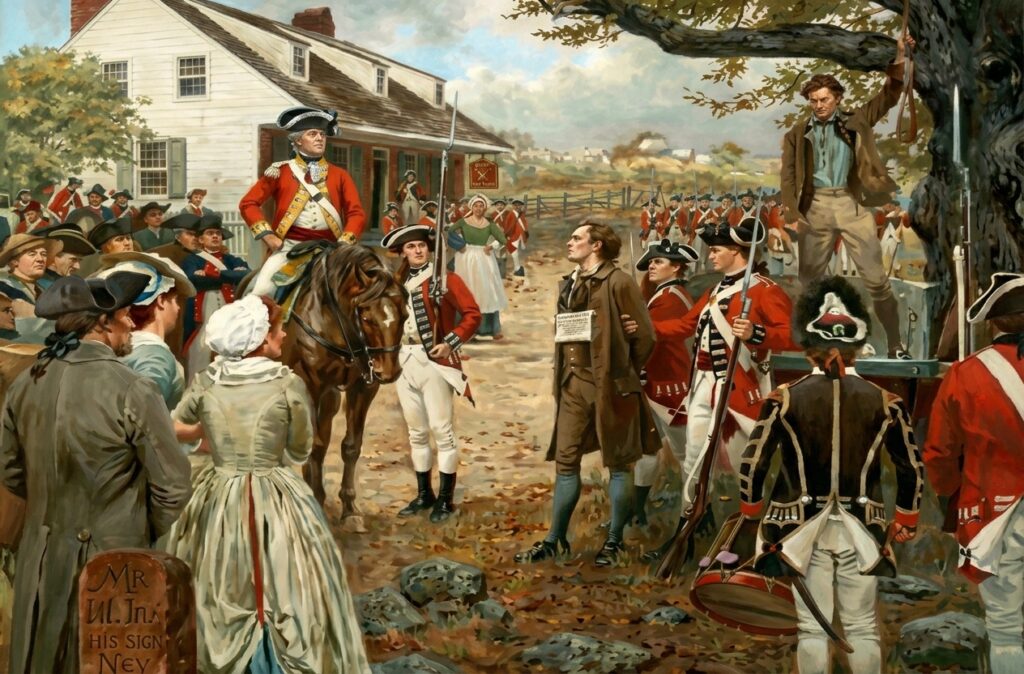
There are many iconic moments in the history of the American Revolution that Americans tend to remember: Paul Revere’s ride, Washington crossing the Delaware, and so on. One such iconic moment we commemorate today is the death of Nathan Hale, a young man from Connecticut who was captured and executed by the British as a spy. His death by hanging has gone down in history for the words he is said to have uttered just before he died: “I only regret that I have one life to lose for my country.”
Or did he actually say that? Historians have reached various conclusions on the subject, given the skimpy evidence of exactly what Hale said from the gallows. Only one eyewitness has attributed the famous words to Hale at the moment of his death: a British soldier who was there, and who reported that these were Hale’s dying words. There is no doubt that Hale gave a speech, and several accounts have him saying things that conveyed similar sentiments, if not the exact words. We will never know, but it has served the purpose of elevating Nathan Hale to the status of a martyr.
Background
How is it that Nathan Hale found himself a captive spy in the first place? In September 1776, American troops under the command of General Washington were literally on the run, having escaped with their lives after being surrounded during the Battle of Long Island in late August. The British had tightened their grip on New York, and the Continental Army needed answers — troop numbers, fortifications, supply lines. General Washington asked for a volunteer to slip behind enemy lines. Young Nathan Hale, just 21 years old, volunteered — the only soldier to volunteer.
Hale was an unlikely spy: he was a well-schooled young man, a student at Yale before the war broke out. After graduating in 1773, he became a school teacher, hardly a profession that prepared him to engage in spycraft. But duty called, and as soon as the war commenced, Hale joined a Connecticut militia unit and quickly became a lieutenant. He also became active in a little-remembered unit known as “Knowlton’s Rangers,” an espionage unit. “I wish to be useful,” he had once told a friend. “And every kind of service necessary to the public good becomes honorable by being necessary.”
Hale’s Capture and Execution
After answering General Washington’s call for a volunteer, Hale disguised himself as a Dutch schoolmaster and crossed into British-held territory. For days he moved quietly through taverns, docks, and encampments, sketching fortifications and noting troop movements. But the city was crawling with Loyalists eager to curry favor with the Crown. One of them was Major Richard Rogers, a veteran soldier who is said to have recognized Hale in a tavern, then followed him and seized him as a captive. Hale was transported to the headquarters of General William Howe. After examining the captive, and supposedly finding incriminating evidence on his person, General Howe ordered Hale’s execution for dawn the following morning, September 22.
That night, Hale was kept under guard in a greenhouse on the estate grounds. He must have guessed his fate, for he asked for a Bible, but was refused. He asked for a clergyman; this request also was refused. But the British soldiers guarding him allowed him pen and paper. Hale is said to have written two letters, one to his mother, one to his commanding officer. If he did so, the letters were never preserved.
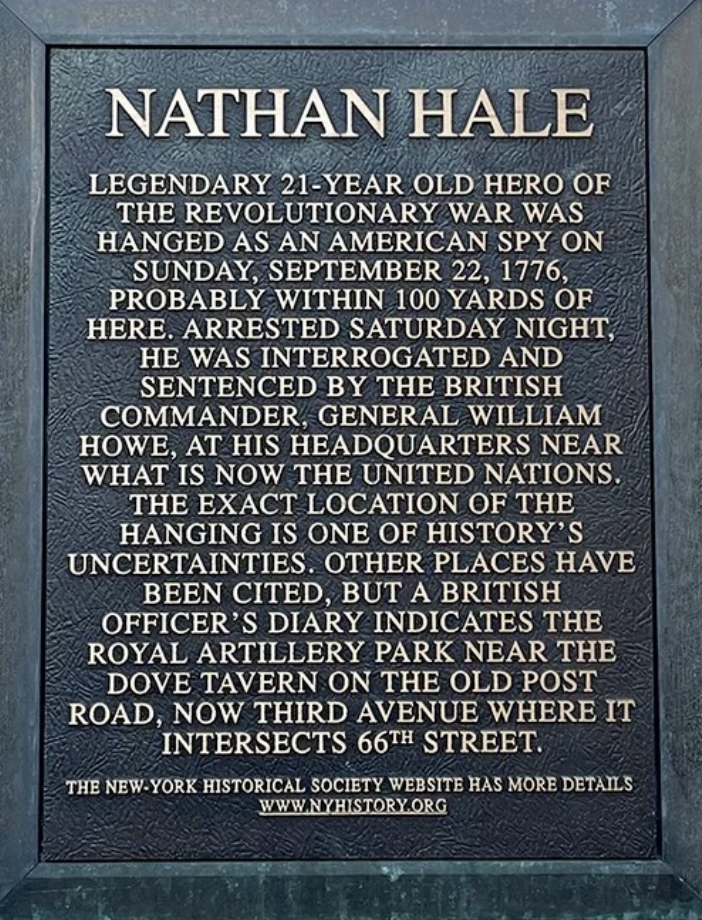
At sunrise, British troops assembled to witness Hale’s execution. Hale was led to a small clearing where the gallows had been erected, believed to have been next to Dove Tavern (modern-day 66th Street and 3rd Avenue in Manhattan). Hale was given the chance to say a few last words. Some witnesses said he spoke softly. But all agreed that Hale was strong and steady in his final moments, and he is said to have died quickly. The British left his body hanging for hours as a warning to other would-be spies. After his body was taken down, it was taken to parts unknown; his body was never found. Today, a memorial to Nathan Hale is located at the site where Hale is believed to have been hung (courtesy of the New York Historical Society).
Nathan Hale’s Legacy
In the decades that followed, statues rose in his honor, including a large statue at City Hall Park in New York City, and in New London, Connecticut. Perhaps in an acknowledgement that Hale was indeed a spy, a statue in his memory stands at the headquarters of the Central Intelligence Agency. His name has become synonymous with patriotism. And though historians debate the exact phrasing of his final declaration, the sentiment of his final words — fierce, selfless, resolute — continue to resonate with the American people.
And so today we honor the memory of Nathan Hale, a true patriot who died this day on September 23, 1776.