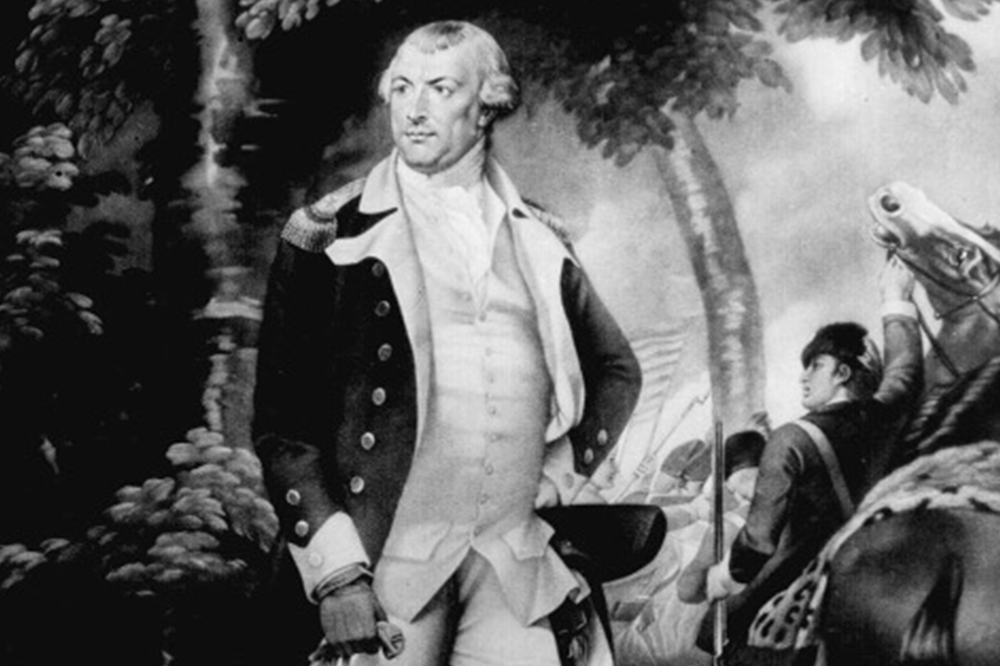
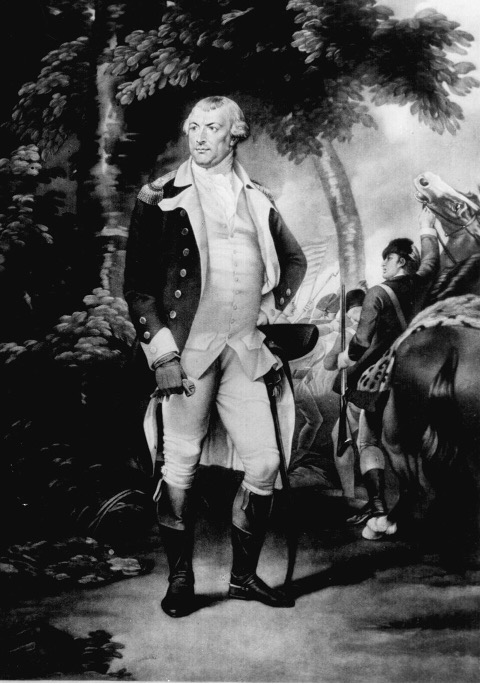
The American Revolution produced a number of unlikely war heroes who came out of nowhere to become leading generals in the Continental Army. Henry Knox, for example, was a bookseller in Boston who joined the Army and immediately distinguished himself for his valor in the Siege of Boston. He later became one of Washington’s top-ranking generals. Another person who was instrumental to the war effort—and a close confidante of General Washington—was Nathanael Greene, who we honor today on the 240th anniversary of his death on June 19, 1786. He was an unlikely candidate to rise to the rank of Major General, or any rank for that matter, because he was raised a Quaker, a religion that preached non-violence, and told its members that joining the rebellion would lead to their banishment from the faith. That is precisely what happened to Nathanael Greene.
Greene’s upbringing offers a few glimmers of how he might have gravitated to the cause of independence. Born in 1742, Greene was the son of a very prosperous merchant and farmer, Nathanael Greene Sr., The family resided in Warwick, Rhode Island (a colony known for its religious tolerance). Raised in the Quaker faith, at a young age Nathanael immersed himself in book-learning, and gained a well-rounded education in the classics, mathematics, and philosophy. It was perhaps the latter subject that exposed him to the Enlightenment philosophers such as John Locke who propounded a theory of “natural rights” that so influenced our Founding Fathers. Greene later expanded his readings to include various military histories, at a time when the American Colonies were embroiled in the French and Indian War (1753-1763). That War included violent encounters in Rhode Island, including the seizure of one of Greene’s sailing vessels, an incident that left may have drove Greene towards the rebel cause. Perhaps because of his increasing support for the rebel cause, he was suspended from Quaker meetings in 1773. The following year, it was Greene who organized a Rhode Island militia unit, which turned out to be the beginning of his leadership role in the Revolution to come.
The Revolutionary War Begins
As soon as war broke out in April 1775, Green was appointed to command the Rhode Island Army, and his unit participated in the Siege of Boston. His impressive performance led to his being named a brigadier general in the Continental Army. Over the next two years he led his men into battle at various of the critical engagements: the Battle of Long Island, the Battle of Harlem Heights, the Battle of Fort Washington, the Battle of Trenton, and the Battle of Princeton. In 1777, he was on the battlefield at Brandywine and Germantown. It seems like Greene was everywhere.
Greene as Quartermaster General, and Leader of the Southern Campaign
Following the Continental Army’s winter encampment of 1777-78, when Washington & his troops were at Valley Forge, Washington persuaded Greene to take on the critical position of Quartermaster General for the Continental Army. Greene proceeded to reorganize that department and ensure that the troops were well provisioned; his efforts were successful, and he returned to regular service in time to lead his men in the Battle of Monmouth and the Battle of Rhode Island. Greene returned to his Quartermaster General duties, but by the Fall of 1780 he was back on the front lines, this time as the commander of the Southern Department of the Continental Army. The subsequent “Southern Campaign” has gone down in history as one of the pivotal moments in the Revolution, as Greene and his counterpart, British General Cornwallis, played a cat-and-mouse game across the states of North Carolina, South Carolina, Georgia, and ultimately Virginia. He was there at the famous battle of Guilford Courthouse in March 1781.
All of this was a prelude to the deciding Battle of Yorktown, fought in October 1781. Greene’s Southern Campaign had set up the confrontation by forcing Cornwallis to retreat to a tactically disadvantageous position at Yorktown, where the British Army was defeated and Cornwallis surrendered. While Greene was not there, he is credited as having played a major role in the victory at Yorktown. The war was essentially over.
Aftermath
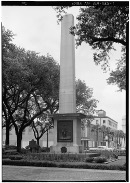
Greene’s war experiences gradually led him to believe that a major failing of the war effort was the lack of support from the Continental Congress. Thankfully the end of the war was near: in April 1783, the war ended, and Greene went home to Rhode Island. Apparently he owned land in Savannah, Georgia that he decided would be a better home, so he moved his family to the Mulberry Grove Plantation near Savannah, where he spent the rest of his life. He died there on June19, 1786. He is believed to have died of sunstroke. He was only 43 years old. Today, the Nathanael Greene National Monument stands in tribute to him, a man who played a monumental role in America’s victory over the British armies.
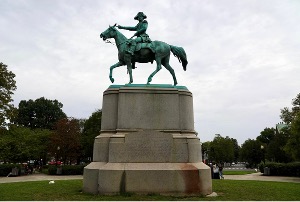
Also, a statue of Greene is prominently featured in Stanton Park in Washington D.C. The Park is operated by the National Park Service, which has dubbed Nathanael Greene “The Fighting Quaker.” On June 20, 2026 at 11 am Eastern, there will be an unveiling of the newly-restored statue of Greene as part of day-long events taking place in and around Washington D.C. For more information about the unveiling ceremonies, click here.