When we think of our Founding Fathers, with a few exceptions we tend to think of political figures like John Adams, John Hancock, James Madison, Patrick Henry, Alexander Hamilton, and the many other men who signed the Declaration of Independence or the Constitution. Often overlooked are the military heroes of the Revolution, General Washington’s righthand men who led the troops in battle, among them Nathanael Greene, Henry Knox and Francis Marion (the “Swamp Fox”).
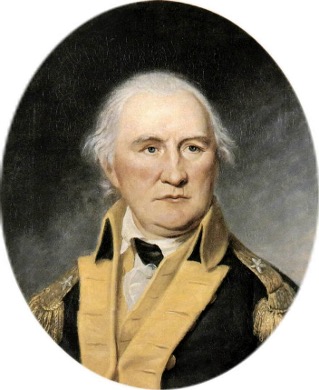
For historians who have written about the major battles of the American Revolution, one name that is frequently mentioned is Daniel Morgan, who led an army of Virginia riflemen which became one of the effective fighting units in the War. Morgan and his men were instrumental in the Americans’ victory at the Battle of Saratoga and the Battle of Cowpens, as well as major battles in which the Americans did not prevail, but Morgan and his men distinguished themselves for their valor—the Siege of Quebec in December 1775 being a prime example. We honor him today on the anniversary of his death on July 6, 1802.
Born in July 1736, Daniel Morgan was a second-generation Welsh American, whose grandparents came from Wales and settled in New Jersey. After falling out with his father, Morgan left home at age 17 and soon found his way to the Shenandoah Valley of Virginia. In his young adult years, he worked as a teamster, ran a sawmill, and made a reasonably good living for himself. Yet he also played hard, and had a reputation for drinking, fighting, gambling and womanizing (he did not marry until he was well into his forties).
Morgan had his first real military experience in the French and Indian Wars (1753-1763), and served as a rifleman in Dunmore’s War, among other battles. His war experience in that war prepared him for his Revolutionary War service, which began when he formed a Virginia infantry unit when war broke out in April 1775. Just after the commencement of hostilities, he led a company of a hundred Virginian soldiers north to New England to support General Washington in the Siege of Boston in June 1775. His troops became known as the “Virginia Riflemen,” expert marksmen who used more accurate “long rifles” (not muskets) to inflict massive losses on opposing British troops.
Shortly after the Siege of Boston, Morgan joined Benedict Arnold in the famous “Arnold Expedition” to Canada, which culminated in the Battle of Quebec in December 1775. It was a major loss for the Americans. Arnold himself was wounded, and General Richard Montgomery was killed in action. As the battle raged, Morgan and his troops were cornered, and he finally surrendered and became a prisoner of war. Happily, he was later freed in a prisoner exchange and returned to active duty with the Continental Army. For his valor at Quebec, he was promoted to Colonel and placed in command of an infantry regiment of the Continental Army—still with his Virginia riflemen among his troops. He went on to play a major role in defeating British troops at the Battle of Saratoga in the Fall of 1777, which led to General Burgoyne’s surrender of is army—a major embarrassment for the British regulars, and a black mark on Burgoyne’s career.
Despite his heroism at Saratoga, Morgan did not receive the recognition felt he deserved; he resigned his commission in June 1779 and went home to Virginia. It took the Americans’ defeat in the Battle of Camden (in which General Horatio Gates was badly out-generaled) to convince Morgan to rejoin the Continental Army. He and his men became a critical fighting force in what came to be known as the “Southern Campaign.” Morgan was finally promoted to brigadier general in October 1780, in time for him to lead his men in the Battle of Cowpens in January 1781, a major victory for the Americans. Soon after that battle, Morgan resigned, after having served his country in battle for over six years.
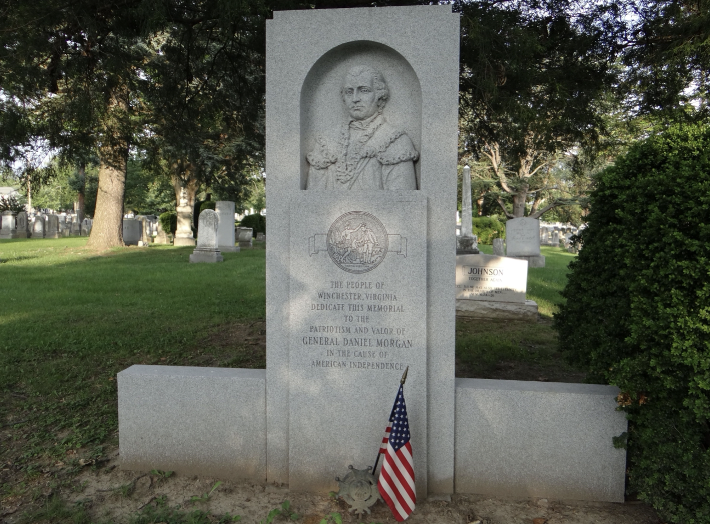
In retirement, Morgan did well for himself, acquiring massive amounts of land and building a home in Winchester, Virginia. He briefly served in the House of Representatives in 1796, but he mainly tended to his property and enjoyed retirement with his wife Abigail Curry, with whom he had two daughters. Morgan died on June 6, 1802, at the age of 66, and is buried in Mount Hebron Cemetery in Winchester, Virginia. His wife Abigail outlived him by 14 years, finally passing away in 1816; she is buried in her family’s cemetery in Kentucky. Morgan is memorialized with a long list of place names, schools, statues, and monuments. His home in Winchester, which still stands, is a National Historic Landmark.