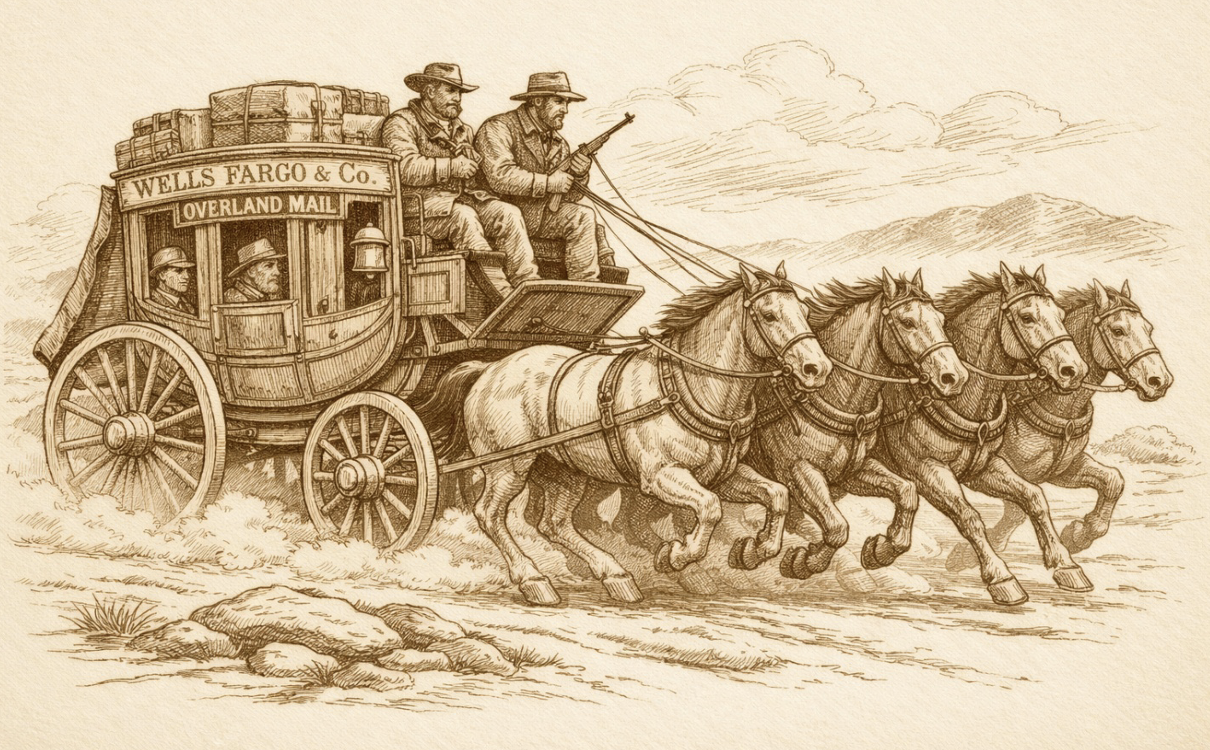
When people think of Wells Fargo, images of stagecoaches, gold shipments, and the rugged American West usually come to mind. What’s less known is the role played by Louis McLane, a statesman‑turned‑business leader whose steady hand helped shape the company during one of its most transformative periods. Though not present at the company’s founding in 1852, McLane’s leadership in the 1860s was instrumental in defining what Wells Fargo would become.
Louis McLane came to Wells Fargo with an impressive résumé. He had served as a U.S. Congressman, Senator, Secretary of the Treasury, Secretary of State, and later as president of the Baltimore & Ohio Railroad. By the time he entered the express and banking world, he was already recognized as a skilled administrator capable of steering large, complex organizations through turbulent times.
His connection to Wells Fargo began in 1866, when he was appointed president of the company. This was no ceremonial role. Wells Fargo was in the midst of a massive shift in the transportation and communications landscape. The Civil War had ended, the transcontinental railroad was nearing completion, and stage lines—long the backbone of Western travel and mail—were struggling to survive.
Under McLane’s leadership, Wells Fargo executed what historians often call the “grand consolidation.” In late 1866, the company purchased Ben Holladay’s vast Overland stage line, merging it with its own express operations and the Overland Mail routes. This move effectively unified the major express and stage services across the West under a single banner. It was a bold, expensive, and strategically essential decision—one that positioned Wells Fargo as the dominant express company from the Missouri River to California.
McLane’s presidency lasted only a few years, ending in 1869, but the impact of his tenure endured. He provided stability during a volatile era and helped guide the company through the transition from stagecoaches to railroads, ensuring Wells Fargo remained relevant as the nation modernized.
Interestingly, the McLane family’s influence on Wells Fargo extended beyond Louis himself. His son, Louis McLane Jr., played a decisive role during the California banking panic of 1855, choosing to keep Wells Fargo’s doors open when others closed. That single act preserved public confidence and helped cement the company’s early reputation for reliability.
Together, father and son helped shepherd Wells Fargo through its formative decades—one through crisis, the other through consolidation. Their contributions, though often overlooked, remain woven into the company’s early story and the broader history of American finance and transportation.