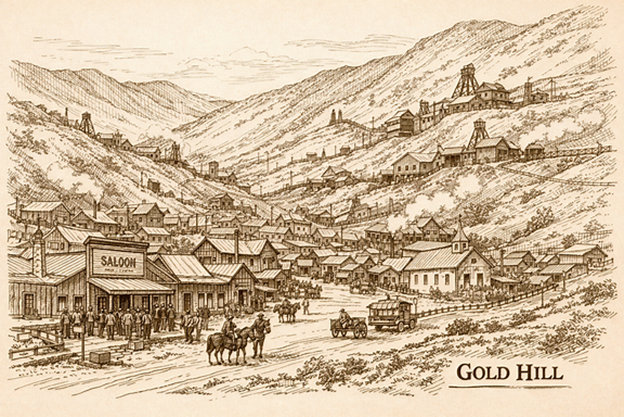
The Nevada frontier had a way of hiding its treasures behind hardship. In 1859, the hills above Gold Hill looked like any other stretch of dusty, wind‑scoured country — scattered diggings, rough cabins, and men chasing rumors of gold with more hope than luck. Nothing about the place suggested a secret. Nothing hinted that the ground beneath those boots held a fortune so vast it would reshape the West.
The first signs weren’t glorious. They were annoying. The miners at the Ophir claim kept running into a heavy, sticky blue clay that clogged their shovels and slowed their work. They cursed it, tossed it aside, and tried to dig past it. They didn’t know that the “nuisance” was rich with silver — richer than anything North America had ever seen.
Into this confusion wandered Henry Comstock.
Comstock was a familiar type on the frontier: a drifter with a borrowed name, a thin resume, and a talent for appearing wherever opportunity might be coaxed loose. He had never struck a meaningful claim of his own. He had no special gift for reading rock. But he possessed something far more useful in moments of uncertainty — nerve. The kind of nerve that could turn hesitation into advantage.
When Comstock arrived at the Ophir diggings, he didn’t study the ore. He studied the men. He saw their uncertainty about the boundaries. He saw their frustration with the blue clay. He saw the kind of hesitation that could be pushed, shaped, and exploited. And he stepped forward with the confidence of a man who owned the whole hillside.
Comstock announced — boldly, loudly, and with full frontier bravado — that the claim sat squarely on land he owned. He insisted on his rights. He hinted at trouble. He suggested that the miners were trespassing. And then, with the practiced ease of a man who had run this play before, he offered a “peaceful” solution: let him in as a partner and avoid a fight.
The miners hesitated. They didn’t know the legal lines. They didn’t want conflict. They didn’t want to lose what they thought might be a decent gold prospect. And in that hesitation, Comstock found his opening.
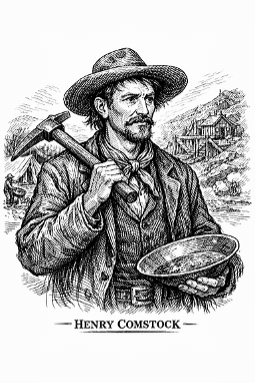
What followed was one of the most audacious swindles in frontier history — executed not in the shadows, but in broad daylight. Comstock didn’t dig. He didn’t invest. He didn’t discover. He talked. He bluffed. He pressed. And by the time the papers were signed, he had maneuvered himself into a controlling interest in what would soon be recognized as the greatest silver strike on the continent.
The brilliance of the swindle wasn’t in its complexity. It was in its timing. Comstock inserted himself at the exact moment when the miners were unsure of what they had. He claimed land he didn’t own. He leveraged confusion he didn’t create. And he walked away with a share of a fortune he never earned.
And once his name was safely attached, Comstock did what swindlers do best: he cashed out. Quickly. Cheaply. Before anyone understood the scale of the silver beneath the ground. While others would pull millions from the Comstock Lode, Henry Comstock walked away with a few thousand dollars and a reputation that would outlive him — not as a miner, not as a businessman, but as the man who talked his way into history.
The shock that followed was enormous. The Comstock Lode built boomtowns overnight. It filled Virginia City with wealth, noise, and ambition. It financed San Francisco’s rise. It drew engineers, investors, gamblers, and dreamers from every corner of the country. Mills roared, tunnels stretched deep into the earth, and Nevada’s identity was forged in silver.
But at the center of it all — at the very beginning — stood a moment of pure frontier audacity. A drifter with a borrowed name. A claim he didn’t own. A bluff that worked. And a fortune that changed the West forever.
The Comstock Lode bears Henry Comstock’s name not because he discovered it, but because he talked his way into it. In a land where courage, luck, and sweat built empires, Comstock proved that sometimes the sharpest tool wasn’t the pick — it was the tongue.