Most Americans know that the first Pilgrims came to North America in 1620 on the Mayflower. But how did the Pilgrims come to be on the Mayflower in the first place, and where did they come from?
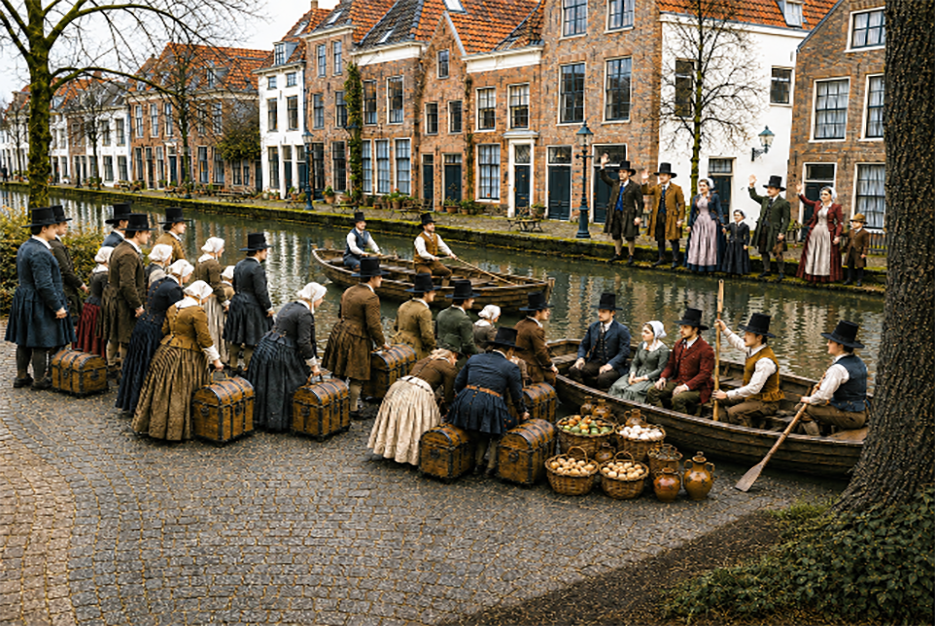
The gist of the story is that the Pilgrims—known as “Separatists” because they had declared that they wanted to separate from the Church of England—came from two places, England and the Netherlands, and they joined together to sail to New England on one ship, the Mayflower. The group of Pilgrims who came from the Netherlands had been living in the town of Leiden, south of Amsterdam, since about 1609. After several years of trying to make a life in a Dutch city, the Separatist leaders concluded that they should leave for America and create their own colony, where they would enjoy greater freedom and opportunity. After much advance planning, transportation was arranged, which for the Leiden contingent involved traveling to England to join other English Separatists, and then sailing two ships to America. The Leiden colonists began the journey on July 21, 1620. After they had gathered some of their possessions (knowing that they could not take much, given the space constraints of the ships that would carry them to New England), they gathered at the edge of one of the canals in Leiden (the “Nieuwe Rijn” canal, in fact), which had stone steps leading down to the waterline, where they would step into small boats that would carry them to their first destination—the town of Delfshaven, part of present-day Rotterdam. There, they would board a larger ship called the Speedwell, which would carry them to England.
We know something about what that leave-taking was like, as one of the Separatists, future Plymouth Colony Governor William Bradford, wrote about the journey, and in it he described the last moments of the Pilgrims as they prepared to travel from Leiden to Delfshaven:
“… they spente a good parte of the day very profitably, and
suitable to their presente occasion. The rest of the time was spente in powering out prairs to the Lord with great fervencie, mixed with abundante of tears. And the time being come that they must departe, they were accompanied with most of their brethren out of the citie, unto a towne sundrie miles of called Delfes-Haven,l where the ship lay ready to receive them. So they lefte that goodly and pleasante citie, which had been their resting place near 12 years.”
What Bradford’s account doesn’t say is that a number of the Leiden Pilgrims were not only leaving behind their possessions, but also family members. Bradford himself left behind his son, who was cared for by his wife’s mother. Thomas Rogers left his wife behind. These are just two examples. The hope was that these loved ones would soon join them in Plymouth, once the settlement was established. In some cases that happened, but in other cases it did not. In fact, during the first winter of 1620-21, half of the Mayflower passengers died, and their loved ones in Europe never saw them again.
Historians have calculated that the trip from Leiden to Delfshaven took about seven hours. The boats that the Pilgrims traveled in were known as “canal boats,” which were shallow-bottomed watercraft designed to travel in shallow waters, like canals, and the Pilgrims’ route involved traversing several different canals or shallow waterways in order to get to Delfshaven by boat. Once in Delfshaven, the Pilgrims needed to be ready to board the Speedwell and complete the journey to England—no time to dawdle, in other words, and the Pilgrims needed to travel light.
One irony of this story is that while the Speedwell successfully made its way from Delshaven to England, it ultimately proved to be unseaworthy for crossing the Atlantic. Thus, the Pilgrims left the Speedwell in port in England, and it fell to the Mayflower to serve as the single ship that would make the journey. This change of plans meant that not all the Pilgrims who had planned to make the journey could fit on one boat, and a number of them therefore were forced to stay behind. In some cases, this happened after they had sold all their worldly possessions in order to make the journey!
Every November, we remember the Pilgrims largely for all the wrong reasons. “Thanksgiving” was not a day that the Pilgrims themselves celebrated, and that word was never used by the Pilgrims to describe it. We also wrongly assume that the main reasons the Pilgrims came to America was to seek religious freedom. Well, they already had that in the Netherlands, at least. Two of the main reasons that Governor Bradford gave for leaving the Netherlands was the lack of economic opportunity there, and the concern that the Pilgrims’ children were too quickly being assimilated into Dutch culture. Two good reasons to leave. Lastly, we applaud them for choosing New England to be their new home, but New England had not been their destination; it was bad weather that drove them to drop anchor at Cape Cod and stay there. All this aside, the main reason to honor the memory of our Pilgrim ancestors cannot be denied: in coming to America, the Pilgrims demonstrated immense courage and conviction, and their determination to govern themselves according to the terms of the famous “Mayflower Compact” is awe-inspiring.
So, today we honor the memory of the Leiden Pilgrims, who began their journey to North America on this day on July 21, 1620.