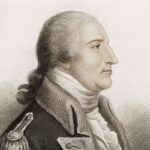
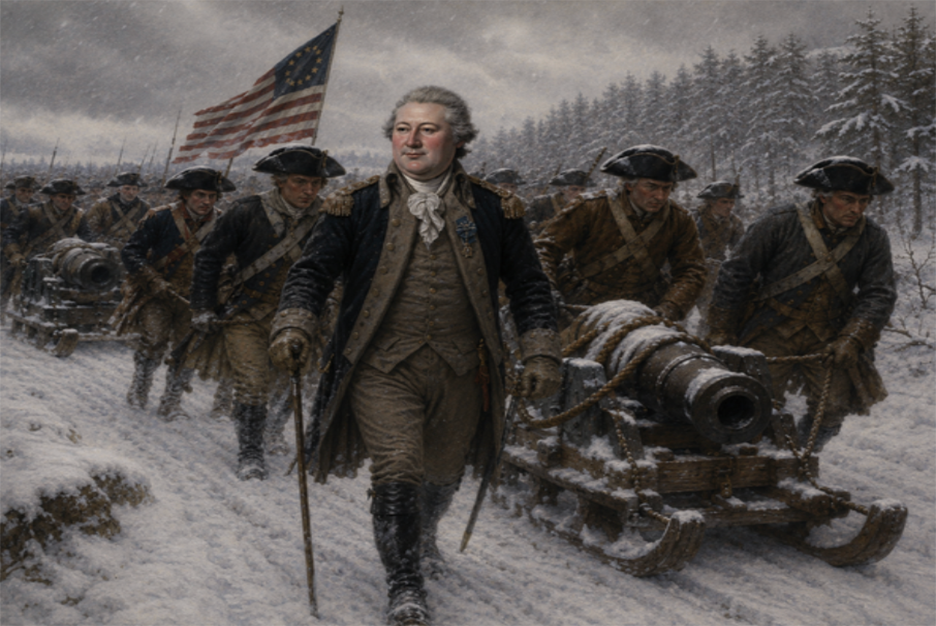
The history of the American Revolution is replete with stories of heroism on the battlefield. One of the most iconic examples of courage and self-sacrifice involved General Henry Knox, who was born this day on July 25, 1750.
Before the war broke out in April 1775, Knox was a Boston merchant by trade, and operated a bookstore. He was a first-generation Scottish-American, his parents having immigrated from Northern Ireland in 1729. Knox received a modicum of education when he was a youngster, but never completed his education: his father died in 1762, and Knox was forced to go to work at the age of 9. His first job was as a clerk in a Boston bookstore, and that became the start of his merchant career. While toiling away in the bookstore, Knox also became a voracious reader, with a particular fascination in military books.
His military interests led him to join a militia unit at age 18 and served in an artillery company, where he learned everything he could about cannons. The colonies were not at war at the time, but nevertheless he committed himself to “The Cause” following the Boston Massacre in 1770. He owned his own successful bookstore at the time, but he increasingly became enmeshed in the Rebel cause, and became a supporter of the Sons of Liberty—the leaders of the resistance to British oppression in Boston.
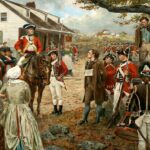
Knox’s most famous military exploit took place almost immediately after the war commenced, and General Washington came to Boston to lead the Siege of Boston. The Americans were facing an entrenched British Army that vastly outnumbered them, and the likelihood of a successful attack was remote. But Washington and Knox had an idea: bring cannons to the ramparts the Americans had erected across the river from Boston, and threaten the British troops with a cannonade that would devastate the city. Knox was familiar with the recent successful capture by the Americans of Ft. Ticonderoga in New York, where a large number of cannons sat unused. Knox told Washington said he would go there and bring them back, and so he did. The weather conditions were atrocious for such a mission, but Knox was not to be deterred. He and his men arrived at Ft. Ticonderoga on December 5, 1775, secured sixty tons worth of cannons, and placed them on sleds to be hauled overland back to Cambridge. The journey was 300 miles, over snow and ice, but Knox persevered. As soon as General Thomas Gage saw the cannons arrayed against him, he announced that he and his troops would withdraw, and abandon Boston to the Americans. Knox’ heroic undertaking has gone down in history.
Knox’s military successes continued for the rest of the war, and his artillery units played a crucial role in many famous battles, such as Washington’s crossing of the Delaware on Christmas eve in December 1776 and the ensuing Battles of Trenton and Princeton in January 1777 (the “Ten Crucial Days” of December 24 to January 3). Knox also participated in the Battle of Brandywine, the Battle of Germantown, the Battle of Monmouth, and many others, culminating in the famous Siege of Yorktown. Over these several years of warfare, Knox and General Washington formed a close working and personal relationship, and Knox became one of the General’s closest confidants.
After the war, Knox was put in charge of the army during the demobilization period in 1783, and he became the senior officer of the American army following Washington’s resignation in December 1783. Knox went on to become a member of Washington’s cabinet as Secretary of War when Washington was elected President of the United States, and he served in that role until he resigned in 1795. Knox devoted the rest of his life to various business pursuits and land schemes. He did not live long; he died at home in Main on October 25, 1806 at the young age of 56. Today, his life is commemorated in countless ways, most notably the naming of “Fort Knox,” the city of Knoxville, Tennessee, and a number of other place names. He is also remembered every year on March 17, when Bostonians celebrate “Evacuation Day.”
So today we honor the memory of Henry Knox, one of the heroes of the American Revolution.