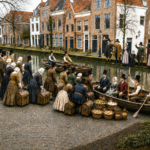
In the founding years of New Netherland (today’s New York), there were very few prominent women to be found amongst the political leaders of the time, even though Dutch women enjoyed a degree of freedom very unlike women in the Massachusetts Bay colony to the north, or the Virginia colony to the south. One woman who attained great respect was Catalina Trico (or Catalyntje Jeronimus Trico), who came to New Netherland in 1624, and was among the very first settlers of the Colony of New Netherland. We honor her today, the anniversary of her birth on July 14, 1605.
Trico was born and raised in the Spanish Netherlands, now part of Belgium. The family was part of a large community of Reformed Protestants known as “Walloons,” the namesake of the region in Belgium called “Wallonia” (southeast of Brussels). The early 1600’s were a time of religious strife in Europe, and in the Spanish Netherlands in particular, where Catholic Spain regularly persecuted Protestants throughout the Spanish empire, including the Walloons. Many of them fled the Spanish Netherlands for the New World, including Trico. In fact, it was a contingent of Walloons who first settled in what became New Netherland when they arrived in 1624 on the ship Eendracht [the “Unity”]. Dutch settlers arrived the following year. When Trico arrived in the New World, she was about 19 years old.
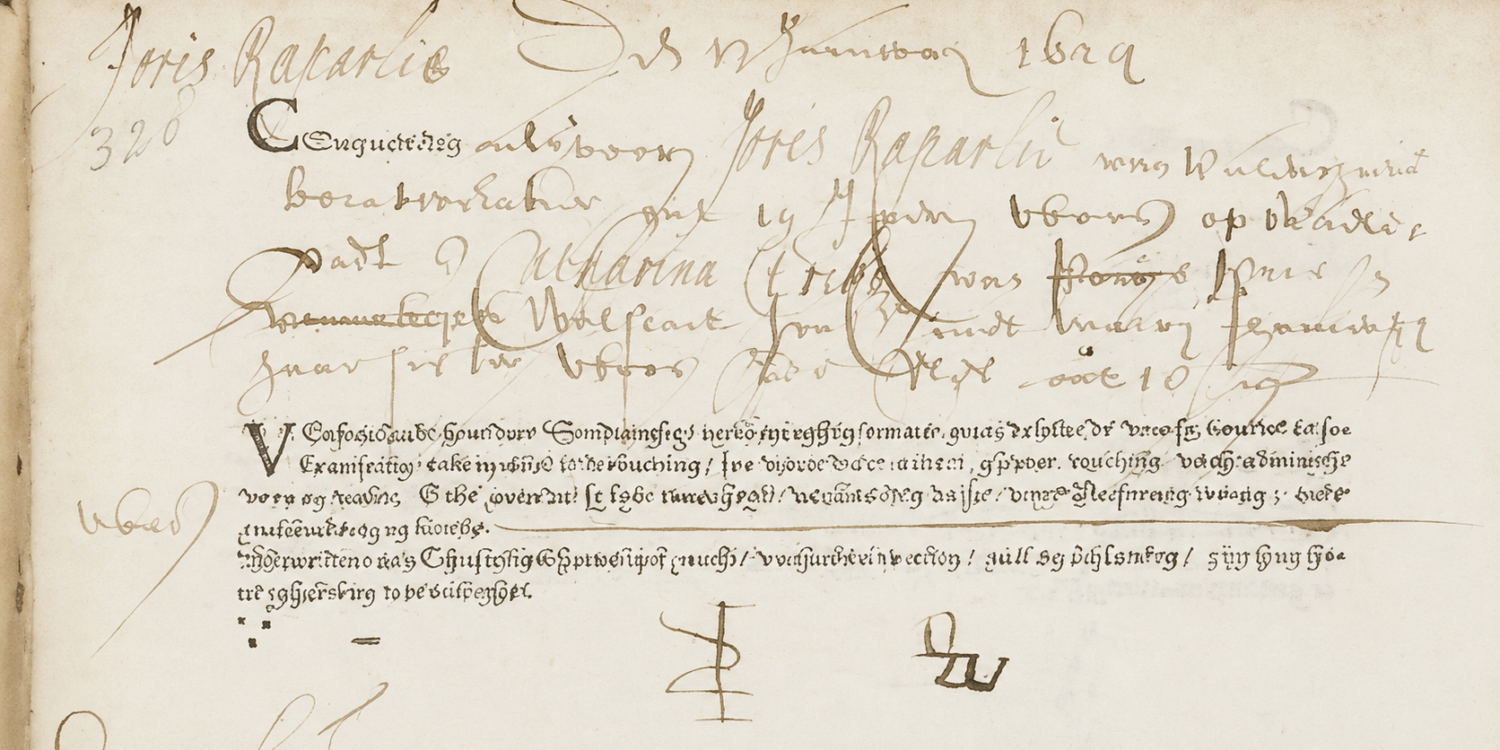
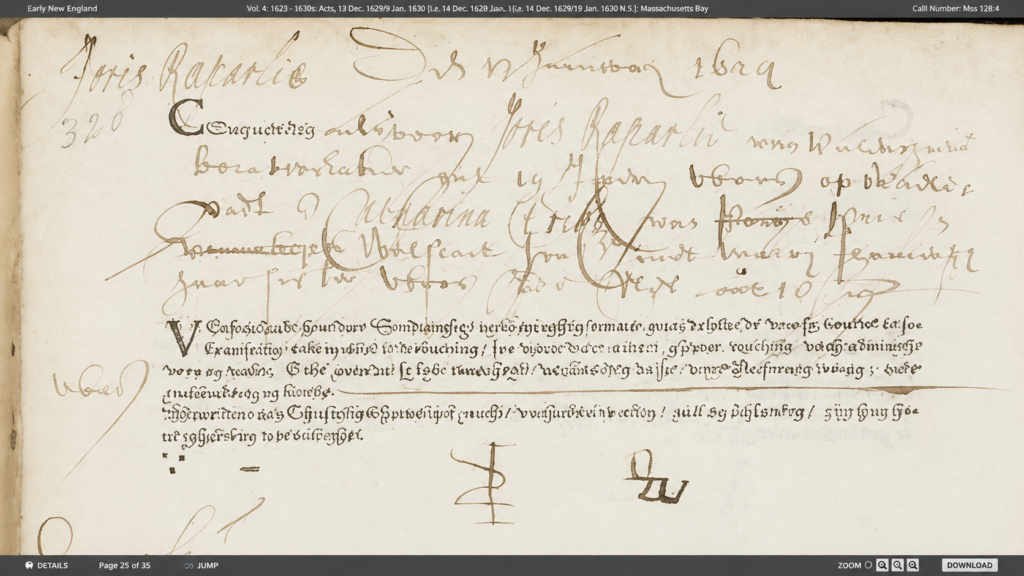
Before coming to America, Trico had married Joris Jansen Rapalje, who later became a relatively successful member of the Colony of New Netherland. Together, Rapalje and Trico ultimately had eleven children. When they came to New Netherland, they resided first at today’s Albany on the Hudson River, where a major Dutch fort had been built, Fort Orange. They are considered one of the “First Families” of New York, and their daughter Sarah Rapalje is considered by some historians to be the first child born to early settlers in New Netherland.
What is remarkable about Trico is that she not only was literate, but she was one of the few female settlers in New Netherland who left a detailed written history of her life there. Her story was captured in two “depositions” she gave in later years, one in 1685, and one in 1688. She was in her 80’s by then, but still had a good memory of the early days of New Netherland (these depositions were taken well after New Netherland had been taken over by the British in 1664). In her 1688 interview, she described her time at Fort Orange, and the extensive contacts she and her fellow settlers had with the neighboring Native-Americans (primarily Mohawks). She is quoted as saying that the Indians she dealt with “were all as quiet as lambs and came and traded with all the freedom imaginable.”
![[Earliest Known Sketch of New Amsterdam]](https://americanheritagepartners.net/wp-content/uploads/2026/06/newamsterdam.jpg)
After spending two or three years in Fort Orange, Trinco and her family moved down river to New Amsterdam (later New York City). This was a time when settlers were suffering from Indian attacks (provoked or unprovoked), and the new Governor of the Colony, Peter Minuit, essentially ordered the residents in outlying areas of the Colony to come to New Amsterdam in order to be safe; a Fort had been built there to protect the colonists from attack. By the time of the move from Fort Orange to New Amsterdam, Trico and Rapalje already had two children. They had eleven children altogether, and lived and worked in New Amsterdam for many years. Joris Rapalje was sufficiently high ranked that in 1661 he was appointed to be a member of the illustrious “Council of Twelve Men” in the Colony’s Government, the equivalent of a presidential cabinet. He later served off and on as a magistrate in Brooklyn. Oddly, records show that he was also a “tapster,” and was operating a tavern.
In 1654, the family moved to today’s Flatbush area of Brooklyn—appropriately next to “Walloon Bay.” Joris Rapalje died in 1663, and by 1680 Trico was living alone on Long Island. One contemporary of Trico’s, writing in the year 1680, described her as “worldly minded, living with whole heart, as well as body, among her progeny, which number 145 and will soon reach 150.” Today, one can imagine that the number of her descendants numbers in the thousands. Trico finally passed away on September 11, 1689, at the age of about 84. Her last known residence was in Wallabout, Brooklyn.
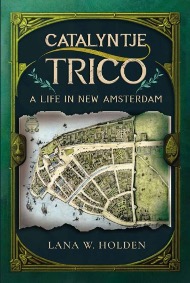
During these 400th anniversary years of the settlement of New Netherland (2024- 2026), scores of articles and video talks have been presented about Trico. One source calls her the “Mother of New York.” A book that sheds further light on the life of Catalina Trico is Lana Holden’s “Catalyntje Trico: A Life in New Amsterdam,” pictured here.
And so today we commemorate the life of Catalina Trico, one of the first females to inhabit what become one of the great cities of the world, New York. Her strength of character shines through in contemporary accounts of her, and she left a lasting legacy.