Although Americans tend to forget how critical our railway system was to the development of the American West, the Pacific Railway Act of 1862 stands as a defining example of how public investment reshaped our nation’s future in the 19th century. Signed by President Abraham Lincoln during the Civil War, the Act authorized federal support for a transcontinental railroad—an ambitious project long debated but never realized due to cost, risk, and political division. Yet, the Act was passed by the House of Representatives by a vote of 104 to 21, and by a vote of 35 to 5 in the Senate. Clearly, by 1862 a strong consensus had emerged that a transcontinental railway must be aggressively pursued. And so it was, and today we commemorate the anniversary of President Lincoln’s signing of the Act into law on July 1, 1862.
The Act provided land grants and government‑backed bonds to two companies: the Union Pacific building west from Omaha, and the Central Pacific building east from Sacramento. This partnership between government and private enterprise created the framework for one of the most significant infrastructure achievements in American history.
Construction began in 1863 and relied heavily on immigrant labor—Irish and European workers on the Union Pacific, and more than 10,000 Chinese laborers on the Central Pacific. Their contributions, often overlooked, were essential in carving rail lines through plains, deserts, and the granite walls of the Sierra Nevada and Rocky Mountains.
Part and parcel with the history of the actual construction of the transcontinental railroad is the history of the financial wizardry that funded the project—and the pervasive corruption that went along with it. Historians tend to focus on the personal stories of the “Big Four” (Leland Stanford, Charles Crocker, Collis Huntington and Mark Hopkins), but there were scores of other financiers and wheeler-dealers who stood behind the effort, including well-known names like J.P. Morgan and Jay Cooke. While today some historians vilify these men, either individually or collectively, the fact remains that without them, the transcontinental railroad may never have happened.
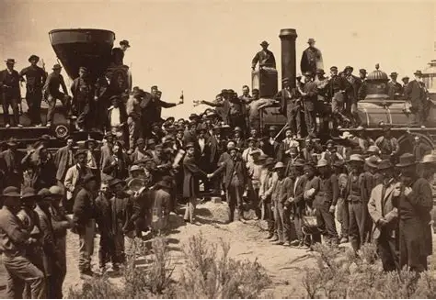
On May 10, 1869, the two lines met at Promontory Summit, Utah, where the ceremonial “Golden Spike” symbolized the completion of the first transcontinental railroad. What had once been a months‑long journey across the continent could now be completed by train in a single week.
The Pacific Railway Act offers a powerful reminder: transformative progress often requires bold vision, collaborative partnerships, and a willingness to invest in the common good. Its legacy continues to shape how we think about national infrastructure, economic development, and the stories we preserve for future generations.
Note: For an excellent book about the history of the construction and financing of the transcontinental railroad, we recommend Richard White’s “Railroaded: The Transcontinentals and the Making of Modern America” (2011). The Wall Street Journal praised the book as “required reading for anyone interested in the history of American railroading.” The Washington Post also praised the book as “an acute analysis that in failure came success and in many ways the map of the nation.”