
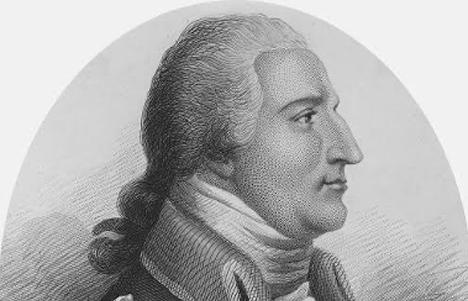
Most Americans have heard of Benedict Arnold. He is generally known as a traitor to his country who rightly deserves our condemnation. Yet, as this story will describe, up until the moment that his treachery was revealed, he was revered as a hero of the Revolution who fearlessly led his men into battle and defeated the enemy, most prominently at the Battle of Saratoga, in which the British Army was soundly defeated, and British General John Burgoyne surrendered his troops. We commemorate Arnold today on the anniversary of his death on June 14, 1801, 225 years ago.
Which was Benedict Arnold: a hero or a villain? I would argue that he was both. We’ll start with the end of Arnold’s story. After his traitorous conduct was discovered on September 24, 1780, Arnold fled to New York to join the British Army. From New York he sailed to Virginia in December 1780 and assumed command of a British regiment. Hardly repentant, before leaving for Virginia, Arnold published a letter entitled “To the Inhabitants of America,” in which he purported to justify his treason and urged Americans to abandon the Declaration of Independence and return to the status of British subjects. Calling the leaders of the Revolution “Usurpers,” he claimed that these men were “criminally protracting the War from Sinister Views.” His verbal assault on the American cause continued for several pages, culminating with his declaration that “I am now led to devote my life to the Reunion of the British Empire, as the best and only means to dry up the streams of misery that have deluged this country.” Arnold then proceeded to inflict his own “streams of misery” on Americans, with no remorse or regrets.
Family Background
How did it come to this? Before the war, Arnold had led a relatively prosperous life as a merchant and ship’s captain. His family traced back to one of the early governors of Connecticut, and Arnold’s father had become a successful businessman in Norwich, Connecticut during Arnold’s formative years. Unfortunately, his father had a drinking problem, and over time the business deteriorated, along with his father’s health; he died in 1761, when Arnold was 21 years old.
Arnold Becomes a Businessman
Arnold was now the family breadwinner, and he threw himself into his business pursuits, By the mid-1760’s he had accumulated a degree of wealth and power. He had already been in business as a pharmacist, but soon he had become involved in the trading business, running schooners to and from the West Indies. He profited handsomely, and he was a hands-on business owner, traveling on his own ships as part of the merchant business he was conducting.
It was his very success as a businessman that perhaps caused Arnold to become an early supporter of The Cause. British legislation such as the Sugar Act of 1764 caused Arnold’s business to suffer massive losses. He resorted to smuggling, and he became involved with the now-famous Sons of Liberty. At some point his financial situation was sufficiently bleak that there were rumors that he might go bankrupt. Not true, but Arnold’s pride was hurt—a recurring theme in Arnold’s life, and perhaps an underlying cause of his future acts of treason.
Arnold Becomes a Warrior
When war broke out in April 1775, Arnold immediately took up arms, and became a captain in his local Connecticut militia. Although he had no prior military experience, Arnold proposed that he lead his men in an attack on Fort Ticonderoga in New York. By May 1775—just weeks after the Battles of Lexington & Concord—he was leading an army west to Ft. Ticonderoga. He and his men quickly achieved the mission—along with several other militia units– and the Fort was captured. Yet when the military leaders of these combined forces quarreled over who was actually in charge of the mission, Arnold quit in a huff and went home—yet another example of wounded pride that Arnold internalized, and caused him to fester.
When Arnold learned that the newly created Continental Army was mounting an expedition to Canada to lay siege to the city of Quebec, Arnold jumped at the opportunity, and he was able to finagle his way into being awarded a commission as a colonel, and being named the leader of the expedition to Canada. “Arnold’s Expedition,” as it later came to be known, was heroic, but not successful. In fact, Arnold was wounded at the final battle that took place on New Year’s Eve 1775-76, and one of the other commanding officers, General Montgomery, was killed in action. The battle lost, Arnold retreated, and scores of his officers were captured and held as prisoners of war for the next six months. Yet, Arnold was touted as a war hero, the first major accolade he was to receive for his battlefield leadership.
It was not long before another event caused Arnold to feel slighted, and indeed he had been. Despite his winning ways on the battlefield, Arnold had been passed over for promotion to a generalship, and he attempted to resign—but was stopped by General Washington, who gave Arnold his moral support, and who told the Continental Congress that perhaps a mistake had been made in passing over Arnold for promotion. But even with General Washington’s support, Arnold didn’t get the promotion. Once again, his pride was deeply hurt.
Arnold’s next major military success on the battlefield was perhaps the zenith of his military career. The Battle of Saratoga in the Fall of 1777 was a massive success, due in no small part to Arnold’s leadership on the field of battle. Seeing the battle lost, British General John Burgoyne surrendered his troops, and suddenly the tide of war shifted in favor of the Americans. Just months later, France entered the war as America’s ally, having been convinced by the Continental Army’s defeat of the British forces at Saratoga that the Americans could actually win the war. It was Benedict Arnold who should have been recognized as the hero of Saratoga. Yet once again, he was slighted, and the accolades went mostly to General Horatio Gates, who was in overall command of the American forces at Saratoga, but who had not led the charge on the battlefield—he remained behind the lines in his tent. Arnold’s pride was hurt once again, magnified by the wounds he received during the battle.
Arnold Becomes an Administrator, and Flirts with the Enemy
Following his success at the Battle of Saratoga, Arnold remained in the army, but took on responsibilities that led him away from the battlefield. In June 1778 Arnold was sent to Philadelphia following the British evacuation of that City, where he became the military governor of the city. In that role he hobnobbed with the local political and business leaders. His too-close association with the merchants of Philadelphia led to allegations of corruption, which further deepened Arnold’s antipathy for the American cause. Thumbing his nose at his accusers, Arnold lived a life of luxury that he couldn’t afford, so much so that finding money to pay his debts because a major obsession. It was in this context that Arnold turned to someone who he thought might help him turn things around: Peggy Shippen, the 15-year-old daughter of a well-heeled Loyalist in the City. As it turned out, Shippen had been courted by the man who would later become Arnold’s “handler” when he turned traitor, Major John Andre, who was the British spy chief in America. Arnold married Shippin in April 1779. Apparently, though, Shippen remained in contact with Andre, and served as an intermediary throughout the next few years when Arnold’s acts of treason were being committed.
Arnold Becomes a Traitor
It was not Peggy Shippen who introduced Arnold to Major Andre, but a different person altogether: Joseph Stansbury, a Philadelphia merchant. How Arnold and Stansbury were first introduced to each other is not entirely clear, but in May 1779, Arnold met with Stansbury, and told Stansbury that he would offer his services to the British—for a price. Just days later, Stansbury met with Major Andre. The rest is history: the details of how Arnold would assist the British were worked out, and Arnold commenced his traitorous activities, often using his wife as a go-between for sending and receiving communications with Andre.
By mid-1779, Arnold’s treason was in full swing. The following Spring, the final, fatal act of treachery that was to lead to Arnold’s downfall was agreed to: Arnold would take steps to surrender the strategically crucial fort at West Point to the British in exchange for the equivalent of $3 million dollars in today’s currency. Thankfully, the plot was discovered, Andre was captured and hanged, and Arnold fled for his life.
Arnold Becomes a British Soldier
As I mentioned at the beginning of this story, after Arnold escaped justice, he joined the British army. While the West Point plot had failed, the British knew Arnold was a warrior, so he was given a commission to serve as a brigadier general, for which he would receive substantial compensation. At the end of 1780, Arnold led his regiment into battle in Virginia, causing major carnage, and capturing the city of Richmond. In 1781 Arnold was leading an army in Connecticut, where he ordered his men to burn the city of New London to the ground. He was as much a warrior for the British as he had been for the Americans, and he was respected and feared by American troops.
After the war was essentially over following the Battle of Yorktown in 1781, Arnold left America for England, where he remained for the rest of his days. As the calendar shows, Arnold lived another 20 years as a traitor-in-exile. He was not necessarily embraced by the British people, however. A traitor is a traitor, and he was often viewed with suspicion. Arnold was relegated to being a second-class citizen at best. Needing money, Arnold went back into the business world, but charges of cheating and corruption continued to surface, and he was embroiled in a number of lawsuits. Allegations of misconduct once again so wounded Arnold’s pride that he challenged one of his critics, the Earl of Lauderdale, to a duel. No one was hurt, but it was not an auspicious moment for Arnold as he sought to earn the respect of the British people. Yet he continued to create mischief: at one point he was imprisoned, and at another point he almost went to the gallows. His later life was, in a word, a shambles.
Arnold Dies
The end came quickly for Arnold. In early 1801, Arnold became ill and physically disabled. Over the next several months, his condition continued to deteriorate, and he finally died on June 14, 1801. He was survived by his wife, who had remained by his side for over two decades. Peggy Shippen outlived her husband by just a few years, dying in 1804 at the young age of 44. By the end of their lives, the Arnolds were living in straightened circumstances, and carrying significant debt, which was bequeathed to his heirs.
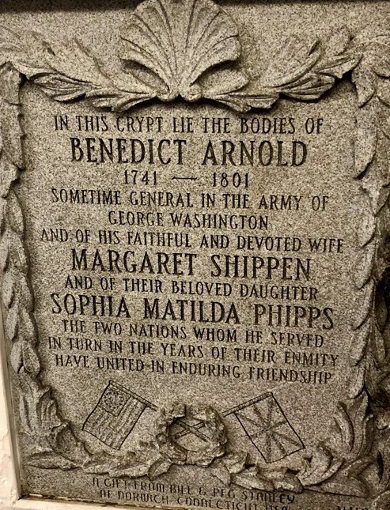
Even the story of Arnold’s grave tells a sad tale. It seems that Arnold and his wife were buried in a church crypt, but somehow as the years passed, the burial crypt was forgotten for two centuries, and was only recently discovered in the church basement behind a large pile of rubble. The crypt where the Shippens had been interred is used today as a space for a kindergarten and Sunday school. Only recently was a marker placed there to honor his memory—sort of. The plaque refers to Arnold as a “Sometime General in the Army of George Washington.” Below that, the plaque states that “the two nations whom he served in turn in the years of their enmity have united in enduring friendship.” We might add, “no thanks to Benedict and Peggy Arnold.”