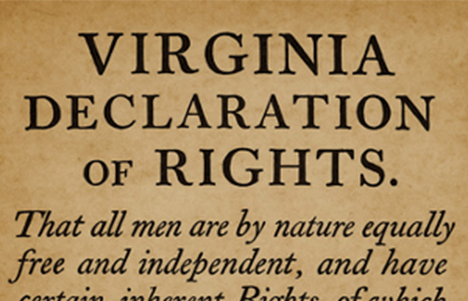
A man largely forgotten in this season of 250th anniversaries of the Declaration of Independence is George Mason, a Virginia political leader, Founding Father, and most importantly, the author of the Virginia Declaration of Rights, which was enacted by the Virginia Convention of Delegates on this day, June 12, 1776. It’s impact on the ultimate drafting of the Declaration of Independence was profound.
The Virginia Declaration of Rights was short, consisting of 16 separate articles—a one-pager, as it were. The very first sentence of the very first article reflects how influential the VA Declaration of Rights was: “That all men are by nature equally free and independent, and have certain inherent rights,” including “the enjoyment of life and liberty.” Substitute the word “unalienable” for “inherent,” and add the “pursuit of happiness,” and there you basically have the first line of our Declaration of Independence. Likewise, Article II recited that “all power in invested in, and consequently derived from, the people”—a precursor of the second sentence of Jefferson’s text, which stated that “Governments are institute among Men, deriving their just powers from the consent of the governed. Further, Mason addressed one of the fundamental causes of the Revolution, the issue of “taxation without representation.” Article VI of Mason’s Declaration of Rights confronted this issue head on, stating that “the community… cannot be taxed without their own consent of that of their representatives so elected.” This provision is echoed in Jefferson’s complaint against the King for having “imposed[d] Taxes on us without our Consent.”
One might reasonably ask, did Thomas Jefferson “borrow” from George Mason’s Declaration? We know that Jefferson was influenced by a number of texts, dating back to the leading philosophers of the European Enlightenment such as John Locke. But more immediately, Jefferson must have been aware of Mason’s work, as a draft of the Virginia Declaration of Rights had been published in the June 6 edition of the Pennsylvania Evening Post. Although Mason wrote his Declaration while living in Virginia, news travelled fast to Philadelphia, and undoubtedly Jefferson read the newspapers as he began work on the drafting of the Declaration of Independence in that city on or about about June 12/13. By sheer coincidence, the final version of Mason’s Declaration of Rights was enacted by the Virginia Convention of Delegates on June 12, the same day that the 2nd Continental Congress meeting in Philadelphia formed the famous “Committee of Five” to draft the Declaration of Independence, and John Adams promptly asked Thomas Jefferson to write the first draft.
What else was in the Virginia Declaration of Rights that one might say was reflected in Jefferson’s own text? Article XI of Mason’s Declaration of Rights advocated for the right to the “ancient trial by jury,” the very thing that Jefferson wrote that King George III was refusing to grant to American colonists. Article XIII of Mason’s Declaration also would prohibit “standing armies in time of peace;” Jefferson’s text indicted the King for having “kept among us, in times of peace, Standing Armies.” These examples demonstrate that the Virginia Declaration of Rights was a highly influential document that must have helped shape Jefferson’s drafting of the Declaration of Independence.
The Virginia Declaration of Rights contained several other important provisions that were well ahead of their time, but were later incorporated into the U.S. Constitution and Bill of Rights enacted years later. Among other things, Mason’s Declaration of Rights set forth the concept of separation of powers, stating that “the legislative and executive powers of the state should be separate and distinct from the judicative.” He further wrote that any executive or legislative officials should be subject to term limits, and that after their term of office was completed, they should be “reduced to a private station.” Finally, Mason’s Declaration of Rights set forth in Articles XI, XII and XVI the rights to trial by jury, freedom of the press, and freedom of religion.
Overall, we can think of the Virginia Declaration of Rights as a document that proposed actual solutions to the many problems our Declaration of Independence complained of. It was not until many years after the Revolution was over that our Congress finally enacted actual solutions to the problems noted in the Declaration of Independence, when the Constitutional Convention was convened in 1787, and the delegates passed the Constitution. Ironically, one of the delegates who refused to vote to approve the Constitution was none other than George Mason. Why? It did not yet contain a Bill of Rights, which would not be enacted and ratified until several years later. George Mason’s home state of Virginia was the last state needed to fully ratify the Bill of Rights, and it voted to do so on December 15, 1791. There is no specific list of the Virginia delegates who voted in favor of ratification, but we can presume that George Mason was one of them— more than fourteen years after he authored the Virginia Declaration of Rights.