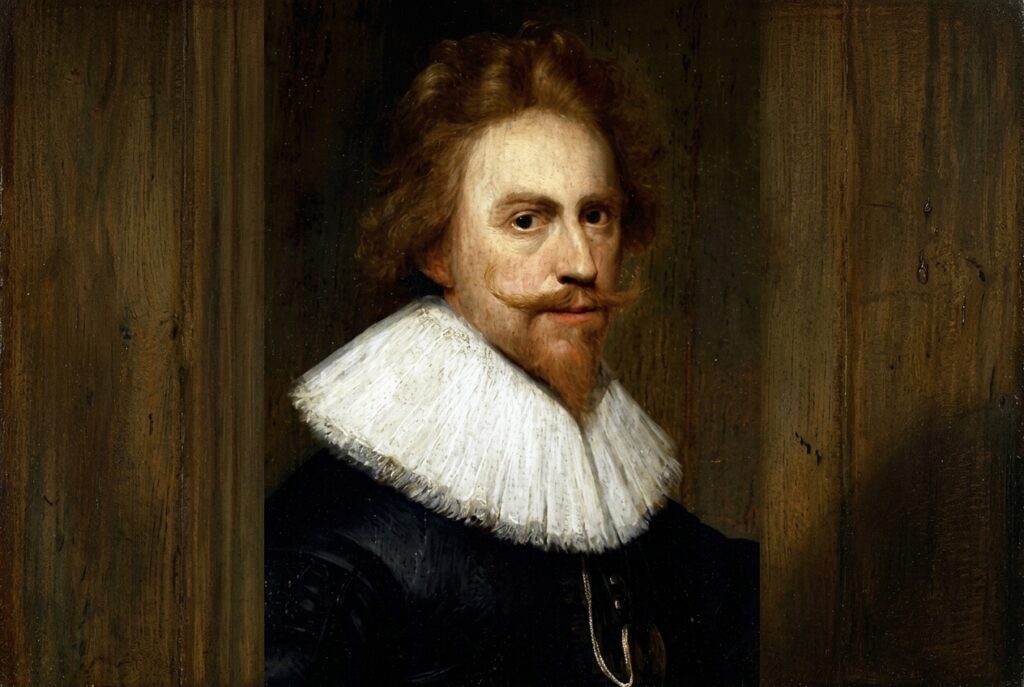
The history of New York is, at root, the history of New Netherland, and the story of the industrious Dutch men and women who came to North America in the 1620s to establish a vibrant trading center at the mouth of the Hudson River. The Colony did not last long—1625 to 1664—but it left an enduring legacy. Americans vaguely remember the story of Peter Minuit buying Manhattan from the Indians for $24. The rest of the history of New Netherland is long forgotten, eclipsed by the mythic story of the landing of the Mayflower and the planting of Plymouth Colony in 1620.
Today, however, we want to resurrect some of the history of New Netherland, specifically the story of Willem Kieft, who was appointed to serve as Director by the Dutch West India Company (the “DWI”) in 1638. Later, in 1643 he formed a council to assist him, known as the “Eight Men” — the first truly representative body in New Netherland. As we’ll see, their advice was rarely followed by Kieft, leading to disastrous consequences for both him and his Colony. The Eight Men were to prove to be Kieft’s undoing.
Background
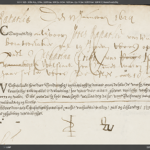
The handwritten Journal of New Netherland 1647 by an unknown Dutch colonist, from the manuscript collections of the National Library of the Netherlands, is an important source for the study of Kieft’s governorship, the war, and New Netherland in the 1640s.
Born in 1597 in Amsterdam, Holland, Kieft was raised to be a merchant, and his early adulthood is largely a story of failed business pursuits. Yet, Kieft apparently had friends in high places, and he was named to serve as the new Director of New Netherland following the unsuccessful tenure of Governor Wouter van Twiller, who served from 1632 to 1638.
When Kieft arrived in 1638, he found the Colony in poor condition. The affairs of the Colony had been sadly neglected by Governor Van Twiller. The Fort was almost in ruins from neglect. The church was in little better condition. The mills were so out of repair that even if the wind could have reached them, they could not have been made to do their work properly. Smugglers took their furs out of the Colony without paying their customs duties. In general, the colonists went about their business with little regard for law and order.
In an effort to turn around the fortunes of the Colony, Governor Kieft rebuilt houses and other infrastructure, put down the smugglers, and generally set matters in New Netherland on more solid footing. As a boost to the Colony, in 1639 the DWI also decided to offer free passage to the Colony of any Dutchmen who promised to cultivate the land in the new country. This new policy led to many new arrivals, and the Colony began to expand into neighboring Native American homelands. While Kieft’s reforms were having a positive impact on the community, his way of achieving those ends was sometimes autocratic, and he gained the nickname of “William the Testy”.
Kieft’s War
Kieft had little tolerance for his Indian neighbors. He tried to tax, and then drive out, local Native Americans. Disastrously, he ordered attacks on the Indian settlements at Pavonia and Corlears Hook on February 25, 1643, which erupted into a horrific massacre (129 Dutch soldiers killed 120 Indians, including women and children). This came to be known as “Kieft’s War,” which lasted from 1643 to 1645, and has gone down in history as one of the worst events in the history of New Netherland. The war took a huge toll on both sides, and Kieft was ultimately removed from office in 1646.
The war Kieft initiated traces to an incident that might have been handled differently, but Kieft was determined to go to war instead. The incident took place on Staten Island, located just south of today’s lower Manhattan. In 1643, an Indian stole several hogs from a colonist. Kieft’s soldiers exacted revenge by attacking the Indians believed to have been responsible for the theft, and killed 10 Indian warriors. A number of colonists had advocated for peaceful solutions to the confrontation, but Kieft was adamant that the colonists must retaliate. The men who wanted peace were headed by a well-regarded colonist, Captain David Pietersen De Vries, who had founded a settlement on Staten Island, where the theft had taken place. Kieft’s “Eight Men” convened a meeting to decide whether there should be peace or war. This council declared that there should be no war. But Kieft would not hear of it, and he caused the attack to be launched.
With Kieft’s blessings, New Netherland colonists attacked Lenape camps and massacred the inhabitants. The soldiers attacked so suddenly that the Indians thought they were being attacked by a neighboring tribe. One Indian made his way to the Fort, where he was met at the gate by De Vries. “Save us,” he cried, “the Mohawks have fallen upon us, and have killed all our people.” But De Vries answered, sadly, “No Indian has done this. It is the Dutch who have killed your people.” And he pointed toward the deep woods close by. “Go there for safety, but do not come here.”
The massacre of Lenape men, women and children encouraged unification among the regional Algonquian tribes against the Dutch and precipitated waves of attacks on both sides. This was one of the earliest conflicts between settlers and Indians in the region. Virtually all the Indians within the borders of New Netherland combined forces, and the war raged fiercely for the next three years. By 1645 the Indians and colonists were worn out, and the war ended. But scarcely a hundred men were left on the Island of Manhattan, and the settlement was a shambles.
Post War
Word of the war made its way to Holland, where the DWI was appalled. Governor Kieft sent correspondence in which he defended his decision to go to war. According to Kieft’s version of events, he was in the right in making the decision to go to war. And despite the death and destruction the war had occasioned, Kieft emphasized that the Colony was in good condition, and that he had governed well, not once having left the settlement.
But at the outbreak of the war in 1643, the Eight Men had already sent a report back to Holland, in the form of a “Remonstrance,” which heavily criticized Kieft for his decision to go to war. The Remonstrance found its way to the Dutch Parliament, which in 1646 decided to recall the Governor.
Kieft’s Death
Kieft left New Netherland in September 1647 in a ship that was packed from stem to stern with the finest of furs. The ship was wrecked at sea, and Kieft drowned on September 27, 1647, in the Princess Amelia shipwreck near Swansea, Wales, en route to Amsterdam to defend himself. He was 51 years old.
And so today we remember Willem Kieft, whose checkered tenure as Governor of the New Netherland Colony was ended by his untimely death. The Colony was to prosper under the leadership of Peter Stuyvesant, until the British takeover of the Colony in 1664.
Additional Readings
- Lovero, Joan D. Hudson County: The Left Bank. Sun Valley, CA: American Historical Press, 1999.
- Savelle, Max and Darold D. Wax. A History of Colonial America. Hinsdale, Illinois: Dryden Press, 1973.
- Shorto, Russell. The Island at the Center of the World. New York: Vintage Books, 2005.
- Winkler, David F. “Revisiting the Attack on Pavonia.” New Jersey History. Fall/Winter 1998: 3–15.