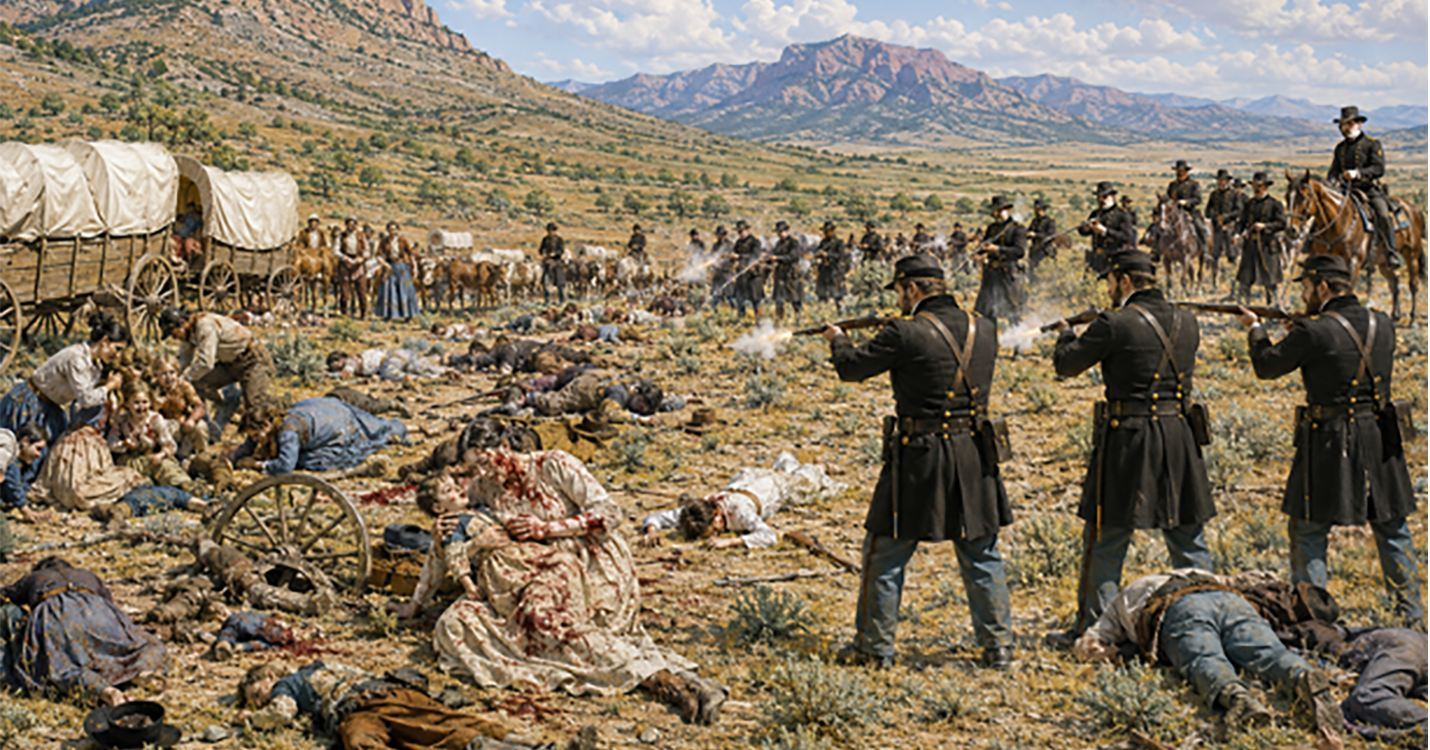
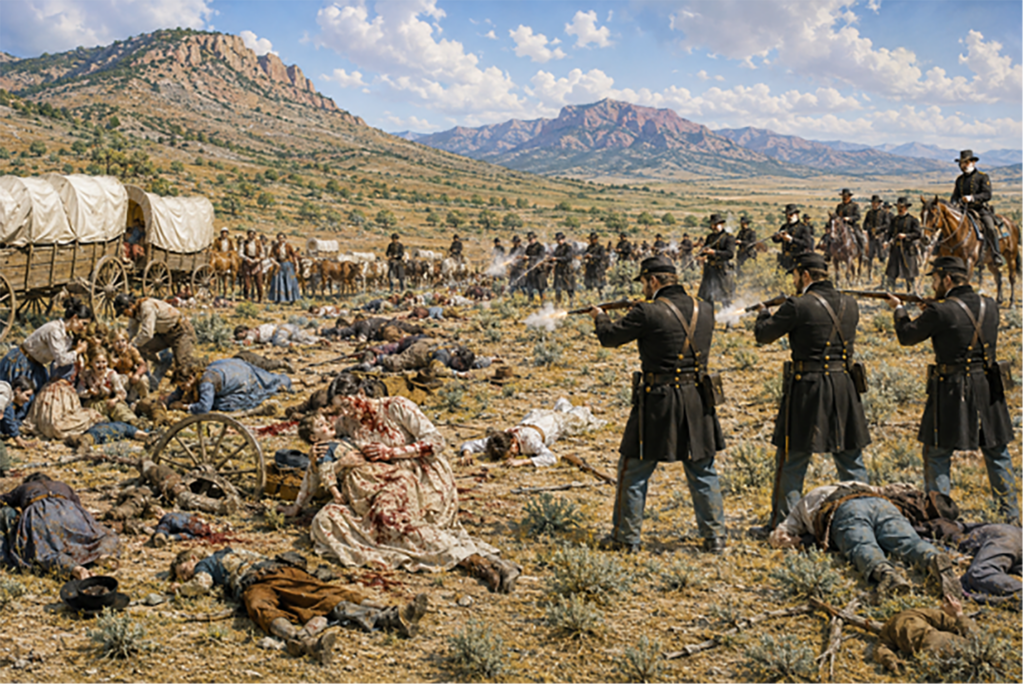
The history of the American West is replete with stories of atrocities committed by Native-Americans against white settlers, and vice-versa. There is no escaping that our U.S. government failed to stop—and perhaps encouraged—some of the more heinous attacks by American troops against Indian men, women and children, and the displacement of Native-Americans from their native lands. Equally troubling was the violence committed by Indian warriors against innocent white people who were moving west across Indian territory to Oregon, California, and other western lands. Rare, however, were white-on-white attacks in the West. One infamous case was the Mountain Meadows Massacre, which took place on this date on September 7, 1857 in the Utah Territory.
Background
The story begins in Arkansas, where two families decided to move west: the Baker and Fancher families, to be precise. They joined together to form a wagon train of over 100 settlers, most of them men and women, but also at least 18 young children. This was not an unusual enterprise in 1857—thousands of settlers were making the trek to the western territories, at a time when almost all of the land west of the Mississippi was unsettled by whites, and no states yet existed. Instead, there were vast areas that had become U.S. territories, the Utah Territory being one of them. That particular territory has been created by the U.S. government in 1850, two years after the discovery of gold in California in 1848, and three years after the founding of Salt Lake City in 1847.
Many of the wagon trains headed to California passed through Salt Lake City, and the Baker-Fancher party was one of them. They arrived there in mid-1857, in the midst of the Utah War between U.S. troops and Mormon settlers. At the time, Brigham Young was the territorial Governor, and leader of the Church of the Latter-Day Saints. It was during the Utah War that Young declared martial law on September 15, 1857, as he contemplated the possibility of a violent confrontation between the U.S. government and the Mormon church. Indeed, in May 1857 U.S. President James Buchanan had ordered troops to go to Utah to remove Brigham Young as the Territorial Governor. There could not have been a worse time for the Baker-Fancher party to venture into Utah Territory—a case of “wrong place, wrong time.”
Prelude to the Slaughter
What happened when the Baker-Fancher party arrived in Utah is painful to write about. First, they were turned away in Salt Lake City from obtaining needed provisions for the rest of their journey to southern California. As a consequence, they proceeded south on the Old Spanish Trail, stopping to rest at Mountain Meadows, north of today’s St. George, Utah. Mormon leaders were suspicious of the Baker-Fancher party, as rumors had circulated that they had engaged in hostile activities in the past. Who started the rumors is unclear, but the decision was made to launch a military operation, led by the “Nauvoo Legion,” a Mormon military unit that was originally formed when the Church was still in its early years in Illinois. At a local council meeting on September 6, it was decided that the Mormons would recruit a group of Native-American Paiutes to join the operation, with the militiamen also dressed as Indians in order to conceal their identities. The plan was to make the subsequent massacre look like it had been carried out by Native-Americans, not Mormon militiamen.
The Massacre
The attack commenced the next day. The order had gone out to kill every last member of the Baker-Fancher party, including women and children. The order was carried out in gruesome fashion. While the men of the Baker-Fancher party did their best to defend themselves and their women and children, the Nauvoo Legion soldiers were relentless, and continued the battle for five days until resistance was futile. To end the hostilities, the Nauvoo Legion soldiers decided to fool the settlers into surrendering. Two of the soldiers, waving a white flag, approached the settlers and told them they would be allowed to live, and they would be escorted to nearby Cedar City. The settlers readily agreed. After the settlers began the trip to Cedar City in their wagon train, however, the soldiers turned on them, first murdering all the men, then proceeding to kill the women and children. Only seventeen children under the age of four remained alive. The children were held in horrible conditions until they were returned to Arkansas.
Aftermath
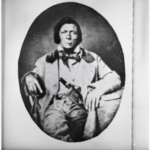
The aftermath of the massacre was a long-drawn-out investigation into what happened, carried out by U.S. government officials beginning in 1859 (the Utah War having delayed the commencement of the inquiry). A grand jury was convened in March, and testimony was received. The federal judge presiding over the trial indicted Brigham Young for having incited the attack. Young was arrested, but he was later released. It wasn’t until the 1870’s that some measure of justice was meted out—but not much. Although a number of perpetrators were arrested, only one man, John D. Lee, was found guilty and executed by firing squad on March 23, 1877, a full two decades after the massacre took place. The execution was carried out on the very spot where the crimes were committed—Mountain Meadows.
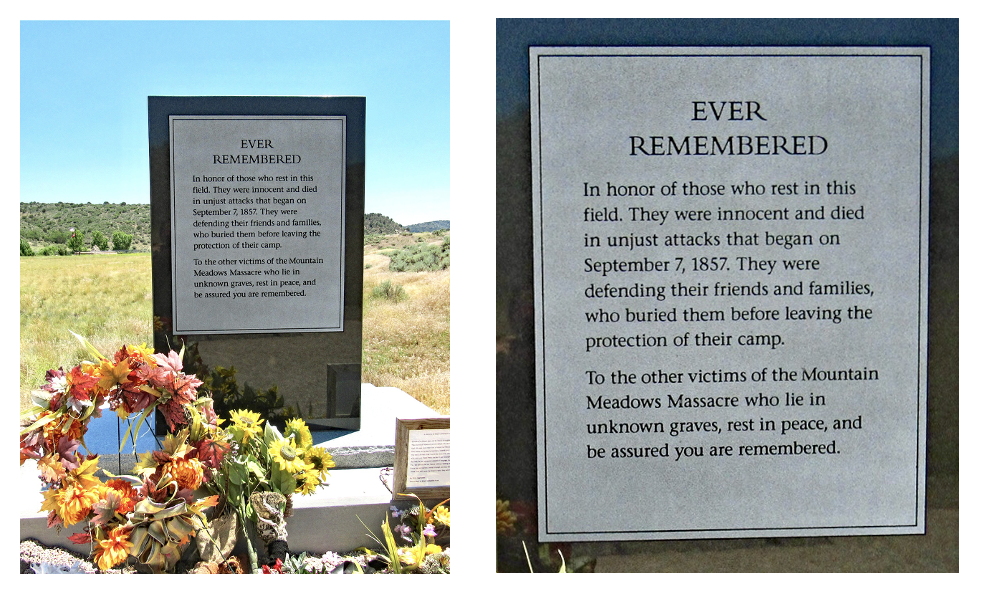
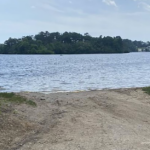
Today, a monument can be found at Mountain Meadows, in memory of the murdered men, women and children of the Baker-Fancher party.