This year we commemorate the 250th anniversary of the signing of the Declaration of Independence, which we think of as the “bookend” to the ultimate end of the War in 1783 with the Treaty of Paris. That’s true, but that was not the end of hostilities between America and Great Britain. On the contrary, just thirty years later, a second war broke out, the War of 1812, sometimes called “Madison’s War,” a not-so-subtle rebuke of President James Madison for having made the disastrous decision to go to war.
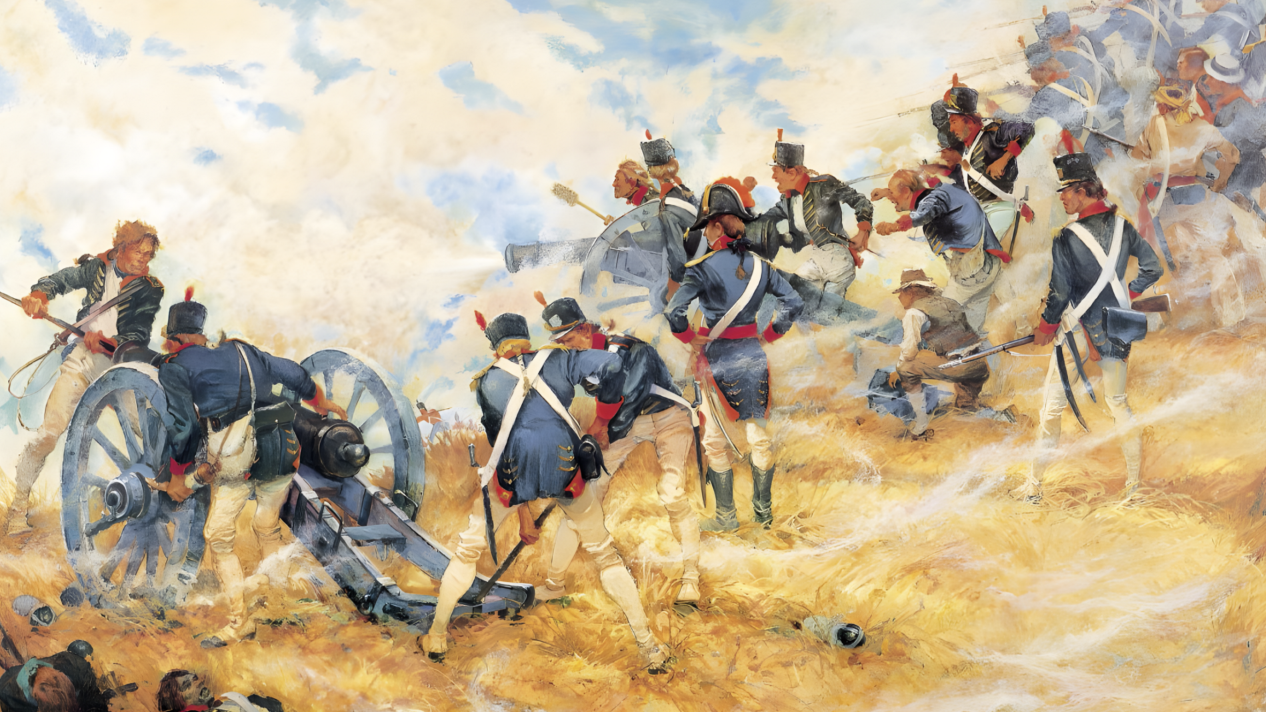
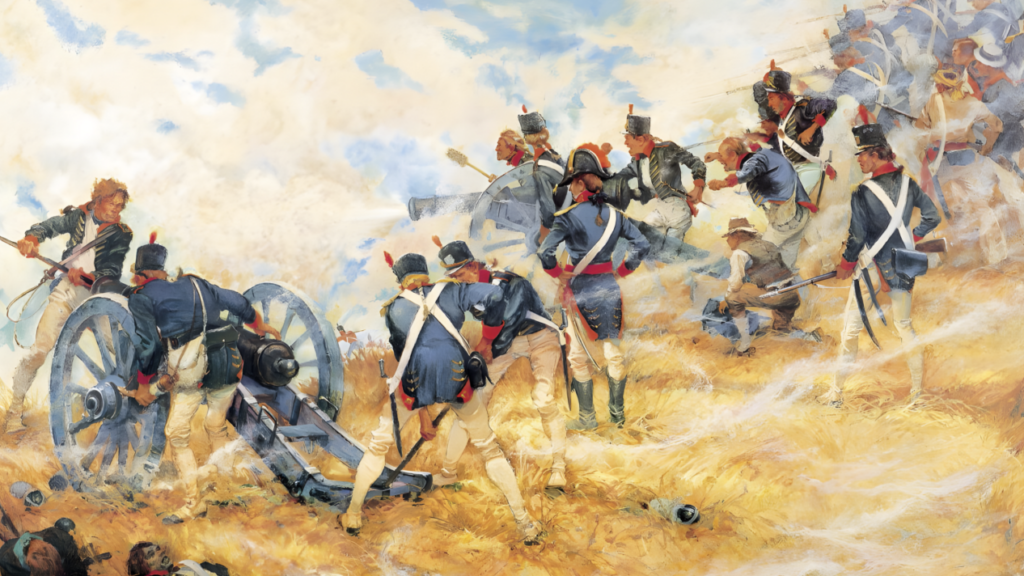
One of the critical battles of the War of 1812 was fought this day on August 24, 1814 at Bladensburg, Maryland, not far from the nation’s capital. This was part of the British army’s Chesapeake campaign, which aimed to capture Washington and crush the American forces in the area. The British launched a land and sea attack, led by Vice Admiral Alexander Cochrane, who often expressed his hatred for the United States, and by Major General Robert Ross. One of the most aggressive of their officers was Cochrane’s second in command, Read Admiral George Cockburn. The British army and navy engaged in battlefield tactics that overwhelmed the Americans, consisting of between 5,000 and 9,000 men under the command of Brigadier General William Winder. The American troops greatly outnumbered the British forces, but as it turned out, that did not dictate the outcome of the battle by any stretch.
In August 1814, the War of 1812 had been raging for three years, with death and destruction having been visited upon a number of cities and towns in the Chesapeake region, as well as in northern New York, New England and the entire Eastern seaboard. To that point, Great Britain had been engaged in warfare not just in North America, but also in Europe, where it was at war with Napoleon. As a result, Great Britain’s troop strength in America was severely reduced.
A turning point took place in April 1814 when Napoleon was defeated and war between France and Great Britain ended. Almost immediately, Great Britain sent thousands of additional troops to the United States to do battle with the Americans. By August, General Ross had over 4,000 men, and was poised to invade the nation’s capitol. American General Winder correctly concluded that the likely British path to Washington would be through Bladensburg, and it was there that he amassed his troops on August 23. The citizens of Washington, alerted to the threat of invasion, were taking steps to flee the city. Meanwhile, American commanders proceeded to make a series of tactical blunders, and their troops were on the verge of exhaustion. As British troops advanced, American troops retreated, in some cases fleeing the field of battle altogether. Due in part to confusing orders from General Winder, the American troops were in disarray as British troops continued their advance.
In the overall scheme of things, casualties were not massive: by some accounts, the British suffered 65 men killed in battle, while the Americans lost no more than 26. If the battle was judged solely by the death toll, the Americans won. But the British had ousted Ross troops from Bladensburg, and the road to Washington was now clear.
It was not long before British troops captured the city, and burned many of the buildings and structures, in what came to be known as the “Burning of Washington.” President Madison was in Washington when the city was attacked, and he was forced to flee. The Americans’ ignominious defeat at the Battle of Bladensburg, and the Burning of Washington, no doubt convinced both sides that continuing the war was in no one’s best interests, and the War of 1812 ended just four months later with the Treaty of Ghent. For the people of Great Britain, however, the Battle of Bladensburg lives on in their collective memory, and has become a cherished moment in British history, honored in countless ways.
And so today we honor the memory of the Battle of Bladensburg, a watershed moment in the War of 1812, and not to be forgotten.