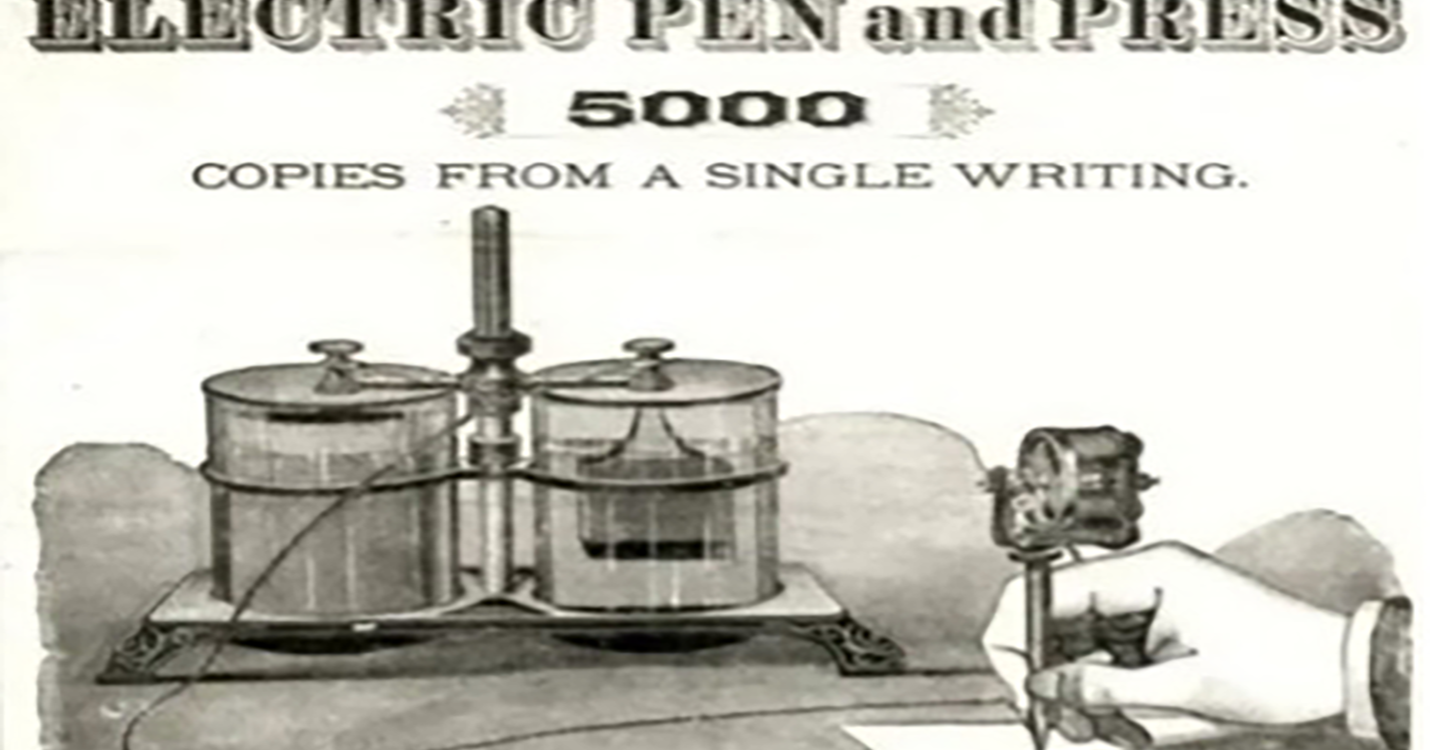
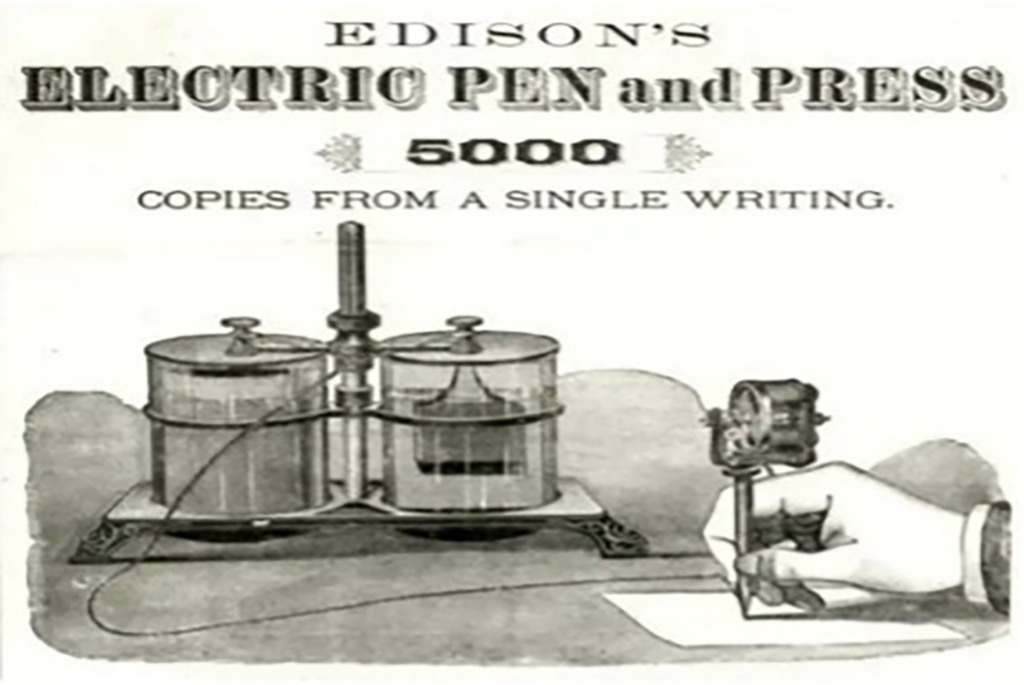
This month we commemorate the 150th anniversary of Thomas Edison’s invention of an “automatic pen,” which historians credit as the first step toward the invention of the mimeograph machine. Like many other patents that Edison was awarded, this one transformed how people communicated, and represented another paradigm-shifting step towards the future world of industrial and commercial automation.
It was In the summer of 1876 that Thomas Edison was chasing an idea that had nothing to do with light bulbs or phonographs. He was obsessed with writing faster. Offices were drowning in paperwork, clerks copied documents by hand, and duplication was slow, tedious, and expensive. Edison believed he could fix that.
His solution was the electric pen — a buzzing, motor‑driven stylus that punched thousands of tiny holes into a waxed sheet. Those holes formed a stencil, and ink could be rolled through them to make perfect duplicates. The pen looked futuristic, sounded like a tiny drill, and startled anyone who tried it. But Edison saw its potential.
The electric pen itself never became popular. It was noisy, required a wet‑cell battery, and needed constant maintenance. But the concept behind it — the autographic stencil — was brilliant. Edison continued to refine his invention, receiving an additional patent in 1880 for his “Method of Preparing Autographic Stencils for Printing.”
his “Method of Preparing Autographic Stencils for Printing.”
The word “mimeograph” was never used by Edison to describe his invention. That word must be credited to Albert Black Dick, a Chicago businessman who licensed Edison’s patents in 1887, and promptly obtained a trademark for the word. Dick refined Edison’s process, replaced the electric pen with a simple stylus, and built a reliable duplicating frame. He soon released the first commercial model: the Edison Mimeograph.
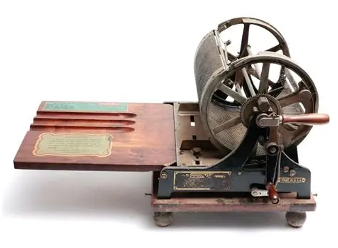
Dick was a shrewd marketer, and he understood that Edison’s name was magic. His decision to attach Edison’s name to the machine he was selling made it instantly credible. The mimeograph became the backbone of schools, churches, small businesses, and community groups for nearly 80 years. It democratized printing long before photocopiers arrived.
Edison later joked that some inventions needed “a second inventor” to find their true purpose. His electric pen — an odd, buzzing gadget — became the seed of one of the most important office technologies of the early 20th century. And so today we commemorate the 150th anniversary of Edison’s ground-breaking invention, a work of pure genius.