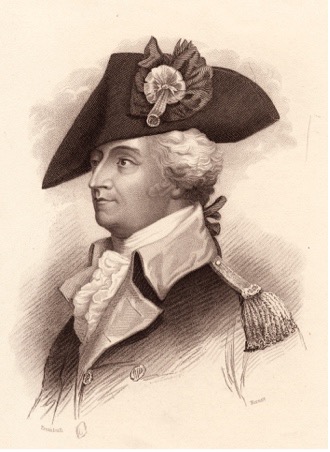
The morning of August 20, 1794 broke humid and gray over the Maumee River, in present-day Indiana and Ohio. A storm had torn through the forest through which the American Legion under the command of General “Mad” Anthony Wayne was marching to confront the Native-American warriors who comprised the “Native Confederacy,” a group of allied tribes that had come together to defend themselves against further encroachment by American settlers.
In 1794 the American Revolution was long over, and George Washington was the sitting President of the United States. The massive movement of settlers going west was well underway, as was the violence that was taking place on the American frontier.
Wayne and his troops were ready for a victory, following a series of having humiliating battlefield losses to Native Americans in the Harmar Campaign of 1790, the Battle of the Wabash at the end of 1791, and other battlefield setbacks. Wayne was appointed by President Washington to lead his troops into battle and turn the tide in the ongoing struggles against the Native Confederacy. Wayne intended to break the cycle of defeat and secure the Northwest Territory once and for all. What ensued has come to be called the Battle of Fallen Timbers.
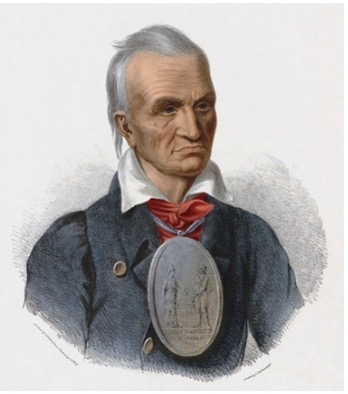
Across the fallen timber field, the Native Confederacy waited– Shawnee, Miami, Delaware, Ottawa warriors, bound together by necessity and the shared memory of homelands slipping away. Blue Jacket of the Shawnee stood among them. Along with Little Turtle of the Miami tribe, Blue Jacket watched the American lines with a strategist’s eye. They had beaten American armies before. They believed they could do it again.
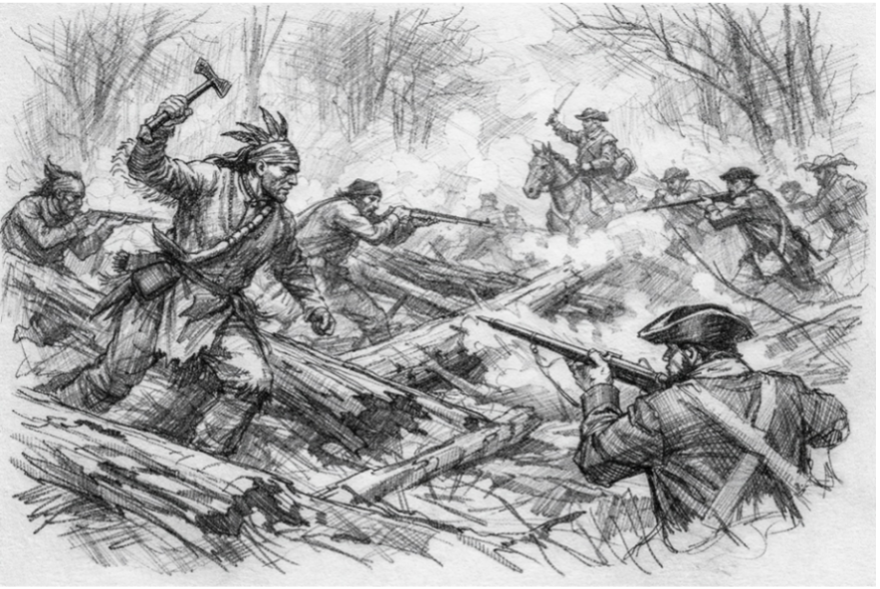
The first shots cracked through the trees like snapping branches. Wayne’s front line surged forward, muskets leveled, bayonets gleaming. The fallen trees made the ground treacherous, but the Legion pressed on, their formation bending but never breaking. Kentucky mounted volunteers swept along the flanks, driving back warriors who tried to circle behind.
Blue Jacket’s men fought fiercely, darting between logs, firing from cover, then vanishing into the brush. But something was different this time. Wayne’s troops didn’t panic. They didn’t scatter. They advanced steadily, pushing the confederacy back step by step.
The battle lasted barely an hour.
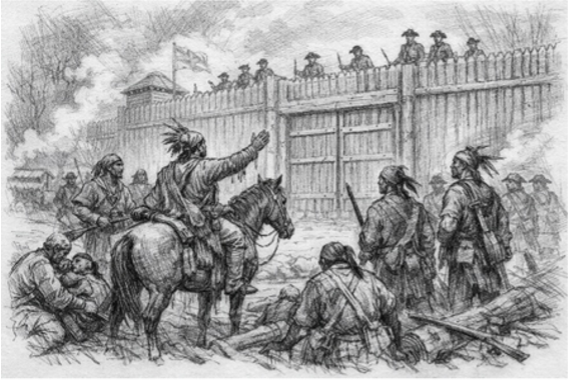
When the Native warriors retreated toward the nearby British-held Fort Miami, they expected refuge. But the gates stayed shut. The British commander, unwilling to provoke a direct war with the United States, refused them entry. Warriors pounded on the doors, shouting in disbelief, but the fort remained silent.
Wayne halted his men at the fort’s edge, refusing to be baited into a larger conflict. Instead, he turned back to the battlefield, ordering the destruction of Native villages, crops, and supplies. It was a harsh message, but one he believed necessary to end the war.
By the evening of August 20, the land of fallen timbers lay quiet again. The Native Confederacy’s resistance had been shattered. Within a year, the Treaty of Greenville would force the cession of most of Ohio to the United States, which opened the floodgates of American settlement in the West.
Those who survived the Battle of Fallen Timbers remembered the battle not for its length, but for its finality. This battle was the moment the control of the American frontier shifted dramatically, and permanently—when the old alliances faltered, when the United States secured its claim, and when the future of the frontier territories was set in motion.
As for the fates of the chief protagonists in the Battle of Fallen Timbers, there was no happy ending for either Anthony Wayne or Blue Jacket. Wayne died in December 1796, just two years after the Battle of Fallen Timbers. He was a young 51 years old. Some historians speculate that he was poisoned by his political and military rival, James Wilkinson, but that’s never been proven. As for Blue Jacket, his leadership of his people effectively ended when he was forced to sign the Treaty of Greenville. Blue Jacket lived much longer than Anthony Wayne, spending his last years trying to serve as a diplomat of sorts between his people and the American government. His exact date and place of death are unknown, but he is believed to have died in about 1810, perhaps in the region of the Detroit River.