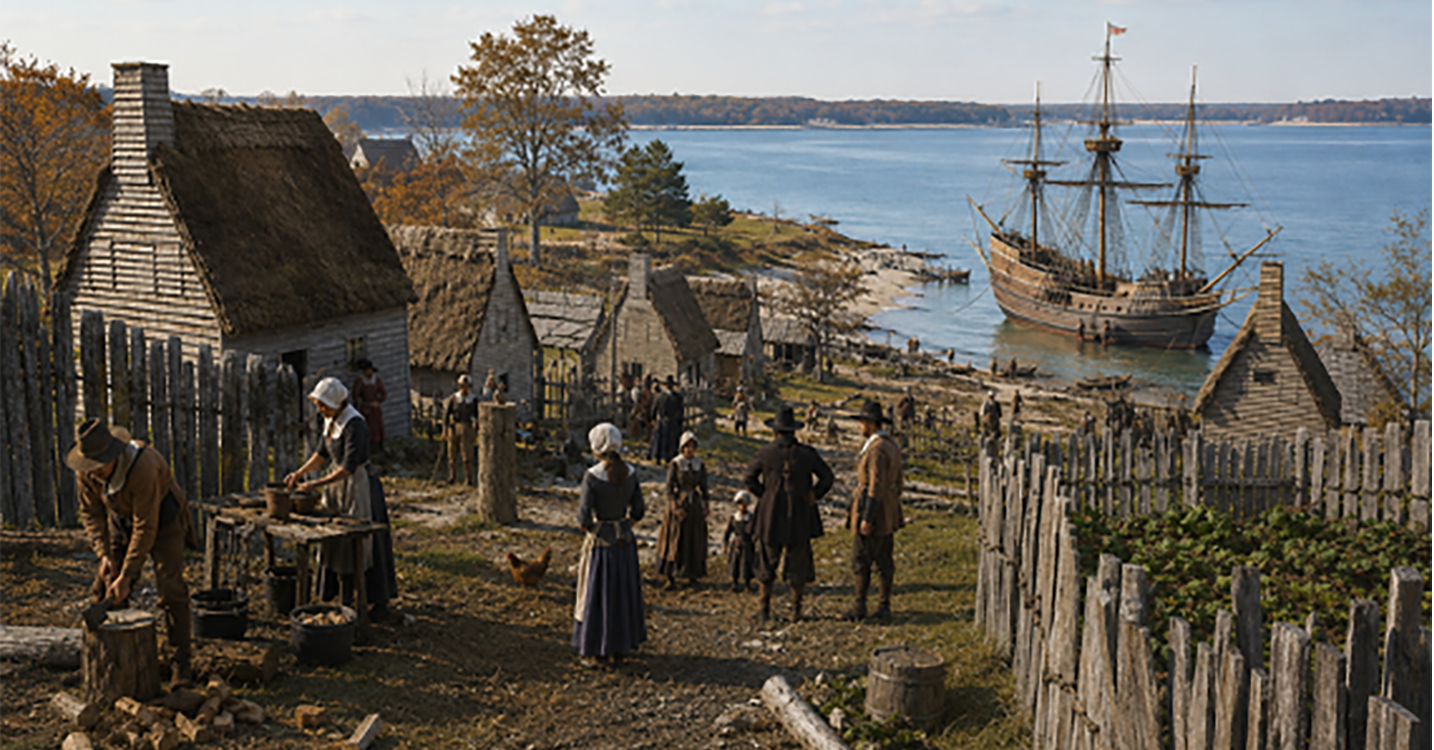
As we head towards the Fall season, and prepare for Thanksgiving celebrations, we honor the memory of the Pilgrim passengers on the Mayflower, who landed at Cape Cod in November 1620, and founded Plymouth Colony. We sometimes overlook, however, two momentous events that took place the following year: the actual Thanksgiving feast that the Pilgrims shared with their Native-American neighbors, which took place in the Fall of 1621 (not in 1620!), and the arrival of a ship named the Fortune, carrying 35 passengers, several of whom were to play central roles in the life of the Colony. One of them was Philip Delano, who died on this day on or about August 22, 1681 at the advanced age of 80. His life story is compelling.
Philip Delano was born in 1603 to Jan (or Jean) de Lannoy and Marie Mahieu. Like a number of other Mayflower passengers, Delano’s family had been living in Leiden, Holland at the time of Philip’s birth. In fact, Philip’s family had arrived in Leiden several years before the English separatists arrived, having come to Holland to escape religious persecution at the hands of the Spanish government. As Philip’s father’s surname suggests, they were not English—they were “Walloons,” that is, Protestants from the French-speaking region of “Wallonia” in southern Belgium, 7 miles from the northern border of present-day France. Philip’s birth name actually was Phillipe de Lannoy, or Delanoy. It is said that the family arrived in Leiden in about 1590, nearly twenty years before the arrival of the English Separatists from Scrooby. They had fled Wallonia in about 1579, and lived in Canterbury, England for over a decade before emigrating to Leiden. Philip was baptized in Leiden on December 7, 1603.
Philip was about 18 years old when he embarked on the Fortune in 1621 (having left his parents behind in Holland). Before he made the journey, some historians have speculated that Philip may have come to England the year before on the Speedwell, the ship that carried a number of the Mayflower passengers to England from Leiden in 1620.
After his arrival in Plymouth in November 1621, he was admitted to the church in Plymouth, and resided with his uncle, Mayflower passenger Francis Cooke (a French Huguenot who had married Philips aunt, Hester Mahieu). As described in Robert Charles Anderson’s “The Pilgrim Migration,” Philip served for many years on the Plymouth grand jury, the petit jury, and as an arbiter, from 1637 to 1679—over 40 years of service to his community. He also served briefly as a soldier in the infamous Pequot War in 1637. Besides his community service, Philip also was a land owner, beginning in 1623 when he and Moses Simonson received two acres of land in Plymouth as passengers on the Fortune. Besides that small land acquisition, Philip later acquired larger tracts of land over the next few decades, including 40 acres of land in Duxbury in 1637, following his move there in 1634. He became a planter, and a sometime fisherman. At some point it appears that at least two other family members (Mary’s) were living in Plymouth, as he engaged in several land transactions with colonists named William Pontus and James Glasse, both with surnames of Philip’s wife Mary (Pontus) Glasse’s family members.
A mark of distinction for Philip was that he was among a group of @ 53 colonists who comprised the “Purchasers” is a transaction in 1626 to acquire rights to the Plymouth Colony from the “Adventurers” who had financed the settlement of the Colony in 1620. One of the leading historians of Plymouth Colony, Eugene Aubrey Stratton, has described the group of Purchasers as “privileged above others in future land grants in the colony.” Among them were the most famous of the Mayflower passengers: William Bradford, William Brewster, Edward Winslow, Isaak Allerton and other well-known names. Philip also was among the 36 purchasers in 1652 who negotiated the acquisition of the town of Dartmouth from Massasoit, the sachem of the Wampanoag tribe. The acquisition involved about 800 acres of land; Philip later transferred his ownership interest to his son Jonathan.
It was several years into his time in Plymouth and Duxbury that he met and married Hester Dewsbury in December 1634, when Philip was about 32 years old. Together they are believed to have had six children, the last one born in 1648. Hester died sometime between 1648 and 1653. Philip then married Mary (Pontus) Glass, who was twenty years younger than Philip, and with whom he is believed to have had another four children, the last one born in 1661, when Philip was almost 60 years old. These figures are not exact, however, as noted in The Pilgrim Migration, in which Anderson states that “the number of children born to Philip Delano and their allocation between his two wives remains a vexed problem, due to the vagueness of his ‘will’, and the almost total lack of chronological checkpoints among his children and grandchildren.”
When Philip passed away in August 1681, he may already have disposed of all of his land, since none was included in the inventory of his estate. He left two memoranda reflecting his testamentary intent, both of which effectively bequeathed most of his remaining estate to his three eldest sons. He noted that he had “seven eldest children” as of that date. He also stated that upon his wife’s death, all of his “moveables” would go to his four youngest children. This suggests that at the time of his death he had 11 living children altogether.
From humble beginnings, Philip became a well-loved member of the Plymouth community. Through his many children, the Delano family has given us a long list of famous descendants, including five U.S. presidents—most notably Franklin Delano Roosevelt. Reflecting the family’s importance, there exists a thriving heritage society known as the “Delano Kindred,” with hundreds of members nationwide.
And so today we honor the memory of Philip Delano, the patriarch of an important New England family and the progenitor of a long line of distinguished descendants.