As we celebrate the 250th anniversary of the Declaration of Independence, we also celebrate the courage shown by our Founding Fathers in taking the giant step of declaring our country’s independence from Great Britain, at the risk of their lives and fortunes— for by signing the Declaration they were committing treason.
One of our Founding Fathers—sometimes overlooked—was Silas Deane, who played a key role in America’s negotiations with France over the terms of the Treaty of Alliance, after which France formally entered the war in 1778 as America’s ally. At the time the Treaty of Alliance was signed, Deane was only 40 years old, yet he was sufficiently highly regarded to be given this critical role. Today we honor him on the anniversary of his death on September 23, 1789.
Deane’s Pre-War Life
Deane came from humble origins: born in 1738 in Connecticut, he was the son of a blacksmith. He was a bright young man, however, and he was able to attend Yale University and be admitted to the bar in 1761. He did not practice law for long, however—he became a merchant, married well, and ran a successful business in Wethersfield, Connecticut for a number of years.
Deane’s political career began in 1768 at the age of 30, when he was elected to the Connecticut House of Representatives. This was three years after the end of the French and Indian War, and the colonies were dealing with a series of British parliamentary acts that were crippling American commerce, most prominently the Stamp Act of 1765 (repealed in 1766), closely followed by the Declaratory Act of 1766. No doubt Deane closely followed these developments as a member of the House of Representatives, and he soon became involved in the early stages of the rebellion. He was a member of the Wethersfield “Committee of Correspondence,” and was a delegate to the 1st and 2nd Continental Congresses in the pre-War years of 1774-76.
The War Years, And Deane’s Role in Negotiating the Treaty of Alliance
After the Revolution broke out in 1775, Deane was given the role for which he is most remembered: he was appointed by the Continental Congress to serve as an envoy to France, a position in which he served from March 1776 to February 1778. His mission was secret at first: America had not yet declared independence, and but it badly needed France’s support. Deane proceed to negotiate for shipments of arms, ammunition, and other provisions the army needed to wage war.
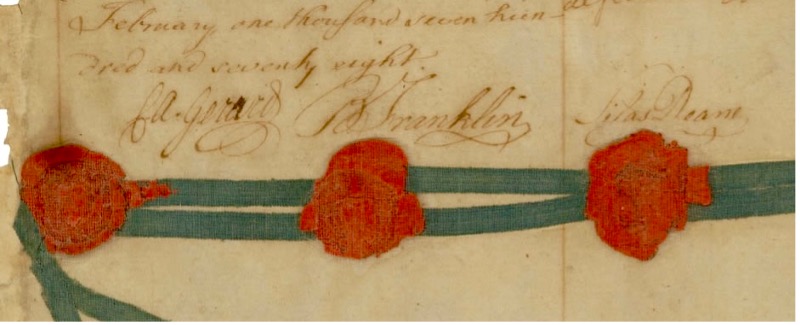
In December 1776, Deane was joined in France by Benjamin Franklin and Arthur Lee. It would be those three men who ultimately signed the Treaty of Alliance in February 6, 1788, as the officially-appointed American diplomats to France. The Treaty was a game-changer: France’s entry into the war altered the entire course of the war. Ultimately the French army and navy proved to have played a critical role in the ultimate victory at Yorktown.
Treaty of Alliance
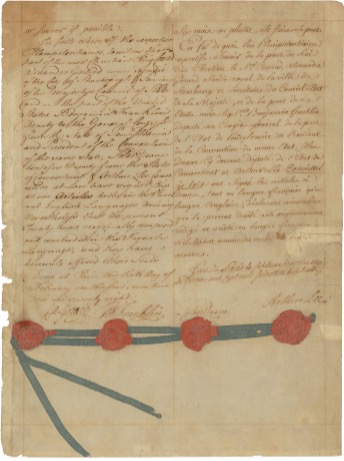
Signatures of Arthur Lee, Ben Franklin and Silas Deane
Aftermath of the Treaty of Paris
Despite Deane’s contributions to the hugely successful treaty negotiations, Deane may have overstepped his role at times, as he undertook efforts to recruit French and other European soldiers such as the Marquis de Lafayette to join the Continental Army—in Lafayette’s case, as a general at the young age of 19! Many American officers resented Deane’s intrusion into the American army’s promotion practices, and sometimes viewed their French counterparts with suspicion. For his perceived transgressions, Deane was officially recalled in March 1778, just after the Treaty of Alliance had been formalized.
More alarming than the ill-will Deane’s recruitment practices had created were the accusations of financial improprieties in which Deane allegedly engaged while serving as an envoy. Upon his return to the states in July 1778, he learned that his fellow diplomat Arthur Lee had been secretly communicating with the Continental Congress in which he claimed Deane had engaged in financial improprieties, forcing Deane to mount a vigorous defense. For the next year a war of words ensued between Deane and Lee (and Lee’s family). Deane was never found guilty, but the damage to Deane’s reputation had been done.
Deane never recovered from the attacks on his character. Compounding his personal problems, the value of his investments collapsed, and by 1780 he was in dire financial straits. He moved to Paris, then Belgium, then London—an itinerant disgraced diplomat struggling to find a new life and new career. Meantime, he sought to vindicate himself by publishing an “Address to the Free and Independent Citizens of the United States of America” (a not-so-subtle reminder of his role in the cause of American freedom)—an inglorious end to an otherwise important life.
Deane’s Final Years
Deane never returned to America. He became ill in 1787, and spent the remainder of his limited funds on treating his ailments. By early 1789 he was sufficiently recovered that he decided to make one last effort to obtain compensation from the U.S. government. To accomplish this, he boarded a ship to return to America, but while en route he took ill again. Deane died on board his ship on September 23, 1789 at the young age of 55. He died of unknown causes, and some speculate foul play. Deane’s descendants finally did receive compensation—in 1842—and Congress passed a resolution saying that the charges of financial irregularities were a “gross injustice.” President John Tyler then signed an act authorizing Congress to pay Deane’s descendants $37,000 that the government owed Deane for services rendered. We put this into the category of “too little, too late.”
Silas Deane House, Wethersfield Connecticut

Deane is remembered today in many ways. His former home in Wethersfield, pictured here, is a National Historic Landmark, and several other roads and buildings in Wethersfield are named for him. Yet, there is no statue, plaque or monument to him in Philadelphia, or in the Nation’s Capitol.
And so we honor Silas Deane today, the anniversary of his death at sea on September 23, 1789. He was one of our important—but now forgotten—Founding Fathers.