Pop quiz: what early American colonist survived a shipwreck, found his way to Jamestowne in 1610, sailed back to England a few years later, then came to America again in 1620 as a passenger on the Mayflower? His is a one-of-a-kind story, and his name is Stephen Hopkins, who died on or about June 6, 1644, in Plymouth Colony.
Stephen Hopkins came from humble origins. Baptized in April 1581 in Upper Clatford, Hampshire, Hopkins was well into his 20’s before much is known about him. We first encounter him when he was living in Hursley, Hampshire, about 15 miles south from his birthplace. There, he was employed as a minister’s clerk in a church where several members of the Virginia Company were congregants. Presumably those men recruited Hopkins to travel to Virginia on the fleet of nine ships that left for Virginia in June 1609, referred to as the “Third Supply.” Apparently by this time Hopkins had married Mary [Kent] and had three children, but he decided to leave for America and leave them behind. Perhaps it was the lure of untold riches that prompted him to leave, as stories still circulated that there was gold and silver to be discovered in Virginia. We simply don’t know.
Bad luck followed Hopkins on his voyage to America. His particular ship, the Sea Venture, was caught in a hurricane, and was shipwrecked off the coast of Bermuda, where he and his fellow passengers managed to get ashore, survived, and lived on the island for about nine months, during which time they built several smaller ships that could carry them on to their intended destination: the Jamestowne Colony. The colonists in Virginia presumed that the Sea Venture was lost at sea, and all its passengers had drowned. Miraculously, the passengers of the Sea Venture sailed into the Jamestowne Colony in May 1610, alive and well! This story of survival was told and retold back in England, where none other than William Shakespeare found the story so compelling that he wrote a play about it, one of his most famous: The Tempest. The story of the Sea Venture has become the stuff of legend.
One thing that must be said about Hopkins: he was not shy. While on Bermuda, he distinguished himself by openly criticizing the leader of the group of survivors, Sir Thomas Gates, who was to become the new Governor of the Jamestowne Colony. Hopkins was arrested for his critical remarks, accused of mutiny, and convicted. He was saved from execution after a number of his fellow colonists pleaded for mercy, and Gates pardoned him. Hopkins was saved, and he joined the rest of the survivors on the voyage to Jamestowne, where he remained until about 1614. Life there was horrific, as the Colony had just survived the so-called “Starving Time” of the winter of 1609-1610, during which a majority of the colonists had died from disease and starvation. Today we know that conditions were so desperate that some colonists had resorted to cannibalism in order to survive.
The evidence of Hopkins’ life during his years in Jamestowne is thin, other than a letter that arrived at Jamestowne in the year 1614 addressed to “Hopkins,” suggesting that he was still in Virginia in 1614. Most Historians therefore assume that Hopkins was at Jamestowne for at least four years, from 1610 to 1614. Somehow during that stay, he must have learned that his wife had died, perhaps via the letter to “Hopkins” in 1614. However he learned of Mary’s death, he now knew that his three children were now alone, back in England, so he returned home in order to tend to his family. When, exactly, he returned is not clear, but one historian has said that he had returned “by early 1618.”
Back in England, Stephen moved to London and is said to have married Elizabeth Fisher, with whom he would father a daughter named Damaris in about 1618. Some historians question whether Elizabeth was a second, third, or even fourth wife, but most historians agree that she was Hopkins’ second wife.
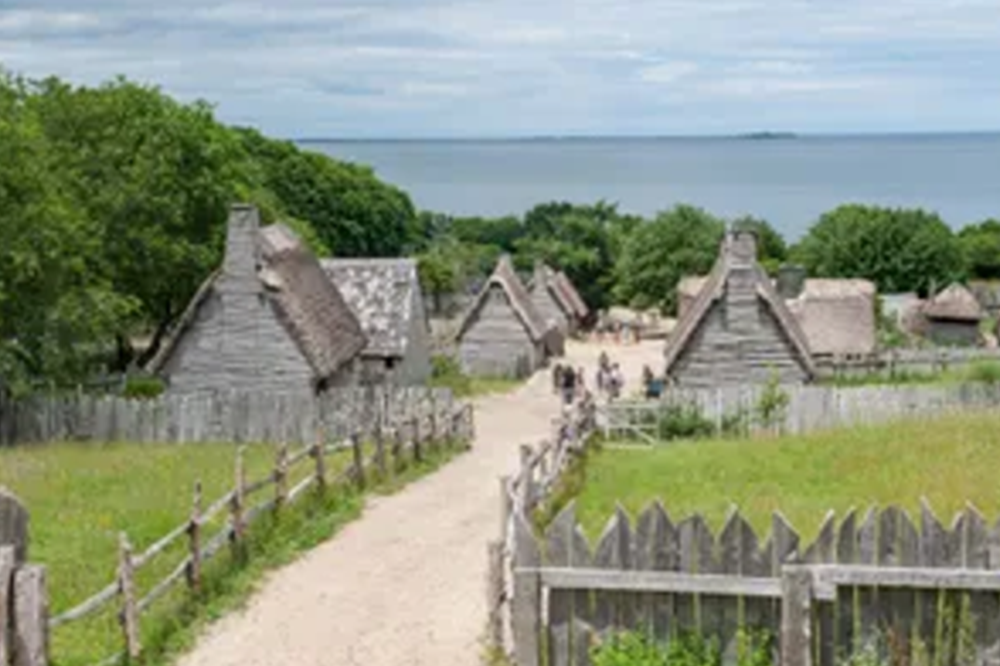
Somehow, serendipity struck: Hopkins learned of plans that were afoot for a group of English separatists to sail to North America to form a new colony, somewhere north of the existing Jamestowne Colony. Who brought this rumor to his attention, and how he was persuaded to return to America after the pain and suffering he experienced on his first North American venture, we’ll never know. What we do know is that this time he decided to bring his new wife, two of his three children by his first wife Mary (the first-born child had either died or married by then), and a third child he had with Elizabeth, Damaris. They boarded the Mayflower in September 1620, and Hopkins embarked on his second voyage to America. The voyage was not without its share of excitement, for while still at sea, Elizabeth gave birth to their second child, who they named “Oceanus.” Miraculously, Stephen and his family survived the first winter in New England, which claimed the lives of half of the approximately 100 passengers who had made the voyage.
Once the Mayflower was safely anchored at Cape Cod, Hopkins was one of the group of men who set out to explore the area, and select the location at which they would establish their new settlement. No doubt because Hopkins already had experience living alongside Native-Americans in North America while at Jamestowne, he also was called upon to make first contact with the leader of the neighboring tribe, Massassoit, and to serve as an interpreter of sorts (apparently Hopkins was able to speak and understand the Indian language, at least to a certain degree). Clearly, Hopkins was a valued member of the colony to have been given this important role to play. He continued to act as an unofficial ambassador to the tribes, and hosted some of their leaders at his home in Plymouth from time to time.
In these first few years of. The Plymouth Colony, Hopkins appears to have been a hard-working member of the community. By all accounts he and Elizabeth also had a solid marriage, as they had five more children between 1624 and 1632, one boy and four girls. As Plymouth Colony grew, however, and life for the Plymouth colonists became more settled, Hopkins’ behavior took a turn for the worse. By the 1630’s he was having run-ins with the authorities over various transgressions. In one case he was charged with battery for having beaten up a fellow colonist, who was “dangerously wounded.” Several other proceedings against him related to alcohol, as Hopkins had been operating an “ordinary,” or tavern keeper, since the early days of the Colony, and he sometimes violated local ordinances. He was sanctioned, for example, for allowing drinking on Sundays, and allowing excessive drinking in his house. By the 1630’s, he had become a bit of a ne’re-do-well.
Despite his mis-steps, Hopkins continued to be a highly-placed member of the community. In 1627 he was selected to serve as one of the so-called “Purchasers,” who made an agreement with the London backers of the Colony to acquire the rights to the lands of Plymouth Colony. By 1635 Hopkins was serving as an Assistant Governor. While he was serving in that capacity, He continued to acquire new lands, with several transactions recorded between 1637 and 1640.
In his 60’s, Hopkins took steps to settle his affairs. On June 6, 1644 he wrote his Last Will & Testament. In it, he first asked to be buried next to his wife Elizabeth, a testament to a fruitful and long-standing marriage. Second, he made a number of bequests to his surviving children, Giles, Stephen [Jr.], Constance, Deborah, Damaris, Ruth and Elizabeth. His oldest son Caleb was to receive the lion’s share of the estate. Hopkins called Caleb his “heir apparent,” and bequethed him all of his house and lands in Plymouth. Caleb was also to serve as executor. Hopkins’ execution of his Will was witnessed by two of the most illustrious Pilgrims at Plymouth, William Bradford and Myles Standish—another testament to the esteem in which Hopkins was held.
Exactly when Hopkins died is unknown, but it would have been shortly after executing his Last Will & Testament, and before the subsequent inventory of his estate was taken in July 1644. Hopkins’ exact burial place also is unknown, although presumably he was buried beside his wife Elizabeth, as he requested.
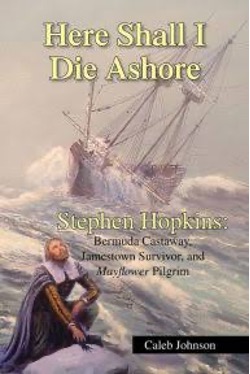
For further reading about Stephen Hopkins’ remarkable life story, we recommend a book written by one of the leading scholars on the history of the Mayflower and its passengers, Caleb Johnson. The Kindle editions of the book, Here Shall I Die Ashore, is available on Amazon.com for $9.99. A profile of Stephen Hopkins can also be found in Robert Charles Anderson’s The Pilgrim Migration (much more expensive, however, and is only offered in hardcover or paperback).
And so today we commemorate the death of Stephen Hopkins in about June 1644. He was a unique person in American history, a man who is the only known colonist to have lived at Jamestowne and who was one of the passengers on the Mayflower and a leading member of the Plymouth Colony: two of the most important settlements in early American History.