
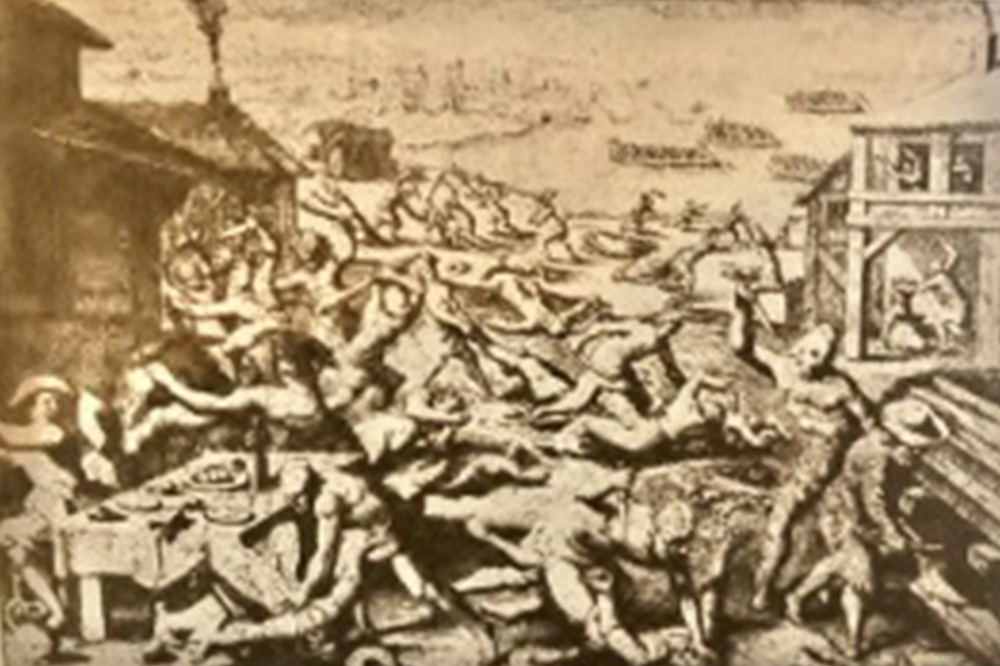
March 22, 1622 was a day that was a turning point in the life of the Jamestowne Colony, and perhaps the most tragic day in Jamestowne’s history—the surprise attack on Jamestowne and its surrounding settlements by hundreds of Powhatan warriors, leading to the deaths of hundreds of Jamestowne colonists. The attack was fueled by growing tensions between the white settlers and the tribes, including disputes over the ever-increasing encroachments on Indian lands, and the destruction of Indian hunting grounds as the colonists cut timber for shipment back to London and cleared lands for agricultural uses (including tobacco), and the general push west as the colonists sought out more and more territories to settle.
Chief Powhatan had died in 1618, and his brothers had taken over. By 1622, the younger brother, Opchanacanough, was the tribal leader, and he concluded that unless stopped, the colonists would ultimately destroy the tribes or push them out of their ancestral lands. Several raiding parties had mounted smaller attacks after a settler lad killed one of the tribesmen.
Based on their frequent visits to Jamestowne and environs, the Powhatan tribe and its allies were very familiar with the Colony’s various settlements and fortifications. Armed with that information, the Indians identified key targets. On the evening before the attack, an Indian boy, aware of the plans, had warned one of the colonists of the impending attack, and word spread quickly as the colonists attempted to bolster their defenses at the last minute. But the warning came too late. In a well-coordinated attack on multiple fronts, on March 22 the Indian warriors caught the colonists completely unawares and overwhelmed them.
In 1623, the year following the massacre, a list was compiled of “The Living and the Dead,” a transcription of which is posted on the Jamestowne Society’s website. The list of victims is painful to read: women and children and entire families were slaughtered. In some of the settlements, half or more of the colonists were killed, and a number of the women were captured. The etching above depicts the carnage. No similar list exists of Powhatan fatalities, but it is believed that hundreds of Indians died as well in the attack. When news of the attack reached London, the English were stunned. From that moment on, friendly relations with the Powhatans essentially ceased.
When news arrived in London of the Massacre of 1622, members of the Virginia Company no doubt were shocked, and any thought that the Colony was on stable footing evaporated overnight: the massacre devastated the colony, and a significant percentage of the population was killed, including women and children.
After conferring among themselves, the leaders of the Virginia Company drafted a long letter to Governor Francis Wyatt and his Council in Virginia, expressing its extreme concerns over the future of the Colony, and—inevitably—assigning blame to the leaders of the Colony for the disaster. The letter, dated August 1, 1622, is many pages in length, but can be briefly summarized: the Jamestowne settlers had failed their God, and must atone; they must now do everything possible to restore order, and they must give urgent attention to the “setting up of Staple Commodities,” to help improve the Colony’s finances. This they were admonished to do with “all your thoughts and endeavours.” On a happier note, the Company told Governor Wyatt that because of the collapse of the settlement’s economy, the King had seen fit to reverse himself on a policy issue that had long frustrated Jamestowne’s planters, namely, the King’s vehement opposition to granting Virginia and the Somers Islands a monopoly on the importation of tobacco to England. Out of the ashes of the massacre thus came a huge new opportunity for the Company to make a profit, and the Company highlighted that fact in its letter in so many words: “the good effects likely hence to ensue are to obvious for us to sett downe.” The Company also reported that the King had agreed to send more firearms “such as against the Indians may be verie usefull,” and that the Company was sending 400 men to replace those who were killed or wounded in the massacre.
That good news aside, the Company warned Governor Wyatt that the Colony would largely need to rely upon its own resources to survive: “we cannot wish you to rely upon any thing, but yourselves.” The Company chastised the colonists for having done a poor job in the past of managing their affairs, and for failing to generate profits for the Company. In the midst of the devastation wrought by the massacre, the Company crassly expressed its hope that “this extremitie will hence forward persuade you not to commit the certaintie of your lives to the uncertainty of one harvest; and that at last you will understand, it is as fit and necessarie to yield the return of Adventures yearly as to receive them.”
Longer range, the Company’s letter urged the Jamestowne leaders to take good care of future immigrants to the Colony, the “many hundreds of people” that the Company anticipated sending to Virginia in the near term. Governor Wyatt was warned that “we think you’re obliged to give all possible furtherance and assistance for the good entertaining, and well settling of them, that they may both thrive & prosper and others by their welfare be drawne after them: This is the way that we conceive most effectual for the engaging of this State, and securing of Virginia, for, in the multitude of people of the strength of the Kingdom.”
The Company’s letter covered many other topics, but in general the letter was meant to admonish and warn the Jamestowne leaders; expressions of grief or sympathy were few and far between. Across the ocean from Virginia, far from the scene of a bloody massacre, the Company’s investors seem to have been singularly focused on the bottom line: how to save the Company’s investment? How to shake up the people of Jamestowne who survived the massacre, and how to motivate them to turn a profit?
On October 7 1622 the Company drafted another long letter to the leaders of the Virginia Colony setting forth its views on the current crisis in Virginia. The letter, which can be read in full in the Records of the Virginia Company (vol. 3 pp. 683-690), is part pep talk, part rallying cry, and part warning. “We see no danger but rather advantage to be made thereby,” the Company’s opening paragraph declared. Yet the Company appeared to think that the colonists had lost their confidence. Cloaking itself in the Bible, the Company lectured the Governor that “we conceave it a Sinne against the dead, to abandon the enterprise, till we have fully settled the possession.” The Company then declared that besides honoring the dead, the colonists should exact “a sharp revenge upon the bloody miscreants, even to the measure that they intended against us, the rooting them out for being longer a people upon the face of the Earth”—fighting words, to be sure, and along with that, vows to supply the colonists with “Armes and weapons fit and prop for such service.”
What arguments could the Company possibly advance for saying that the fallout from the Massacre created some sort of “advantage”? One thing the Company pointed to was the “largnes of supplies now sent by private men, since the publique is not able,” so now the colonists supposedly would have more provisions upon which to subsist (the Indians having previously been the principal source of corn). The Company also discussed how the disaster would now make a stronger case for transporting more people to the Colony, including able bodied servants who could help defend the Colony from further incursions. Before the Massacre, the colonists had resisted more immigration unless the additional people were fully provisioned. Now, with the massive loss of life, the Colony was desperate for more people, and the Company was standing by to transport hundreds of new settlers to the Colony (by which it stood to profit). Many other “make weight” arguments were articulated in support of the proposition that there was a silver lining to the Massacre. Perhaps the Company was trying to convince itself that all was not lost.
What to make of this letter? The Company already was hearing that its own performance was under investigation, and that its Charter was at risk. Was the letter intended to deflect blame? Did the Company really believe that the Massacre created some sort of advantage? There is a plaintive air to the letter, and it painfully reveals the Company’s soul-searching in the face of widespread doubts about its oversight of the Colony. In hindsight, we know that the Company’s comments and criticisms did not turn the situation around. On the authority of King James I, the Company lost its Charter in 1624, and Jamestowne became a Crown Colony.