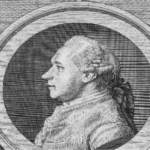
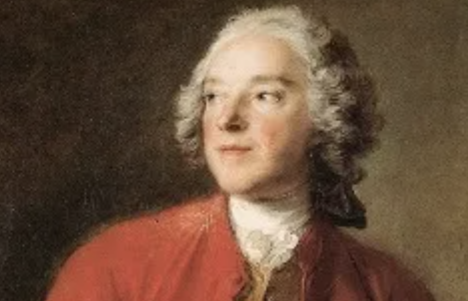
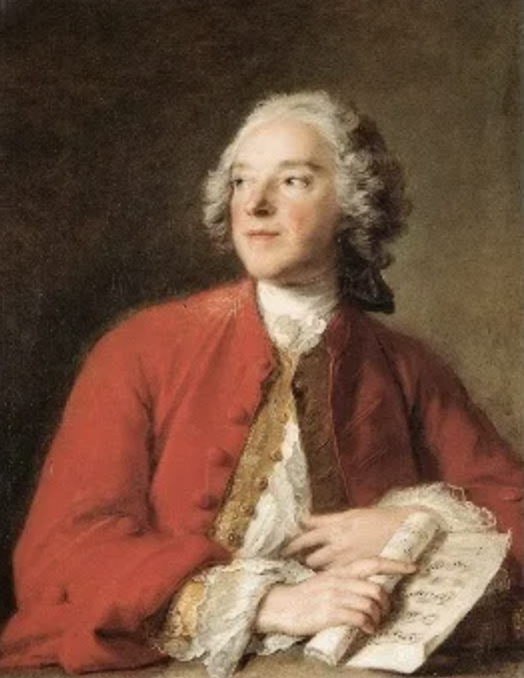
As Americans celebrate the 250th anniversary of the Declaration of Independence this year, our thoughts naturally turn to the “Founding Fathers.” If you peruse the various lists historians have compiled of who qualifies as a “Founding Father,” you’ll find virtually no Frenchmen. Wikipedia, for example, includes the Marquis de Lafayette and the Comte de Rochambeau, but otherwise omits many French political and military leaders whose contributions to the United States’ victory were enormous. Beyond these men, there also were Frenchmen who were instrumental in supporting the American war effort in other ways. Most prominent among them was Pierre Augustin de Beaumarchais, who died this day on May 18, 1799. His story is an incredible tale of risk-taking, derring-do, and personal sacrifice, all in the name of supporting the American cause. One historian who wrote a riveting biography of the man called Beaumarchais the “Improbable Patriot.”
Let’s go first to the end of the story: Beaumarchais has gone down in history as one of the most important French patriots who supported the American war effort. He worked tirelessly to supply the Continental Army by shipping the arms, clothing, food, and other critical provisions that were needed to sustain our soldiers in the field. His work was often thankless, but necessary, as our own Continental Congress was consistently unable or unwilling to authorize the supplies that General Washington was pleading for. Beaumarchais’ work was also extremely dangerous, and he needed to literally disguise himself at times in order to carry out his mission. He also concealed his activities by creating fake companies—and a fake identity—to cover his tracks. At the end of the war, he was considered a hero by those who knew of his clandestine work in support of the cause of freedom in America.
Stepping back, at the beginning of the American Revolution no one would have thought that Beaumarchais was anything other than a man who frequented the salons of Paris, ate and drank well, and lived a life of fun and games. Born in 1732, he was in his 40’s when the war broke out, by which time he had mastered the art of watch-making, and had become a well-known purveyor of fine watches. He also had become a budding playwright and song-writer. At the age of 23, he married Madeleine-Catherine Aubertin, a widow, but who was not of high society. She died less than a year after they married, and they had no children. Soon—and improbably– Beaumarchais was hired to be a music teacher for the royal family, and later he was named to serve as the King’s Secretary-Councilor. His rise was meteoric, and rankled with the French noblemen at Court who saw this commoner as undeserving of the King’s attention. Not to be deterred, Beaumarchais threw himself into his work, and over time he developed an impressive network of business and political connections.
Before and during the War, Beaumarchais also was creating and composing some of the most famous plays in French history, if not in world history. The Marriage of Figaro was his creation, as was the Barber of Seville. Beaumarchais not only wrote the plays and composed the music, he performed in his plays, which received rave reviews from the theatre-going public in Paris. He became a household name among the literati, and a guest of the most rich and powerful people of his era, despite the fact that he was not well-born. Some historians believe that the plays Beaumarchais wrote were semi-autobiographical, poking fun at the French aristocracy and calling out the monarchy for its callous treatment of the common man. Despite their irreverence, or perhaps because of it, his plays are still being performed today (the Marriage of Figaro was turned into one of the most famous of Mozart’s operas, and the Barber of Seville was turned into an opera by Gioachino Rossini).
With his theatrical talents, and his close ties to members of elite society, Beaumarchais did not necessarily need to become involved in the American war effort. But his businesses were not generating substantial profits, and he was in serious debt. He also had become entangled in a series of ugly court actions against him, in which he was sanctioned by the court and effectively ostracized by polite society. Despite his celebrity, the French government revoked his civil rights, which were not restored until 1776.
At the outbreak of the Revolution in 1775, Beaumarchais saw an opportunity to rebound from his business and financial setbacks, and to restore his good name. Even though France had not yet entered into any formal alliances with the United States (which would not happen until two years later), Beaumarchais began to serve as a secret emissary for the French government, reporting to the King on the British government’s growing conflict with the Americans. He also began to make major shipments of materiel to the Americans, using his fictitious Spanish trading company, Roderigue Hortalez and Company, and taking on the role of the owner of the enterprise using an assumed name. His secret sales of arms and provisions to the Americans were often made on credit, however, which later became a bone of contention between him and the American government, which claimed that some or all of the shipments were meant to be “gifts.”
Many historians credit Beaumarchais with delivering the crucial supplies that allowed the Continental Army to defeat the British in the famous Battle of Saratoga, which was a game-changing victory for America, so much so that France soon thereafter entered into the 1778 Treaty of Alliance with the United States, and formally entered the war against Great Britain. Other examples abound of his important role in aiding the American war effort. Sadly, the American government failed to reward him adequately for his efforts; Beaumarchais’ contributions are only now being recognized.
After the end of the American Revolution, Beaumarchais was active in the French Revolution, and supported King Louis XVI as a loyalist. Because of his association with the French nobility, his grand mansion in Paris was destroyed. He was later banished from France as an “émigré,” that is, a loyalist, and he spent several years in exile. He later returned to France in 1796, the same year that Napoleon became a national hero with his victory in the War of the First Coalition.
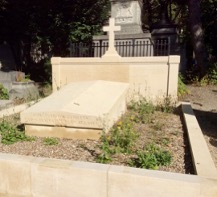
Back home, Beaumarchais lived peacefully with his third wife, Marie-Therese de Willer-Mawlaz, until his death on May 18, 1799 at the age of 67. He left a lasting legacy of sorts—his name was given to the Boulevard Beaumarchais in Paris. His burial plot in the Pere Lanchaise Cemetery in Paris includes an impressive monument (but not well tended to) to the man who saved the American Revolution.