In the modern era, we take for granted that women can serve with distinction in the United States armed forces, whether as support personnel or on the front lines of battle. Reel back the clock 250 years to the time of our American Revolution, however, and you find yourself in an era when women were still largely invisible in our society: they could not vote, they could not run for office (much less serve as political leaders), and they certainly could not join the military. “Subjugation” is a word sometime used to describe the plight of women in the colonial era, even though many women of that era were highly competent, literate, and passionately patriotic.
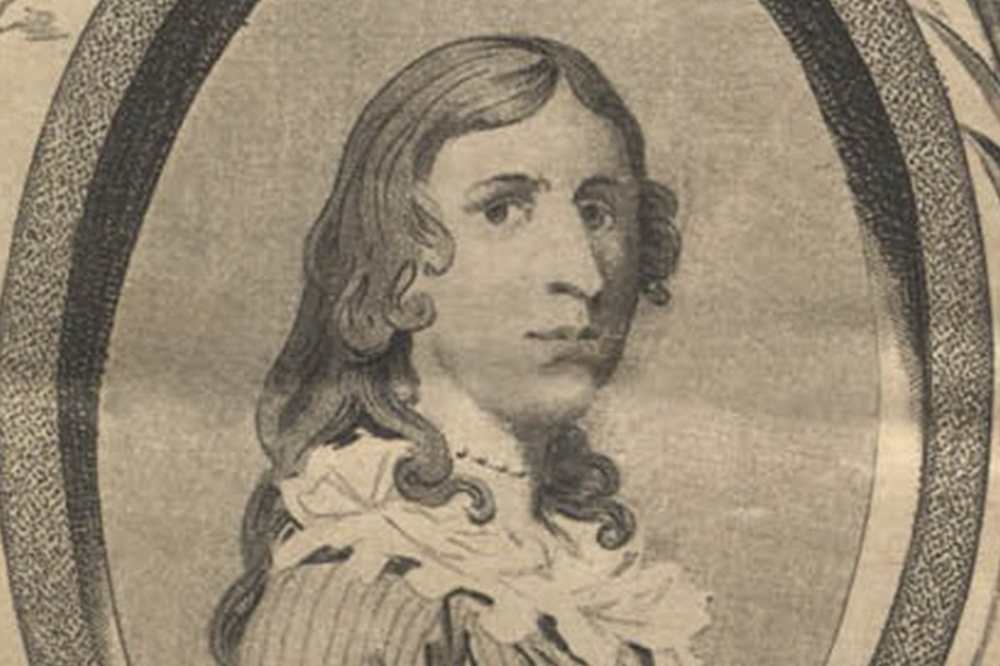
So, what do we make of Deborah Sampson, otherwise known as Robert Shirtliff? Born in Plymouth, Massachusetts in 1760, Deborah was just a teenager when war broke out in 1775. Deborah definitely came from “good stock”: her mother was the great-granddaughter of one of the most famous passengers on the Mayflower, William Bradford, who went on to become Governor of the Plymouth Colony and author of the most important histories of the Colony, “Of Plymouth Plantation.” Yet Deborah’s own family life was dysfunctional, to say the least: her father Jonathan Sampson abandoned the family when Deborah was still young (he was said to be dead, but he secretly had moved to Maine). With his disappearance, Deborah was sent to live with relatives, and later she lived with a minister and his wife. Still later, she became an indentured servant, which was her status when the Revolutionary War broke out in 1775. Still in her teens, she learned various skills, and worked in various trades. While not a tomboy per se, she was a hard worker and earned her keep. She was also a strong patriot.
Deborah’s patriotic fervor led her to join a militia company in Massachusetts in 1782—posing as “Robert Shirtliff.” Her first deployment was in a light infantry regiment, suggesting that she was big enough and strong enough to join with the men of a light infantry brigade, known for their relatively stronger physical attributes. That first year she had her first battlefield experience. Although injured in the fight, she was able to avoid having any medical care that might reveal her true identity—and her true sex. She was able to heal herself, and went on to serve in a unit sent to Philadelphia. There, she became ill. This time, she was forced to see a doctor, who discovered that she was a woman. In an abundance of kindness, he chose not to reveal her secret. After recovering, she continued to serve until the end of the war. She was honorably discharged in September 1783, following the signing of the Treaty of Paris—still posing as Robert Shirtliff.
After the war, Deborah returned to being a woman, married, and had four children. But she was not content to stay silent about her war service. Nearly a decade after the end of the war, Deborah applied for back pay, openly admitting that she had pretended to be a man, but that she had served her country ably. Amazingly, rather than being punished, she was awarded her backpay in an order signed by none other than John Hancock. Her story gained notoriety, and she began to make public appearances. Yet, she and her family were struggling financially, so she called upon Paul Revere, who assisted her in applying for a pension as an “invalid” due to her wartime wounds. Her application was granted in March 1805. In 1809, she applied to increase her monthly payment, and this application, too, was granted in 1816. Two decades later (and a decade after Deborah’s death), in 1837 Congress awarded her husband additional compensation, saying that the war years “furnished no other example of female heroism, fidelity and courage.”
Today, historians debate what motivated Deborah to join the military as a man, and what was her real gender identity. Did she join the army out of sheer patriotism? Was she gay, or maybe bi-sexual? Was she mentally unstable? We will never know, but we know that she served her country and held her own as a Revolutionary War solider. Deborah is memorialized today with a statue, a historic home, and a bronze plaque, among other recognitions. The town of Plympton Massachusetts has called her an “Official Heroine of the Commonwealth of Massachusetts.” Deborah died of yellow fever at the age of 66, leaving behind a lasting legacy of female courage and conviction. So today we honor her memory on the anniversary of her death on April 29, 1827.