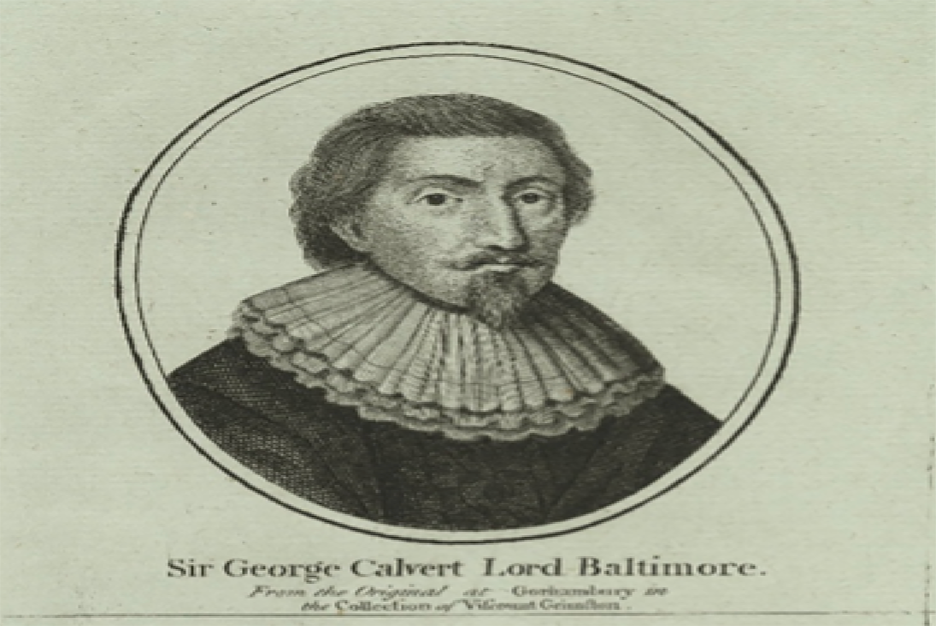
In the early seventeenth century, when England strained under religious division and political uncertainty, one family quietly set in motion the creation of a new society across the Atlantic. The story begins with George Calvert, a man whose ambitions were shaped as much by faith as by politics, and continues through his sons Cecil and Leonard, who transformed their father’s vision into a living colony called Maryland.
George Calvert: The Vision in Exile
George Calvert had once stood near the center of English power. As Secretary of State under King James I, he was trusted, capable, and respected. But his private conversion to Catholicism — a dangerous step in Protestant England — slowly pushed him from the political stage. He resigned his office, accepted the king’s friendship but not his favor, and turned his attention to the New World.
Calvert’s first attempt at building a refuge was Avalon, a cold and wind‑scoured corner of Newfoundland. He tried to make it work — he invested money, sent settlers, and even lived there for a time — but the climate was merciless. Ice, storms, and conflict with the French convinced him that Avalon could never be the haven he imagined.
So George looked south, toward the gentler waters of the Chesapeake. He petitioned King Charles I for a new colony, one that would allow Catholics and Protestants to live side by side under a policy of civil tolerance. It was a bold idea in an age when religious difference often meant violence.
But George Calvert never saw his dream completed. He died in April 1632, just weeks before the charter was finalized.
Cecil Calvert: The Founder Who Never Set Foot in Maryland
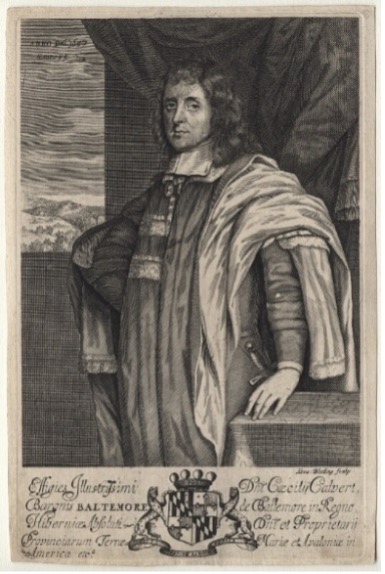
The charter passed to his eldest son, Cecilius — Cecil — Calvert, who became the 2nd Baron Baltimore, and he is remembered today as the namesake of the City of Baltimore. Cecil was young, educated, and determined. He took his father’s unfinished plans and shaped them into a functioning blueprint for a colony.
On June 20, 1632, the Charter of Maryland was granted to Cecil. It gave him extraordinary authority: Maryland would be his proprietary domain, governed under his direction, funded by his resources, and guided by his policies.
Cecil never crossed the ocean. Instead, he governed Maryland from England for more than forty years, issuing detailed instructions that shaped everything from land distribution to relations with Indigenous nations. He insisted on religious toleration — not out of idealism alone, but because he knew Maryland’s survival depended on peace between its Catholic founders and its Protestant majority.
Leonard Calvert: The Brother Who Built the First Town
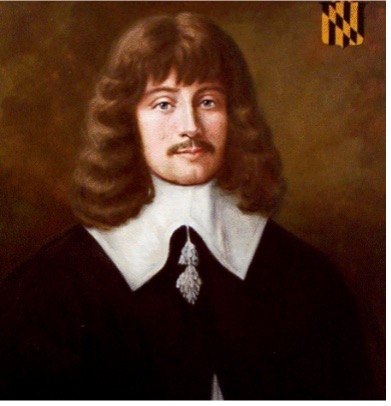
To carry out his plans, Cecil turned to his younger brother, Leonard Calvert. Leonard was practical, steady, and willing to shoulder the risks of frontier life. In late 1633, he boarded the Ark and the Dove with the first group of settlers. Their voyage took them to Jamestown first — a necessary stop for supplies and intelligence — before they sailed north into the Potomac River.
In March 1634, Leonard founded St. Mary’s City, Maryland’s first capital. He negotiated peacefully with the Yaocomico people for land, established the first government, and enforced Cecil’s policy of religious coexistence. Leonard’s leadership was tested repeatedly — by Virginia’s hostility, by internal rebellions, and by the chaos of the English Civil War — but he held the colony together until his death in 1647.
A Colony Built by Three Hands
Maryland was not the creation of one man. It was a relay:
- George Calvert imagined a place where faith would not be a crime.
- Cecil Calvert secured the charter and built the legal and political framework.
- Leonard Calvert crossed the ocean, raised the first houses, and governed the first settlers.
Together, they created a colony unlike any other in English America — a place founded on tolerance, shaped by family leadership, and born from the determination of a father and the loyalty of his sons.
Additional Reading
Dickey, Jonathan Cobb, The Life and Times of the Jamestown Colony 1607-1699, Aeronaut Books, June 1, 2026,