In this year of commemorations of the 250th anniversary of the signing of the Declaration of Independence, we at AHP want to honor our Founding Fathers who established our democratic republic, and in particular the several Founding Fathers who went on to serve as Presidents of the United States: George Washington, John Adams, Thomas Jefferson, James Madison and James Monroe. Together they collectively and consecutively served for forty years, from 1789 to 1825. Noteworthy is the fact that of those first five Presidents, all were Virginians except John Adams.
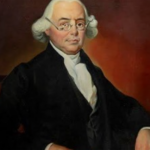
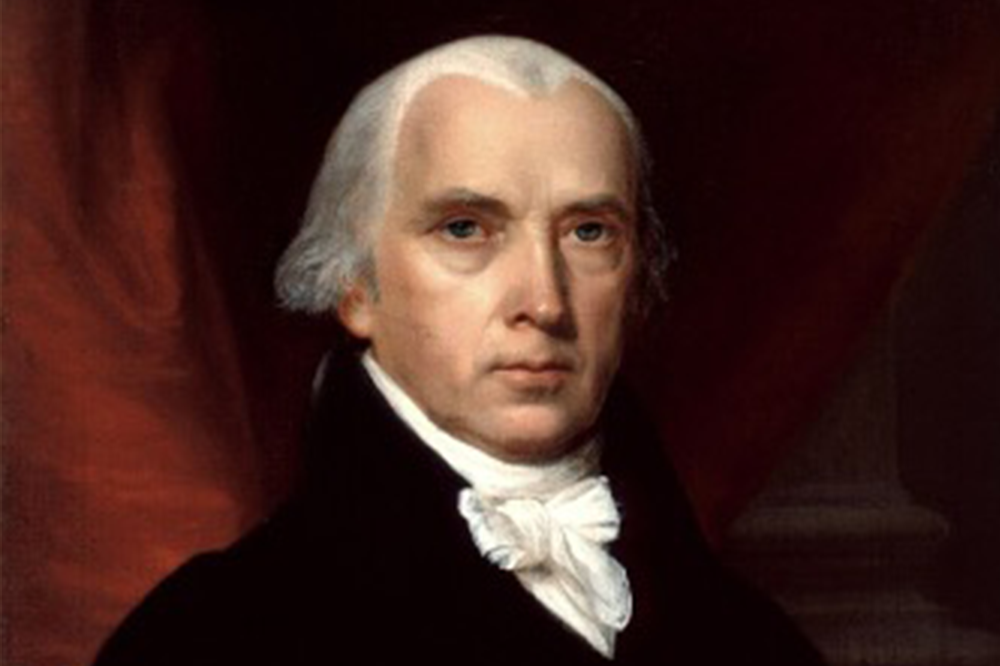
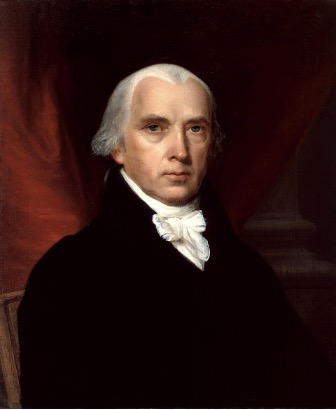
This month we want to honor the memory of one of those Virginians, James Madison, the fourth President of the United States, and a man who is credited with playing perhaps the most important role in the passage of the U.S. Constitution and Bill of Rights. So profound was his influence that Madison is sometimes called the “Father of the Constitution.” Madison also is credited—if that’s the right word—with having led our country into the War of 1812, a truly misguided venture that many of Madison’s opponents at the time labeled “Madison’s War.” And for some of our citizens, Madison is famous for having married Dolley Payne, otherwise known as Dolley Madison, who has served as the model for First Ladies ever since, and about whom we’ve written previously—see our story on Dolley Madison on AHP’s website on our “Stories” page.
James Madison was born this day 275 years ago on March 16, 1751, in Port Conway, Virginia. His family was part of the “planter” aristocracy of Virginia, and they owned the “Belle Grove” plantation where James grew up. The Madisons were among the largest landowners in the Piedmont region of Virginia, and traced back to some of the original settlers of the state. James was given an excellent education, and attended college at Princeton University in New Jersey (an unusual selection, as almost all the sons of the Virginia aristocracy attended William and Mary College in Williamsburg). He graduated in 1772, just a few years before the commencement of the Revolutionary War. After graduation he also studied law, which stood him in good stead during the later debates of the Continental Congress over the provisions of the Constitution. His legal training also prepared him well for the many learned tracts he authored about the Constitution that have come to be known as the Federalist Papers (co-authored in significant part by Alexander Hamilton).
By 1774, the rebellion in the thirteen colonies was well underway, but not yet to the point of actual warfare. Many of the colonies had formed so-called “Committees of Safety,” and Madison served on such a Committee in Virginia. When war broke out in 1775, he briefly served in the local militia, but Madison was not a born soldier (his health was always questionable), and his main contribution to the war effort was as a political leader. He thus became a delegate to the Fifth Virginia Convention, where he was tasked with developing a constitution. He also had a major role in the drafting of the Virginia Declaration of Rights in May 1776, a pre-cursor of America’s Declaration of Independence signed a few months later.
During the War itself, Madison was involved in the passage of the Articles of Confederation in 1777, the key piece of legislation that governed the affairs of state for the rest of the War. Almost all historians agree that it was a deeply flawed document, and left the Continental Congress largely powerless to support the war effort unless the legislatures of the thirteen colonies stepped up—which more often than not did not happen. This wartime experience led Madison to argue for a far stronger central government to replace the Articles of Confederation—which is what ultimately produced the U.S. Constitution. Madison lobbied for this from the get-go when he was elected to the very first House of Representatives in March 1789, where he continued to serve until 1797. During this period Madison played a prominent role in shaping what became known as the “Federalist Party,” America’s first political party.
Over time, Madison’s political thinking shifted, and he became a close ally of Thomas Jefferson. Together they developed what became the Democratic-Republican Party, which was essentially an anti-Federalist faction opposed to the “big government” philosophy espoused by Washington, Adams, and Hamilton. With Madison’s strong support, Jefferson won the hotly-contested 1800 presidential race against John Adams, and Madison became his Secretary of State starting in May 1801. Madison served as Secretary of State for the entire two terms of Jefferson’s presidency, and succeeded him as President in March 1809.
As Secretary of State, Madison worked with Jefferson to dismantle much of the Federalist-inspired legislation enacted during Adams’ presidency. Madison also was instrumental in passage of the Embargo Act of 1807, which banned exports to foreign nations—an Act that targeted Great Britain in particular. It was a highly controversial piece of legislation, however, and Madison paid a political price later on for his strong support of the embargo.
When Madison assumed the presidency, he already had strong opposition from many members of Congress who loathed the Embargo Act, which was not repealed until March 1809, shortly before Madison took office. Among his critics was none other than future President James Monroe, who had not forgiven Madison for undermining some of Monroe’s diplomatic initiatives when Monroe was serving as a diplomat and Madison was serving as Secretary of State. Yet the two of them reconciled, and Madison named Monroe his Secretary of State in 1811. Bad timing for Monroe—the next year saw the nation go to war against Great Britain in the War of 1812.
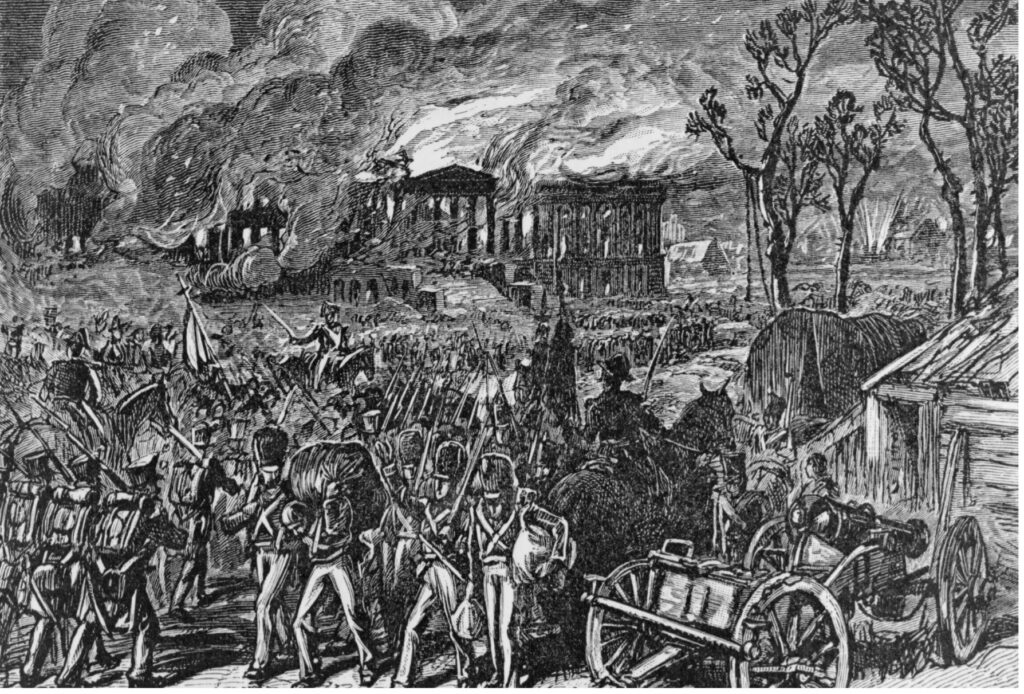
A low point in James Madison’s career was the War of 1812. Great Britain had been causing trouble for several years, attacking American shipping, and “impressing” American sailors, among other mischief-making. After pursuing several failed diplomatic solutions, Madison concluded that war was the only way to stop British depredations. And so in March 1812, he asked Congress to declare war on Great Britain, and Congress cooperated. Unfortunately, America was not ready for war—its troop strength was inadequate to the task, and the military was otherwise ill-equipped for an extended war effort. The war was a debacle for Madison, and even though he was re-elected President that same year, the war was unpopular in large areas of the country, most prominently in the Northeast. Early diplomatic efforts to end the war failed, and the war continued for several more years, finally concluding with the Battle of New Orleans in 1815 and the Treaty of Ghent.
The rest of Madison’s second term of office was occupied with various matters related to western expansion, tariffs, and relations with Native-Americans. Madison was sympathetic to the plight of Native-Americans, much to the consternation of the hero of the Battle of New Orleans, Andrew Jackson. While the War of 1812 was still raging, various battles between Americans and Native-American tribes were taking place, such as the Creek War and the Peoria War. Madison largely stood by and watched, and took no aggressive steps to stop American aggressions. Privately, Madison is said to have felt -– like his mentor Thomas Jefferson before him—that Native-Americans needed to abandon their hunter-gatherer lifestyle, and become farmers.
As for his private life, Madison married Dolley in 1794 while he was serving in the House of Representatives. He was much older than Dolley when they married, he being 43 and she being 26. They had no children. After his presidency, James and Dolley lived well and prospered at their estate at Montpelier. They enjoyed a steady stream of visitors, and from time to time Madison was consulted on matters of state. In his last decade, Madison was persuaded to briefly return to politics, and he served as a delegate at the Virginia Constitutional Convention in 1829. He otherwise kept his distance, and sought to preserve and protect his legacy by, among other things, doctoring the records of his presidency.
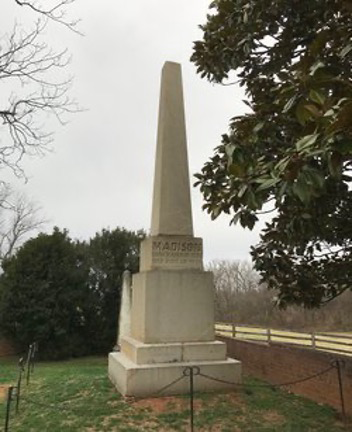
Madison lived another two decades after the end of his presidency in 1817. He died of heart failure on June 28, 1836 at the age of 85. His wife Dolley outlived him by a dozen years, dying in 1849 at the age of 81. They are buried together in the Madison Family Cemetery at Montpelier in Virginia. His life has been commemorated in so many ways: he appears on our U.S. coinage and stamps, for example, and his name has been attached to a myriad of schools, roads, buildings, parks and places. In all respects he was one of our greatest Founding Fathers, and we honor him today on the anniversary of his birth in 1751, 275 years ago today.