Just two months after the United States declared independence from Great Britain on July 4, 1776, America’s military forces were badly beaten by British troops in the Battle of Long Island, sometimes called the “Battle of Brooklyn,” for it was at Brooklyn that General Washington and his troops were corned by the British invaders, seemingly trapped—but escaped in one of the most heroic retreats of the American Revolution.
The battle began in the wee hours of August 27, 1776. Americans already were well aware of the arrival of British troops in the area of western Long Island, whose mission was to attack the Americans and oust them from control of Manhattan and surrounding areas. General Washington knew that the attack might happen at any moment. On August 27, dawn crept over the wooded hills of western Long Island. General George Washington had spent the night riding between positions, his face set in that familiar mask of resolve. Along the American lines, men tightened worn leather straps, checked powder horns, and tried to quiet the unease that had settled over the trenches at Brooklyn Heights. Washington knew the British were coming. What Washington and his men did not know—what no one on the American side yet realized—was that the enemy had already slipped behind them.
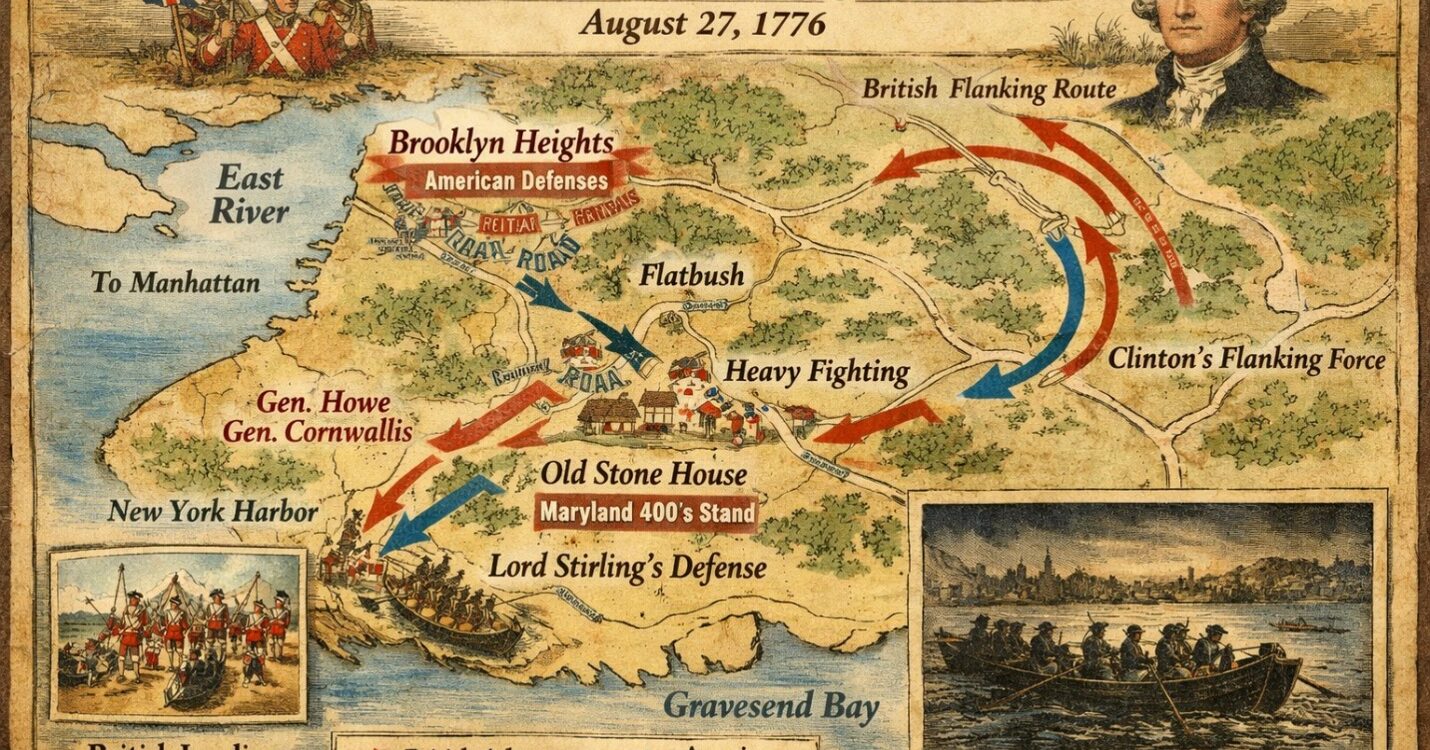
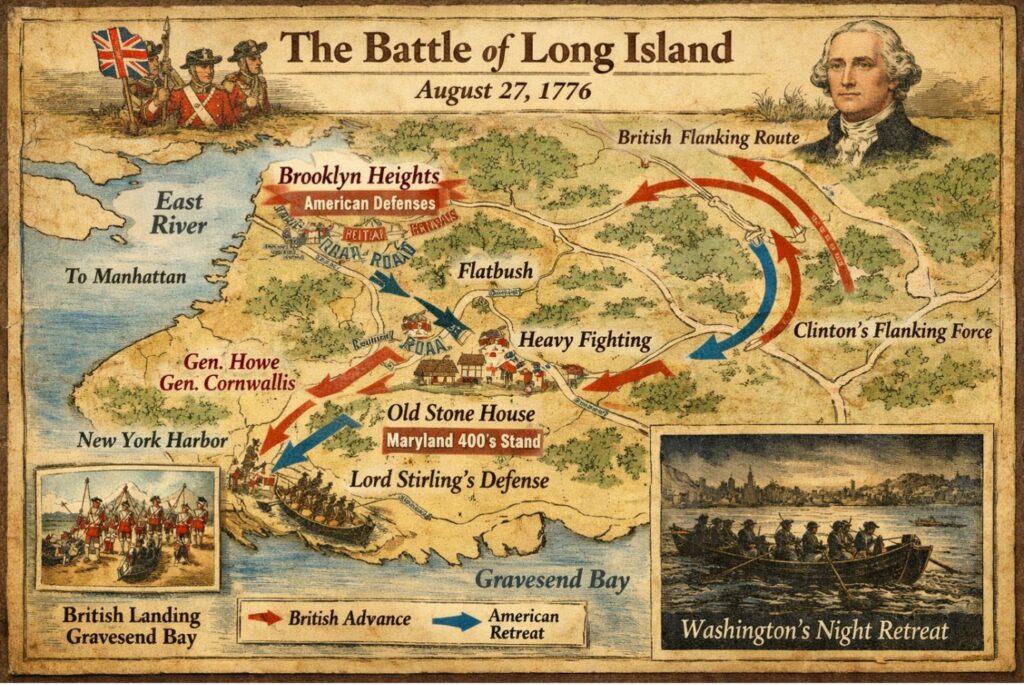
To the south, at Gravesend Bay, red-coated soldiers had come ashore days earlier, their landing craft scraping the pebbled beach as thousands of British and Hessian troops formed ranks. Now they moved with deliberate precision, columns advancing along the Gowanus and Flatbush roads. Their drums beat a steady cadence, echoing off the hills like distant thunder.
American pickets fired the first shots. The fighting intensified near the Old Stone House, where Lord Stirling and his Marylanders—young men barely seasoned by war—held their ground against overwhelming numbers. They charged again and again, buying precious minutes for their comrades to escape. Some would later say that the Revolution survived because of those boys from Maryland, who stood firm when retreat seemed the only sane choice.
But the real danger came from the east. Under cover of darkness, British General William Howe, the Commander in Chief of the British military in North America, had led his main force through Jamaica Pass, a narrow, lightly guarded road the Americans believed impassable. By midmorning, British troops emerged behind the Continental positions, their bayonets glinting in the rising sun. The trap snapped shut. Washington watched from a ridge as the truth became clear. His army—outnumbered, inexperienced, and now surrounded—was on the brink of destruction. For two days, the British prepared to finish the job. Howe, cautious after the bloodletting at Bunker Hill, chose not to storm the defenses. He would wait, tighten the noose, and force Washington to surrender.
Yet even in that moment of crisis, he did not falter. Washington ordered a withdrawal to the fortifications at Brooklyn Heights, rallying scattered units and directing the retreat with calm authority. On the night of August 29, as a cold wind swept across the East River, the Continental Army began to vanish. Fishermen, sailors, and soldiers ferried regiment after regiment across the dark water, muffling oars with cloth to silence each stroke. Horses, cannons, and supplies followed. Washington himself crossed only after the last boatload of men had embarked.
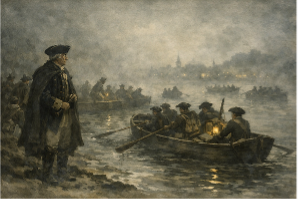
At dawn, a thick fog rolled in—so dense that British sentries could barely see twenty paces ahead. When the mist finally lifted, the trenches at Brooklyn Heights were empty. The Continental Army had escaped.
The Battle of Long Island was a British victory, but Washington’s retreat preserved the Revolution. In the quiet hours of that fog-shrouded morning, the war’s future slipped through the British grasp like a ghost.
Additional Reading:
Adams, Charles Francis (1896). “The Battle of Long Island”. The American Historical Review. 1 (4): 650–670.
Field, Thomas Warren (1869). The Battle of Long Island. Brooklyn: The Long Island Historical Society.
Gallagher, John J. (1995), The Battle of Brooklyn 1776, Brooklyn: Castle Books,