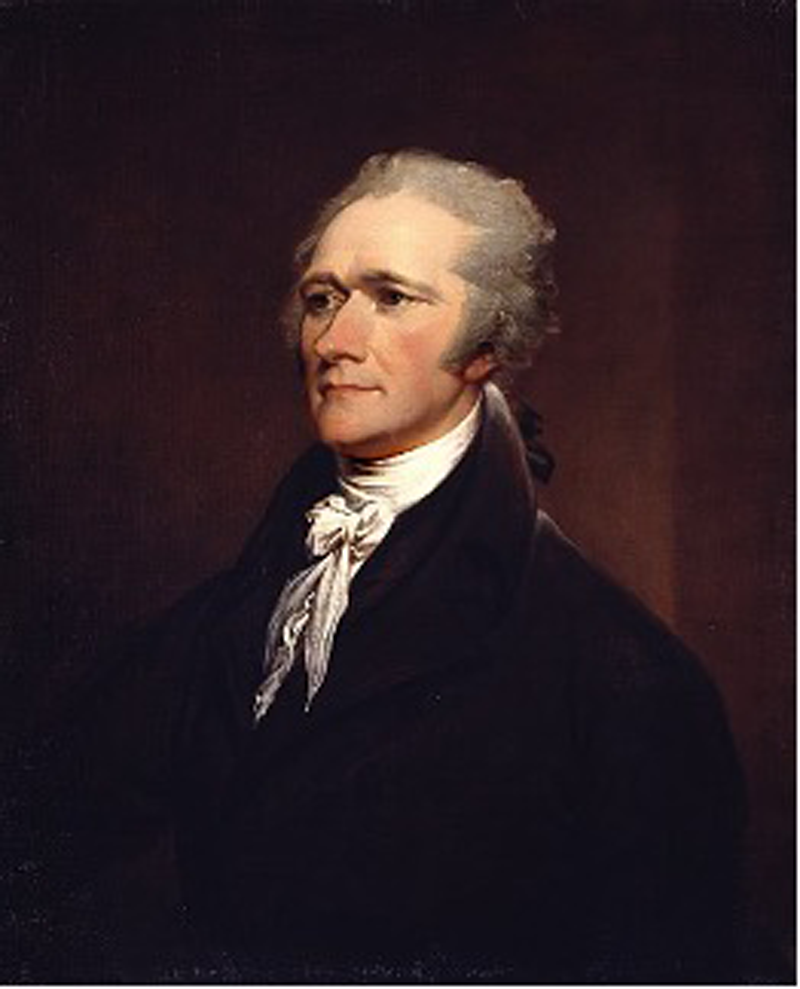
You see his face every day on our $10 bill. A Broadway musical is named after him. And he’s known as the man who was killed in a duel with Aaron Burr in 1804. Alexander Hamilton is a truly iconic figure in American history, and one of the most complex and misunderstood of our Founding Fathers. Today we celebrate the 270th anniversary of his birthday on January 11, 1755.
Hamilton was the illegitimate son of James Hamilton, a Scotsman who emigrated to the Island of St. Kitts in the Caribbean and there took up with Rachel Lavien, who had left her husband in Nevis and moved to St. Kitts, where she first met James. James and Rachel were parents of Alexander and his brother James Jr., but the family unit was soon destroyed when James Sr. abandoned them, and Rachel died of yellow fever in 1768 when Alexander was 13 years old. Left to fend for himself (his father was nowhere to be found), Alexander pursued various jobs in Nevis, but left for the United States in 1772. In New York he briefly attended Columbia University, but by 1774 he had been radicalized and joined the growing chorus of colonists who supported independence from Great Britain. When war broke out in 1775, Hamilton was quick to join the local militia. Over the course of the next few years, he rose through the ranks, and ultimately became an adjunct to General Washington, who promoted him to the rank of Lt. Colonel. Theirs was a sometimes-dysfunctional relationship, as Hamilton pressed for higher rank and greater roles in the fighting, while Washington held him back in order that Hamilton continue to serve as one of Washington’s principal aides. It wasn’t until July 1781—right before the Battle of Yorktown—that Washington relented and gave Hamilton command of three battalions. Hamilton exploited the opportunity to the fullest, and led one of the attacks at Yorktown that led to General Cornwallis’ surrender. Through his sheer determination, Hamilton became a war hero.
Following the Treaty of Paris that ended the war in 1783, Hamilton went on to have a stellar career in business and politics. He has married well—his wife Elizabeth Schuyler was from one of the most prominent New York families, which helped him achieve greater and greater business and political success over the next two decades. In 1784, he founded the Bank of New York, while also serving in the New York legislature. In 1787, he was a delegate to the Constitutional Convention, in which he strongly advocated for a strong federal government—a position that was opposed by many rebel leaders such as Samuel Adams and Patrick Henry. He played a central role in the drafting of the Constitution, and was a principal author of the famous Federalist Papers. When Washington was elected the first President of the United States, he named Hamilton to be America’s first Secretary of the Treasury, and Hamilton used that platform to help create the first National Bank in 1791, and established the U.S. Mint in 1792 (the first official U.S. coins were minted beginning in 1794).
During his tenure as Treasury Secretary, Hamilton made many enemies, and he became embroiled in a number of ugly political feuds—most prominently with Thomas Jefferson, Washington’s Secretary of State, James Madison and Aaron Burr—the man who was to kill him a few years later. Hamilton resigned in 1795, but stayed involved in the political infighting behind the scenes. He was a leader of the new Federalist Party, and one of the fiercest advocates for federal control of commerce and trade, a strong “standing army,” and other federal regulations that were anathema to the new Democratic-Republican Party. Yet, Hamilton was also an opponent of his own party’s presidential nominee in the Election of 1800, John Adams, and Hamilton worked tirelessly to cause Adams’ defeat. Indeed, Hamilton was the deciding vote in the Electoral College to elect Jefferson on the 36th ballot over Aaron Burr, with whom Jefferson had been tied. Burr’s consolation prize was that he became Jefferson’s Vice President, but the animosity between Hamilton and Burr would only increase over time.
The duel with Burr was the result of what can only be called fatal hubris on both sides—Burr was incensed with Hamilton’s continued machinations against him, and Hamilton was intent on destroying Burr’s political career. Finally, in June 1804, Burr had had enough, and demanded an apology from Hamilton for his assaults on his character. When Hamilton refused to apologize, Burr challenged him to a duel. The duel took place on July 11, 1804 at Weehawken, New Jersey. Historians continue to debate what happened—who shot first? Did Hamilton aim to miss? Whatever the truth, Hamilton was hit, and died of his wounds the next day. In the days following, the nation mourned, and the turn-out for Hamilton’s funeral procession in New York City was immense. He was buried in the cemetery at Trinity Church in Manhattan. We honor him today, one of the greatest of the Founding Fathers.