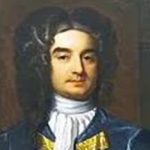
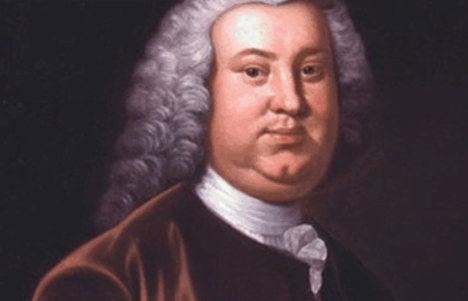
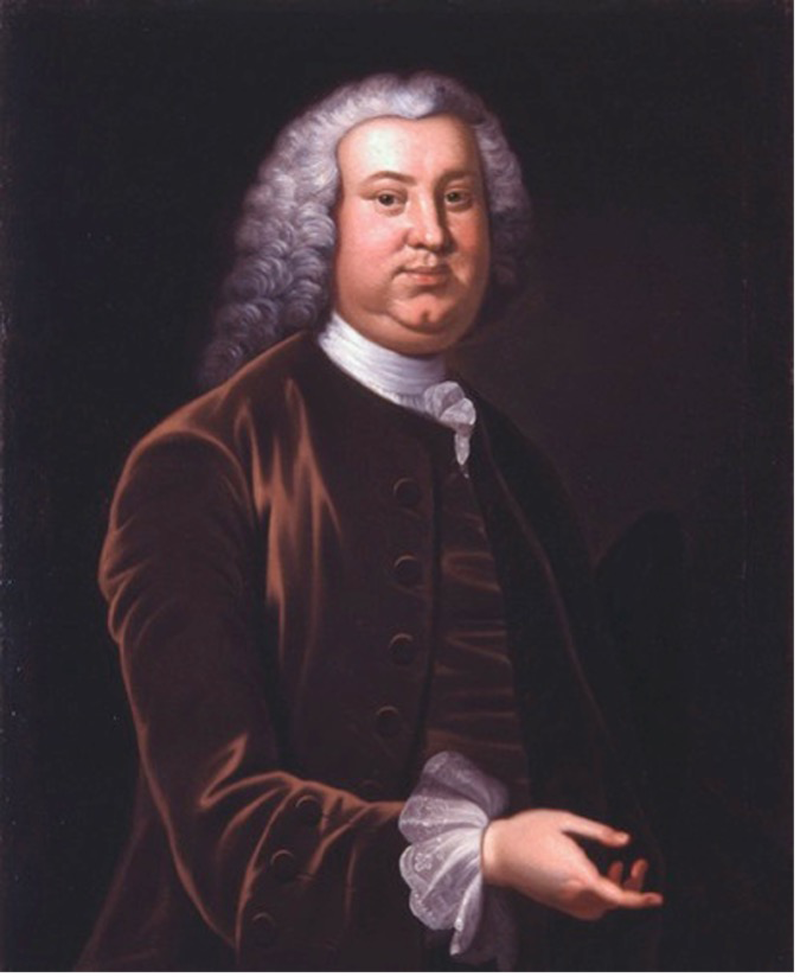
As we commemorate the history of the American Revolution, which began 250 years ago in 1775, much of the focus has been on battles—Lexington & Concord (April 1775), Bunker Hill (June 1775), etc. – and the military exploits of various generals, most prominently General George Washington, appointed in June 1775 to serve as Commander in Chief of the newly-created Continental Army. Significantly less attention has been given to the various members of the Continental Congress who also played a critical role in the war effort. Among them was the man we honor in this post, Peyton Randolph, who died this day on October 22, 1775.
Peyton Randolph was the descendant of a number of distinguished Virginians who served with distinction in the government of colonial Virginia, dating back to the first immigrant member of the Randolph family, William Randolph. William was born in Warwickshire in November 1650, and emigrated to Virginia in about 1669. There, he served in the House of Burgesses from 1684 to 1698, and became Speaker of the House in 1698. William’s son Isham Randolph (b. 1687) was the father of Jane Randolph, future wife of Thomas Jefferson. William’s son John Randolph (b. 1693) became the Lt. Governor of Virginia. John and his wife, Lady Susanna Beverley, were the parents of Peyton Randolph, the subject of this story, who was born in 1721 at Tazewell Hall, the family’s plantation in Williamsburg. At the age of 22, Payton became a member of the bar. Five years later Peyton was appointed attorney general of the Virginia Colony, and was elected to the Virginia House of Representatives at the young age of 27. His meteoric rise did not stop there.
Peyton’s assent to the ranks of the Founding Fathers began when the English Parliament enacted the Stamp Act in 1765. He served on a drafting committee to develop Virginia’s response to the Act, where he worked alongside of—and knocked heads with—Patrick Henry. The following year Peyton was elected speaker of the Virginia House of Burgesses, the most prestigious post in the Virginia government next to the office of Colony Governor. As the American independence move gained traction, Peyton became a key player in Virginia’s “Committee of Correspondence,” and later in the Virginia Conventions. In March 1775—right before the Battle of Lexington & Concord—he was named President of the Second Virginia Convention, again working closely with Patrick Henry.
When the Revolutionary War officially broke out in April 1775 with the “shot heard round the world,” Peyton committed himself to the cause of freedom. A testament to his strength of character, Peyton already had been elected President of the First Continental Congress in 1774, and when war broke out he was elected President the Second Continental Congress which first convened in June 1775.
Sadly, Peyton did not have long to live. Just months after assuming the Presidency of the Second Continental Congress, he suffered a fit of apoplexy while dining with Thomas Jefferson in Philadelphia. He never recovered, and he died that same day on October 22, 1775. He was survived by his wife Elizabeth Harrison (she herself was a member of a famous Virginia family, the Harrisons; she was the sister of Benjamin Harrison V, another Founding Father).
Today, Peyton Randolph is remembered in various ways. One of the first naval frigates in U.S. history was named for him, the USS Randolph. Several counties in America are named after him (North Carolina, Massachusetts and Indiana). His house in Williamsburg still stands, and is a popular tourist attraction at Colonial Williamsburg (a National Historic Landmark building).
And so we honor Peyton Randolph, a patriot who played a leading role in our nation’s founding, who died 250 years ago today.