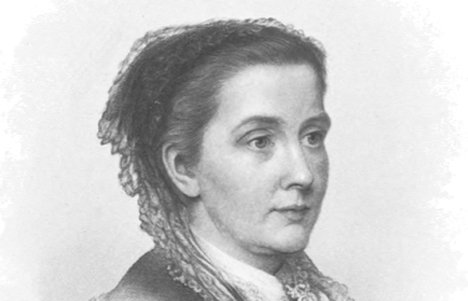
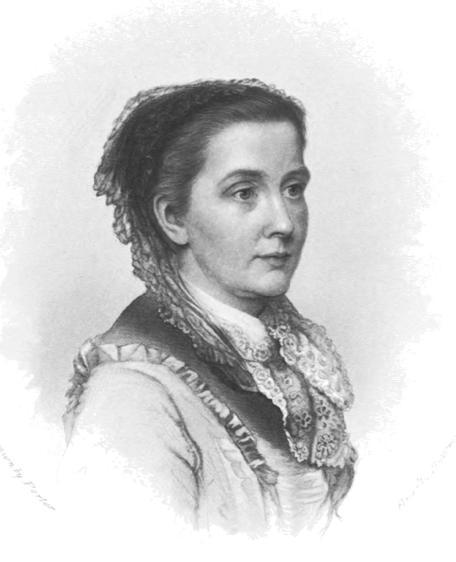
The women’s suffrage movement in America culminated in 1920 with passage of the 19th Amendment of the U.S. Constitution, giving women the right to vote. The movement began long before that, however, led by several courageous women who stood up for gender equality in an era when women were literally second-class citizens. One such woman was Julia Ward Howe, who died this day on October 17, 1910 at the advanced age of 91.
Julia’s life as a political activist came late to her. Born in New York City in 1819, she came from a relatively wealthy family—her father a banker, her mother a poet. She married Samuel Gridley Howe at age 24 and raised six children. She began publishing poetry in the 1850’s, some of them containing thinly-veiled references to her unhappy marriage. It was not until the 1860’s that she became involved in the fight for women’s right to vote. In 1868, she helped found the New England Woman Suffrage Association, and the following year the American Woman Suffrage Association. Her activism expanded in 1877 when she founded the Women’s Educational and Industrial Union, and later the Association of American Women, which advocated offering more educational opportunities to women and girls. Julia is credited as the author of the “Mother’s Day Proclamation,” which urged women to advocate for world peace. Her activism was widespread, and warmly embraced by women throughout the nation.
In the meantime, exercising her artistic talents, she found time to write the “Battle Hymn of the Republic,” which she composed during the Civil War. It became one of the most cherished patriotic songs in American history, and still sung today.
Julia died in Portsmouth, Rhode Island on October 17, 1910, and is buried in Mount Auburn Cemetery in Cambridge, Massachusetts. We remember her today for her fierce determination to advance the cause of social justice for women in America.