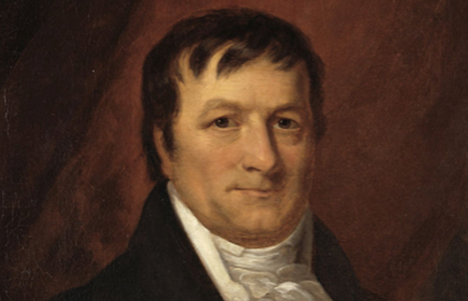
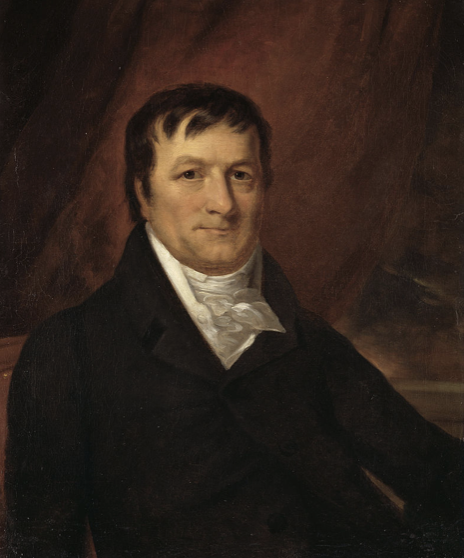
We don’t often write about American business leaders of the 19th Century, most of whom are not the subject of classroom study or popular history books. If they are studied at all, it’s often the case that they are stereotyped as greedy “fat cats” who mistreated their workers or schemed to defraud the public (or both). Of course, history is more complicated than that, and the life stories of these business leaders are far more nuanced, and far more interesting. In fact, a number of them made an enormous impact on the course of American history. One example might be the “railroad barons” of the 1860’s, whose efforts gave rise to the trans-continental railway system. A much earlier example is the man we commemorate today— John Jacob Astor, who died this day on March 29, 1848.
John Jacob Astor was born in Germany to a father who ran a butcher shop. After working a few years for his father, at age 16 he went to England to work for his uncle in a factory producing pianos, flutes and other musical instruments. In 1783 he left for America at age 20. He quickly met and married Sarah Cox Todd, who was his landlord’s daughter. Over the course of the next fourteen years they had eight children, two of whom died in their first year of life, and a third died at age two. Sarah died in 1842 at the age of 80.
In the post-Revolutionary War era, many Americans looked west, where the fur trade beckoned. By the end of his first decade in America, Astor owned a fur goods shop in New York, and began his career as a businessman. Soon, he became a dominant figure in the fur trade, a major part of which was shipping furs from Canada and the Great Lakes region to New York City, then on to Europe. By 1800 he was wealthy and powerful, and he continued expanding his business interests to include China and the Far East. In 1808 he founded the American Fur Company, which extended its reach to the Pacific Coast. There, he established a trading post called Fort Astoria, and undertook an ambitious plan to monopolize the west coast and Asian fur trade. Various setbacks led to the collapse of Fort Astoria, but he soon bounced back when he shifted from fur trading to trading opium, mostly by smuggling opium from sources in the Ottoman Empire. Astor was nothing if not resilient. His American Fur Company continued to thrive into the 1820’s, and it was during those years that Astor began acquiring real estate in New York City. Ultimately, he sold the American Fur Company in order to invest in more and more real estate. His second career in real estate generated enormous profits, and his wealthy increased geometrically. When he died, he was the wealthiest man in America.
In his later years, Astor turned to philanthropy, and became one of the most prominent benefactor of various charities and cultural institutions. Among the most lasting of his charitable donations was the New York Public Library, to which he bequeathed $400,000 (a vast sum of money in those days). A number of place names are named after him, including the neighborhood in Queens New York called “Astoria,” the city block in Manhattan known as Astor Place, the town of Astor in Wisconsin, and various other examples. His name today is synonymous with wealth and power. Astor died on March 29, 1848, and is buried in Trinity Church in Manhattan. He outlived his wife by several years.
And so today we honor John Jacob Astor, one of the original American “captains of industry.”