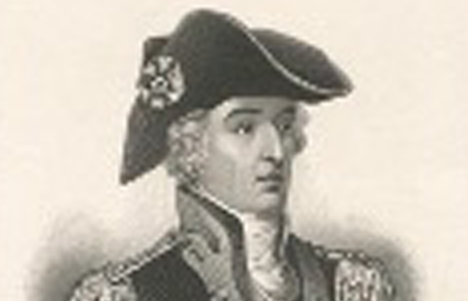
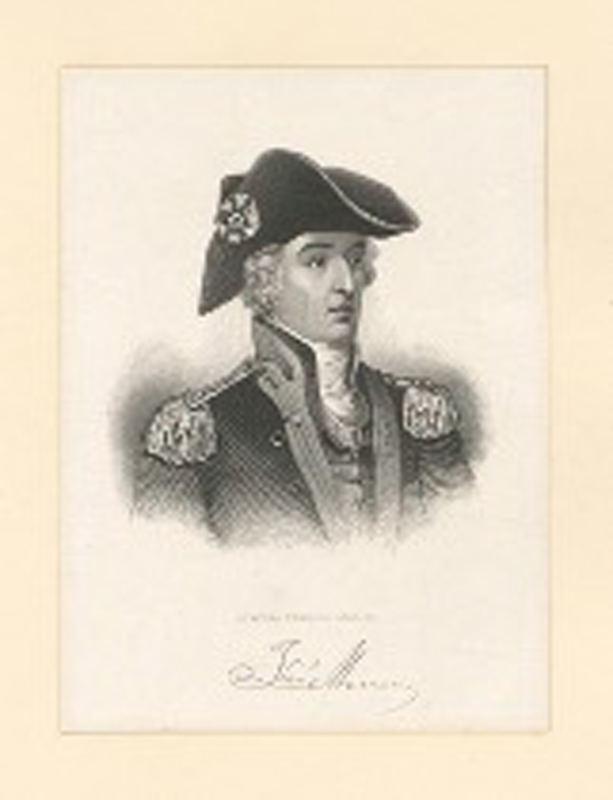
Our country’s Revolutionary War lasted eight years, from 1775 to 1783. Many historians contend that the War was won in no small part in a series of skirmishes and battles in the final years of the war in what is referred to as the “Southern Campaign,” culminating in the victory at Yorktown Virginia in October 1781. One of the principle actors in the Continental Army during the Southern Campaign was Francis Marion, known to his enemies as the “Swamp Fox” for his daring maneuvers in the swamps of the Carolinas. He died in South Carolina on this day on February 27, 1795 at the age of 63.
Marion was born to French Huguenot parents in 1732 on a plantation in South Carolina. By the age of 25 he was already an experienced soldier, having fought in the French & Indian War and the Anglo-Cherokee War. After the Revolutionary War commenced in April 1775, Marion was commissioned a captain in the South Carolina Regiment in June 1775. He was promoted to Lt. Colonel in the Continental Army in September 1776, and took part in several major battles, including the Siege of Savannah and the Siege of Charleston.
Marion’s military fame really began after a falling out between him and General Horatio Gates, the hero of the Battle of Saratoga. The two men did not get along, and right before the Battle of Camden in August 1780—the battle that would destroy Gates’ reputation—Marion was banished to the frontier areas of South Carolina, where he quickly put together what was to become a highly effective guerilla unit known as “Marion’s Men.” Over the course of the next two years, Marion and his men launched a series of surprise attacks against British forces and Loyalist sympathizers. From September 1780 to September 1782, Marion led at least a dozen major skirmishes and battles, in some cases going head-to-head with one of the British Army’s fiercest warriors, Colonel Banastre Tartleton. Historians say it was Tartleton who coined the nickname “Swamp Fox,” as Marion consistently escaped being captured by disappearing into the swamps with his men. In early 1781 he joined forces with General Nathanael Greene of the Continental Army, and fought under Greene’s command at the Battle of Eutaw Springs. By the end of the war, the Swamp Fox had become known as a legendary leader of men.
After the victory at Yorktown, Marion stepped away from his military career, and became a political leader in the South Carolina General Assembly, while rebuilding his plantation, Pond Bluff. He also married his cousin, Mary Esther Videau. After his death in 1795, his reputation continued to grow. Marion has been honored for his exploits in countless books, films and television shows, including Walt Disney’s The Swamp Fox. Some historians have criticized the hero-worship of Marion, contending that while Marion was certainly an effective military leader, he is not deserving of the kind of praise he has received. They point to his status as a slaveholder, and to the acts of violence he allegedly committed against Native-Americans, as reasons to question Marion’s reputation. These criticisms notwithstanding, the Swamp Fox continues to enjoy public acclaim, as reflected in the many monuments, statues, and other public tributes paid to him. And so today, we join the chorus of voices who commemorate the life of Francis Marion, one of the truly great warriors of the Revolutionary War, on this 230th anniversary of his death on February 27, 1795.