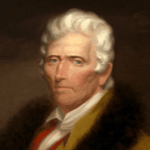
On this day in 1752, George Rogers Clark was born in Albermarle County, Virginia. Sometimes called the “Conqueror of the Old Northwest,” Clark was a brigadier general in the Revolutionary War, and engaged in a number of battles in the Northwest Territory, most notably the Siege of Ft. Sackville. After the war he served as a commander of U.S. military forces in the Northwest Indian War. His younger brother was William Clark, the famous co-leader of the Lewis & Clark Expedition.
Clark got his start as a major in the Kentucky militia at the start of the Revolutionary War. He was quickly identified as a leader of men, and was appointed to petition the Virginia government to make Kentucky an official district of Virginia. After the petition was granted, Clark and his men were charged with defending western settlements against British and Indian encroachments. Clark convinced his superiors to launch attacks against British posts in the Ohio River Valley. In 1778 he was given the title of Lt. colonel, and he led the attack on Kaskaskia on the Mississippi River in the Illinois Territory. Clark and his troops capture the town without firing a shot. Following this route, in 1779 Clark led his regiment against the British at Ft. Sackville, where he once again was victorious, and the British surrendered the fort. The following year, back in Kentucky, he stopped an advance by British and Indian forces. This string of victories led to Clark being named a brigadier general in 1781. Some historians have credited Clark’s victories in the Northwest Territory as one of the principal reasons that England surrendered the entire Territory to America in the Treaty of Paris in 1783.
Clark’s later life was troubled. He was described by many as an “Indian hater,” and he advocated the annihilation of all Indians occupying the Ohio Valley, including women and children. Constant warfare broke out between white settlers and Indian tribes, and in 1786, Clark led an expedition to attack Native American villages along the Wabash River. It was during this campaign that his troops mutinied, accusing him of public drunkenness and incompetence. His reputation was irrevocably tarnished, and he was forced to resign.
In Clark’s private life, he amassed huge debts which drove him into poverty, even though the Virginia government has granted him 150,000 acres of land as a reward for his military service. Clark defended himself against charges of financial fraud in an autobiography he published, but it was to no avail. His financial failures led him to joined the French Army as a Major General in 1793—but George Washington took quick action to stop France from commencing any military action, and he forced France to revoke Clark’s military commission.
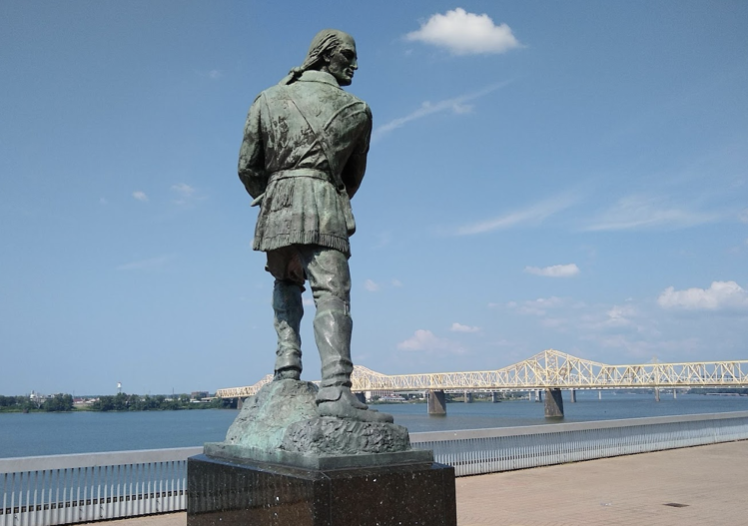
In 1809, after years of financial hardships and reputational damage, Clark suffered a stroke, fell into a burning fireplace, and had his leg amputated. Fortunately, his sister Lucy lived nearby, and she tended to him for several years. But Clark suffered a second stroke, and he died in semi-obscurity in 1818 at the age of 66. He was buried at Cave Hill Cemetery in Louisville, Kentucky. A massive statue of Clark stands on the waterfront in downtown Louisville, overlooking the Ohio River. On this day, we commemorate his life, and we thank him for his many contributions to America’s victory in the War of Independence.