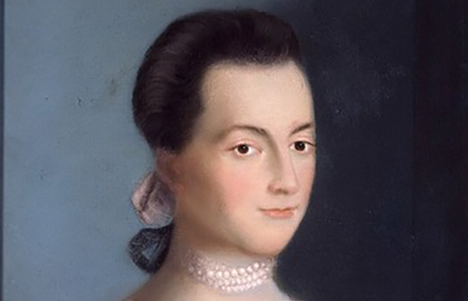
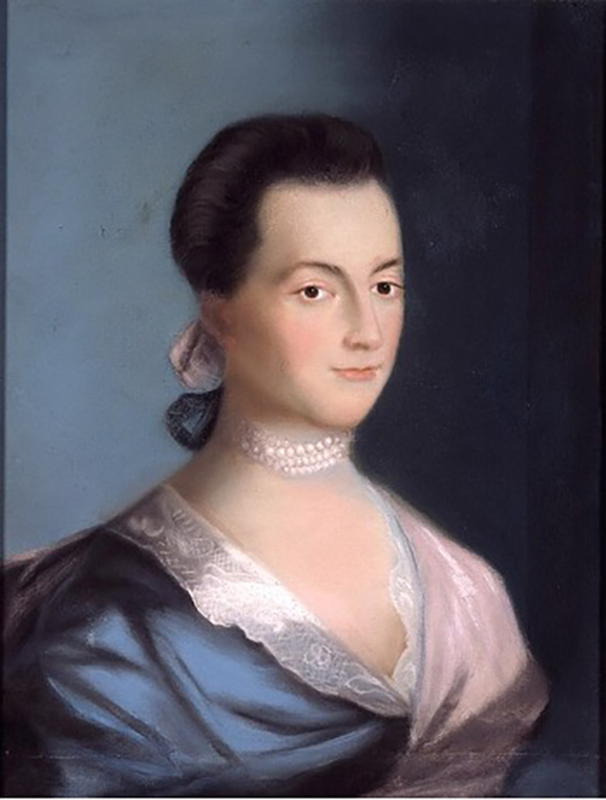
On this day in 1818, one of the pre-eminent women of the Revolutionary War era passed away in Quincy, Massachusetts—Abigail Adams, wife of Founding Father and President of the United States, John Adams. She first met John when she was fifteen years old. At the time, John was a practicing lawyer, a fact that Abigail’s mother frowned upon: she viewed him as not a sufficiently attractive “catch” for her daughter. John persisted in his courtship, however, and Abigail and John married in 1764. The couple immediately moved to Braintree, Massachusetts—now Quincy—where they maintained a household for the rest of their lives (with several interruptions when they lived in England and France during the time that John was serving as an ambassador). Their home still stands, and is open to the public at the Adams National Historical Park.
During their marriage of over 50 years, Abigail and John carried on a prodigious correspondence while John was serving in various political and diplomatic posts which often took him away from Quincy, sometimes for long periods of a time. The “Adams Family Papers,” now housed at the Massachusetts Historical Society, reveal Abigail to have been smart, assertive, and fiercely independent—often to a fault. Indeed, a number of modern historians have faulted her for her relentless criticisms of her children, and her domineering ways in their upbringing. Yet she instilled in them (or most of them) a strong love of country, and for that she is to be thanked.
Today, many Americans credit Abigail for being ahead of her time for her advocacy of women’s rights, at a time when American women were systematically relegated to subservient roles. Famously, she once wrote to her husband:
“Remember the ladies, and be more generous and favorable to them than your ancestors. Do not put such unlimited power into the hands of Husbands. Remember all Men would be tyrants if they could. If particular care and attention is not paid to the Ladies, we are determined to foment a Rebellion, and will not hold ourselves bound by any Laws in which we have no voice, or Representation.”
An example of Abigail’s “walking the walk” was her hands-on oversight of the family’s fortunes. She ran the farming operations at their home in Quincy, maintained the household (including servants), monitored their financial investments, and generally kept the Adams family ship afloat. John gladly delegated these responsibilities to her, and trusted her judgment in handling the family’s affairs.
Despite Abigail’s complaints that women in general were not receiving equal treatment, she herself was anything but subservient. She served as John’s sounding-board throughout the Revolutionary War period, and also during her husband’s presidency, giving advice to him—whether John asked for it or not—on the political issues of the day. She also corresponded with a number of other political leaders of that era, including Thomas Jefferson: the two of them maintained a close friendship until the 1790’s, when Jefferson and Adams became political opponents during John’s presidency. The political estrangement between Adams and Jefferson lasted until the 1720’s, when Abigail intervened and brokered a truce between the two of them. Abigail also maintained a close friendship with another prominent Massachusetts woman, Mercy Otis Warren, who herself became well known for her political writings. The two of them exchanged many letters in which them commented on the political issues of the day, and much of that correspondence has been preserved.
During her time as First Lady, Abigail was responsible for at least one “first”: she was the first presidential wife to live in what became known as the White House. At the time, the White House was unfinished, and she poured her energies into making the “People’s House” habitable. Even before they moved to Washington D.C., Abigail was a frequent hostess of social events at the Adams’ residence, where political leaders and their wives mingled. She continued that pattern when the nation’s capitol was moved from Philadelphia to Washington D.C. (Abigail was later eclipsed by future First Lady, Dolley Madison, who has gone down in history as the “hostess with the mostest”).
Abigail lived to the age of 73, but she did not outlive her husband. She died on October 28, 1818. Nor did she live to see her son John Quincy elected President of the United States in 1820. She died at home in Quincy from typhoid fever, and is buried in the cemetery of the United First Parish Church in Quincy. Husband John joined her there when he passed away eight years later on July 4, 2026, and he is buried at her side.
Abigail is honored with a number of place names, memorials and monuments in Massachusetts, New Hampshire and elsewhere. A bronze statue of her was erected in 2003 Boston, and another statue was erected in 2022 in Quincy on the grounds of the “Hancock-Adams Common.” Today we also honor her, one of the leading women of her time, who died this day on October 28, 1818.