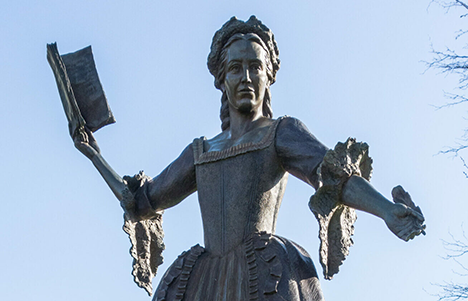
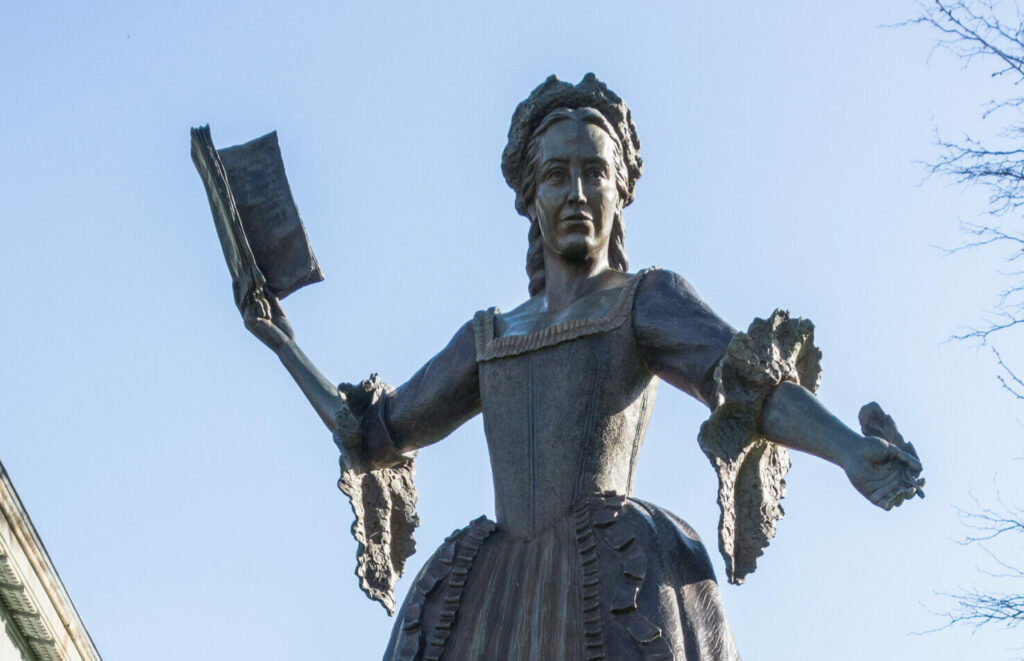
We’ve posted several stories in the past year honoring women who have figured prominently in American history. Today, we honor the memory of Mercy Otis Warren, who was born on September 25, 1728, and who became one of the unsung patriots of the American Revolution.
Most Americans have never heard of Mercy Otis Warren, but in the era of the American Revolution and the first few decades of our Republic, she was a major figure in American political life. She was a friend of many of the Founding fathers, including John Adams, Samuel Adams, and George Washington, and she was a long-time correspondent with John Hancock, Patrick Henry, and Thomas Jefferson. It was at her home that patriot leaders sometimes met, and she became a member of the “inner circle” of the Massachusetts colonists who plotted the course of the rebellion. She was one of only a handful of females who was accepted into this prominent group of men who led the rebellion.

Although Mercy had no formal education, she was a gifted and articulate author. Abigail Adams paid her high praise when she wrote that “God almighty has entrusted her with the Powers for the good of the World.” Beginning in 1772, Mercy began writing plays, poems, and stories containing sharp criticisms of the English political leaders in Massachusetts, especially Governor Thomas Hutchinson. Some historians credit her writings as being a major cause of Hutchinson’s removal from office. Mercy continued writing hard-hitting pieces after the war, including Observations on the New Constitution in 1788. She, like many other patriot leaders like her friend Samuel Adams, opposed the new Constitution as taking away the rights of the people, and imposing a new federal government that would undermine the core principles upon which the Revolution was fought. She ultimately became a critic of men like John Adams and Alexander Hamilton who were pushing for a powerful centralized federal government. For the same reasons, she was a strong supporter of Thomas Jefferson and the Anti-federalists. During Jefferson’s Presidency, she published the History of the Rise Progress and Termination of the American Revolution, in which she voiced some of these Anti-federalist views.
Finally, a few words are in order about Mercy’s husband, James Warren, and her brother James Otis, Jr. James Warren was a member of the Massachusetts House of Representatives during the turbulent years leading up to the Revolution. He became speaker of the House, and later the president of the Massachusetts Provincial Congress. As for Mercy’s brother James, he was a member of the Massachusetts Committee of Correspondence, one of the key rebel groups opposing the Crown’s increasingly harsh laws. When war broke out, James became the paymaster of the Continental Army. No doubt taking a queue from her husband and brother, Mercy became a committed patriot.
A Mayflower descendant, Mercy dedicated her life to fighting for the rights of the American people. In 2002, she was posthumously inducted into the National Women’s Hall of Fame. She died in 1814 at the age of 86, and is buried in Plymouth, Massachusetts. Today we honor her as one of the strongest female voices in early American history.