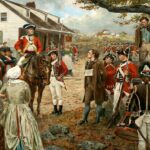
Last month, the nation commemorated the 250th anniversary of the Battle of Lexington & Concord—the “Shot Heard Round the World.” The battle was mostly fought by militia men from neighboring towns; there was no American army as we think of that concept today. Following the battle, the American colonists did not immediately declare war on England; the immediate aftermath was the Siege of Boston. But still there was no centralized American government to make decisions on whether to go to war. And there was no army to do so. All of that was to change in a matter of weeks.
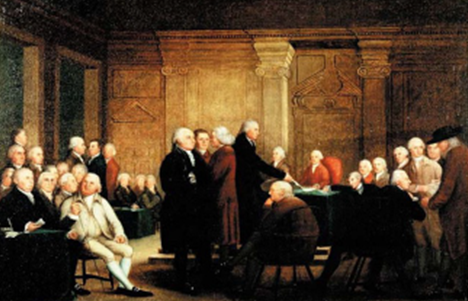
What happened the following month was a major event in the history of the Revolution— the gathering in May 1775 of delegates to the Second Continental Congress, which convened on May 10 in Philadelphia. The men who attended the Congress included political leaders from nine American colonies (Vermont was not yet a colony; Maine was a district of Massachusetts; and Georgia did not attend initially). From Massachusetts, the delegates included Samuel Adams and John Hancock, who had been the targets of the British army that marched on Lexington & Concord in April, with orders to arrest them. Fortunately, Adams and Hancock had escaped, however, and headed straight for Philadelphia. Other attendees included men who would go on to become Founding Fathers of our constitutional republic: Benjamin Franklin, Thomas Jefferson, John Adams, John Jay, and Roger Sherman, to name a few. All of these men were risking their lives and fortunes in attending the Congress, as the creation of the Second Continental Congress was, in the minds of King George III and Parliament, treason.
It is miraculous that the details of the proceedings of the Congress were carefully recorded, so that 250 years later we can read the day-by-day, blow-by-blow deliberations that took place in those history-making sessions. You can read all those details in the Journals of the Continental Congress, 1774- 1789 (vol. II), available on archive.org. From the Journals, we know that on June 14, the Second Continental Congress created the Continental Army, and that George Washington was appointed Commander-in-Chief the next day. We also know that on July 6, the Congress issued its “Declaration of the Causes and Necessity of Taking Up Arms,” which laid out the case for going to war—another treasonous action. On July 8, the delegates signed the so-called “Olive Branch Petition” to King George, a final effort to avoid war; but the petition was preceded by a highly contentious debate on whether to send such a petition at all, as many of the delegates believed that it would be viewed by King George as a sign of weakness. Indeed, in his diary, John Adams called it “this Measure of Imbecility, the second Petition to the King [which] embarrassed every Exertion of Congress.” As it turned out, King George refused even to read the petition; instead, on August 23 he issued his “Proclamation for Suppressing Rebellion and Sedition,” effectively declaring war on the American colonies.
The Second Continental Congress remained the main political body of the American rebels for the next six years. John Hancock became the President of the Congress on May 24, 1775, and he remained in that post until the end of October 1777. In the month after Hancock stepped down, the Congress adopted the Articles of Confederation in November 1777, the precursor of the U.S. Constitution (which was not enacted until a dozen years later in 1789). While many political and military leaders viewed the Articles as toothless, the Articles nevertheless represented the very first effort of the thirteen colonies to come together as one body politic, and to form what they called the United Colonies (the phrase that was printed on the new “Continental Currency” issued beginning in May 1775).
So, this month we commemorate the founding of the Second Continental Congress. The decisions made at the Congress’ sessions over the summer of 1775 were momentous, and set the country on the path to war.