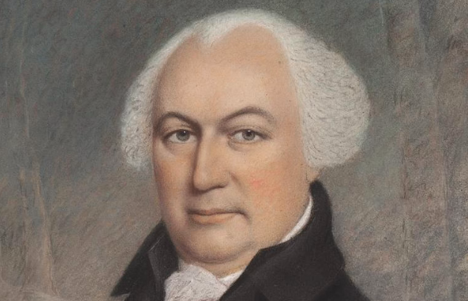
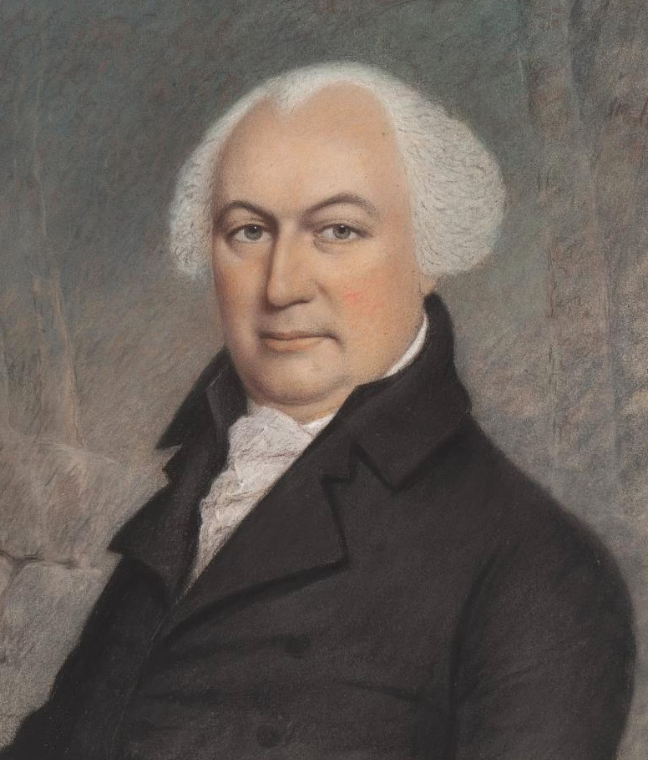
A Founding Father. A member of the Continental Congress and a signatory to the U.S. Constitution. A Senator for the State of New York. A Minister to France. And yes, the man who coined the most famous three words in our Constitution: “We the People.” The man was Gouverneur Morris, a leading politician of the Revolutionary War era, who died this day on November 6, 1816.
Morris was born in New York and remained a New Yorker for much of his adult life, including during the war years when New York City was occupied by British troops, and the state itself contained a large number of “Loyalists,” that is, people who were loyal to the Crown (including his mother and several other family members). While his first name means “Governor” in French, he was actually named for his mother, Sarah Gouverneur. Morris was only 23 years old when he was first elected to the New York Provincial Congress in May 1775, just weeks after the battles of Lexington and Concord.
Morris was a vocal advocate for the cause of independence, a fact that led to his appointment as a member of the Continental Congress in January 1778, a week before the United States and France entered into the Treaty of Alliance, and France formally entered the war as an ally of the Americans. While Morris only served in the Continental Congress for a short while, he went on to become an advocate for a strong central government, which invariably explains his becoming a delegate to the Constitutional Convention in 1787. By then, he was living in Philadelphia and represented that state in the Convention. He played a major role in the drafting of the Constitution and is said by most historians to be the author of the preamble, with its iconic first three words, “We the People.” He was one of the most vocal delegates during the proceedings, speaking frequently and fighting for language that would guarantee a strong federal government (which came to pass, with the aid of fellow delegates James Madison, Alexander Hamilton, and other delegates who later formed the core of the “Federalist” party)
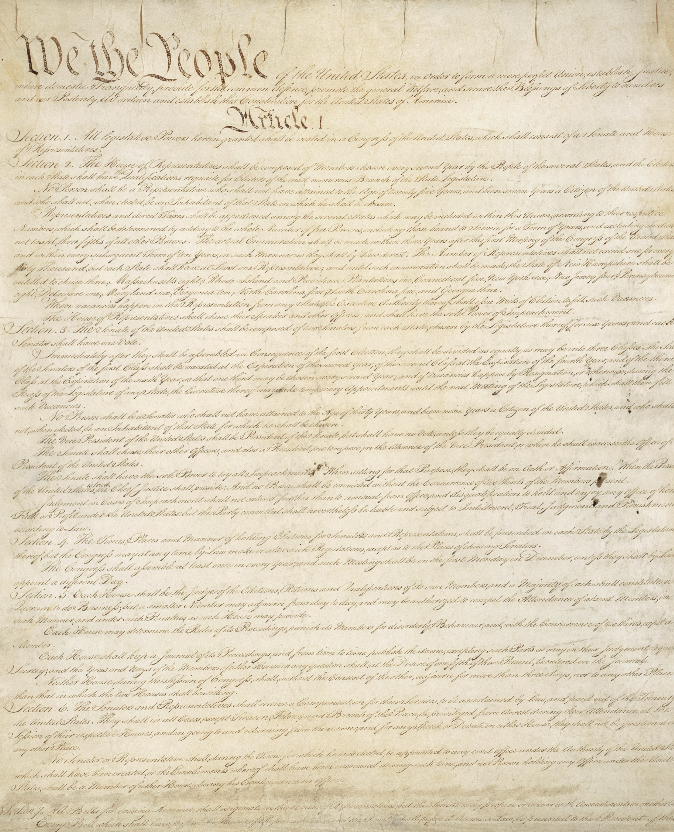
It must be said that not all of Morris’ positions were well received, especially his stance on slavery. Morris attacked the institution of slavery, and sought to have the Constitution make it unlawful. This was anathema to the Southern states, and his efforts came to naught. The end result of the debates was to adopt the notorious “three-fifths rule,” counting slaves as three-fifths of a person for purposes of determining the number of representatives from the individual states who would be seated in the Congress. Holding his nose, perhaps, Morris ultimately voted to approve the Constitution and became one of its signers.
While it was bad enough for Morris to live through the contentious debates over the drafting and passage of the Constitution, in the following years Morris found himself in France, serving as a “Minister Plenipotentiary” for the United States during the French Revolution, where he was witness to the tragic violence in the streets of Paris and the execution of the King and Queen of France. From his first-hand experiences, he had little tolerance for Thomas Jefferson (his future boss), who was a supporter of the French Revolution notwithstanding the horrific events that took place during the “Reign of Terror.” Morris stepped down from his post in disgust and returned to America in April 1794, just before the Reign of Terror ended in July 1794.
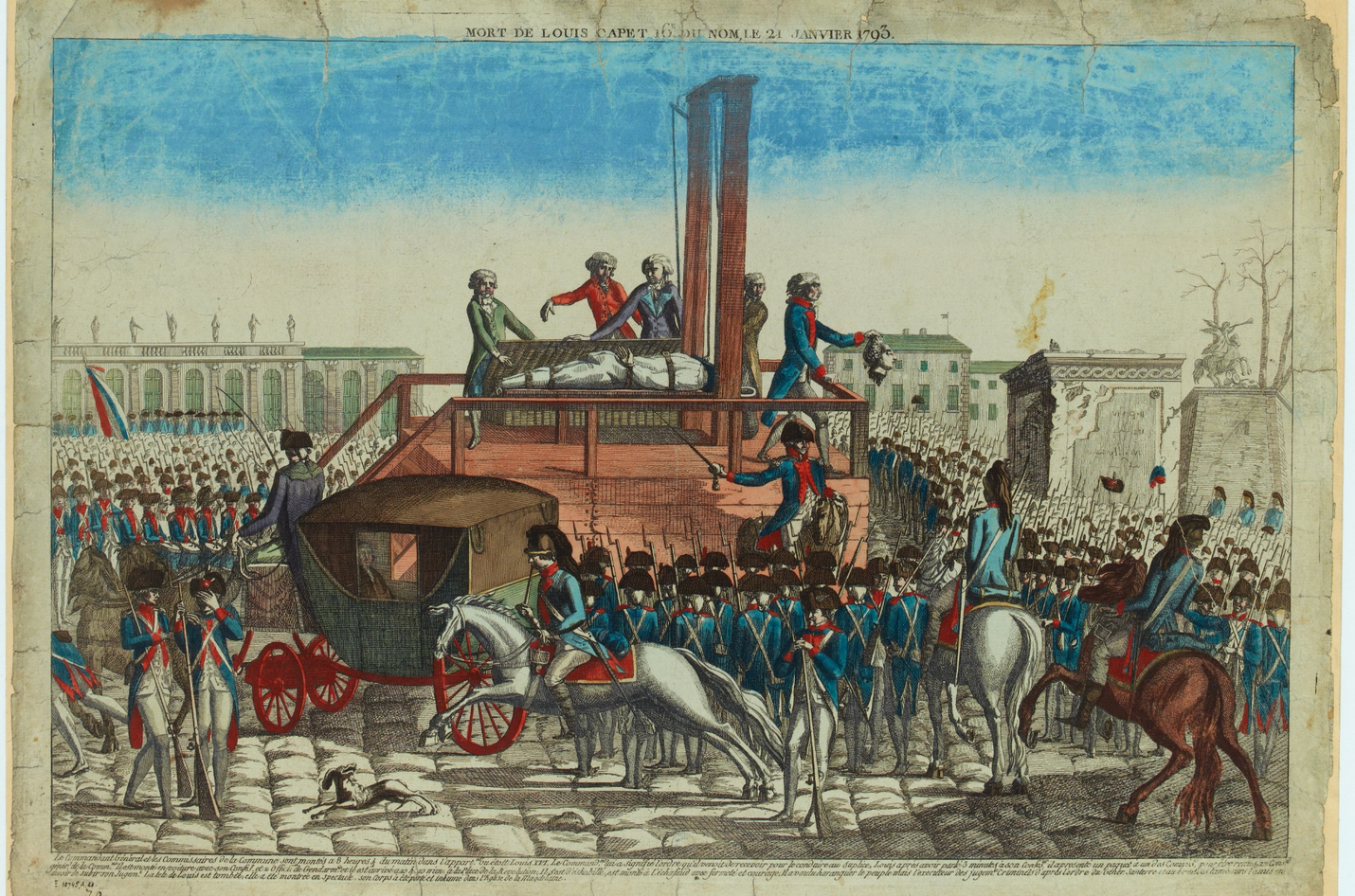
The execution of King Louis XVI at the Place de la Révolution in Paris on January 21, 1793. Gouverneur Morris, then serving as U.S. minister to France, witnessed the execution.
Returning to New York, Morris was elected a Senator and served in that capacity from 1800 to 1803, during the first term of President Jefferson. After stepping away from national politics, he lived another 13 years, during which he held various positions, including serving as Chairman of the Erie Canal Commission. He did not live to see the canal’s completion in 1825, but he played a central role in the formative years of the project to build it.
Morris became a family man late in life when, in 1809, he married Ann Cary Randolph, who was his housekeeper. They had one son, Gouverneur Morris, Jr., and by all accounts it was a happy marriage. Morris played an instrumental role in the founding of our country, and for that we honor him today on the 210th anniversary of his death on November 6, 1816.
Images
- Cover: Gouverneur Morris, James Sharples, 1810. Pastel on paper. National Portrait Gallery, Smithsonian Institution
- Constitution of the United States, 1787. National Archives, Washington, D.C.
- Anonymous artist, Mort de Louis Capet 16e du nom, le 21 janvier 1793, 1793. Etching. Musée Carnavalet – Histoire de Paris, Paris.
Further Reading
- National Archives. “Gouverneur Morris.” America’s Founding Fathers: Delegates to the Constitutional Convention.
- National Constitution Center. “Gouverneur Morris: Constitutional Convention Speeches, July 5 and 11 and Aug. 8, 1787.”
- George Washington’s Mount Vernon. “Gouverneur Morris.” Digital Encyclopedia.
- Online Library of Liberty. “The Diary and Letters of Gouverneur Morris (2 vols.).”* Edited by Anne Cary Morris.