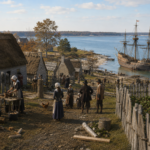
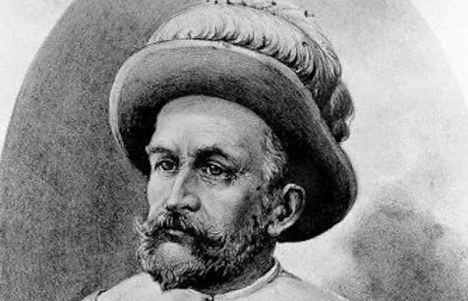
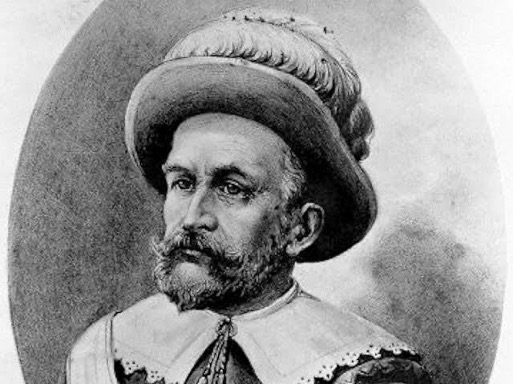
Most of us have heard the legend of Peter Minuit, who is said to have purchased the island of Manhattan from the Indians for $24. Well, the story is largely true, and I’ll talk about it below. It was on May 4, 1626— 400 years ago today—that he arrived in New Netherland, and quickly proceeded to close a deal with the Native-Americans to transfer of ownership of Manhattan to the Dutch. Or did it?
Born in about 1580, Peter Minuit was of German extraction, whose family lived in Wesel, Germany. His surname was French. In his twenties, Minuit married Gertrude Raedts and moved to the Netherlands in 1625. He was successful in business: in the 1620’s he became a member of the Dutch West India Company, and in 1626 he was appointed to serve as the Director of the Colony of New Netherland. He sailed there that same year, arriving on May 4.
It took a “New York second” for Minuit to see the value of the island of Manhattan, and he immediately went to work to negotiate a transaction with the Native-Americans who populated the region by which the Dutch settlement would “purchase” Manhattan using trade goods as the currency for the payment. What did they pay? According to a letter sent back to the Netherlands by a member of the Dutch East India Company, the trade goods were valued at 60 guilders, which translates to not more than about $24. The value today might be as much as @ $2,000, but still a trivial amount. The letter in question is the only evidence of the deal that was struck, but it has been accepted by most modern historians as a true account of what happened.
But what did the “purchase” actually mean to the Native-Americans who entered into the agreement? There is no first-hand account, of course, but Native-American culture in the 17th century suggests that the Indians had a fundamentally different understanding of what land was—it was not something to be owned, but to be shared, preserved and protected. The history of American expansion over the next several centuries is replete with examples of Indian land grants and deeds that purported to sell their lands, but in retrospect, the Native-Americans entering into these bargains had no conception that they were selling their native lands, much less that they were agreeing to remove themselves from those areas. This total disconnect between the understandings of European settlers and Native-Americans is one of the great tragedies of American history.
Minuit’s tenure as Director of New Netherland was short-lived. He served from 1626 to mid-1632, when he was recalled to the Netherlands and then summarily dismissed amidst allegations of corruption. Yet, under his leadership the Colony had grown to some 300 souls by the time he returned to the Netherlands. Minuit left behind a community that was socially and economically thriving. Minuit moved on to other business endeavors, including the development of a Swedish colony on the Delaware River called “New Sweden.” Minuit spent time at this Colony, and helped the colonists develop trade relations with merchants in the West Indies. It was during a voyage to St. Kitts that the vessel on which he was sailing was lost at sea in 1638.
Minuit has been memorialized in many ways, including having his name attached to various parks, schools, buildings and other structures. He also has been the subject of a number of films, television shows, and songs. His story has become the stuff of legend, and so we honor his memory on the anniversary of his arrival in New Netherland, 400 years ago today.