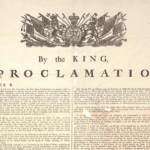
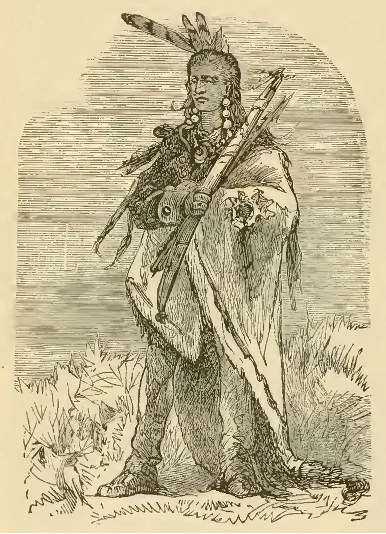
I’ve written before about the French & Indian War, which for several complicated reasons became a major cause of the American Revolution. Another thing it caused was a major upheaval in the British American colonies’ relations with Native-Americans, most prominently in the western territories that France had controlled, but which became English territories when the war was concluded— and technically off limits to further American expansion under King George III’s “Proclamation of 1763.” As had been true for a century, however, white settlers ignored the British government’s restrictions on western expansion. One area the colonists continued to occupy was the Great Lakes region, home to a number of Native-American tribes (the Chippewas, Miami, and Catawba tribes, among others). One such tribe, the Odawas, lived in the area of present-day Detroit. At the end of the French & Indian War In 1763, the British maintained a major military force there at Fort Detroit.
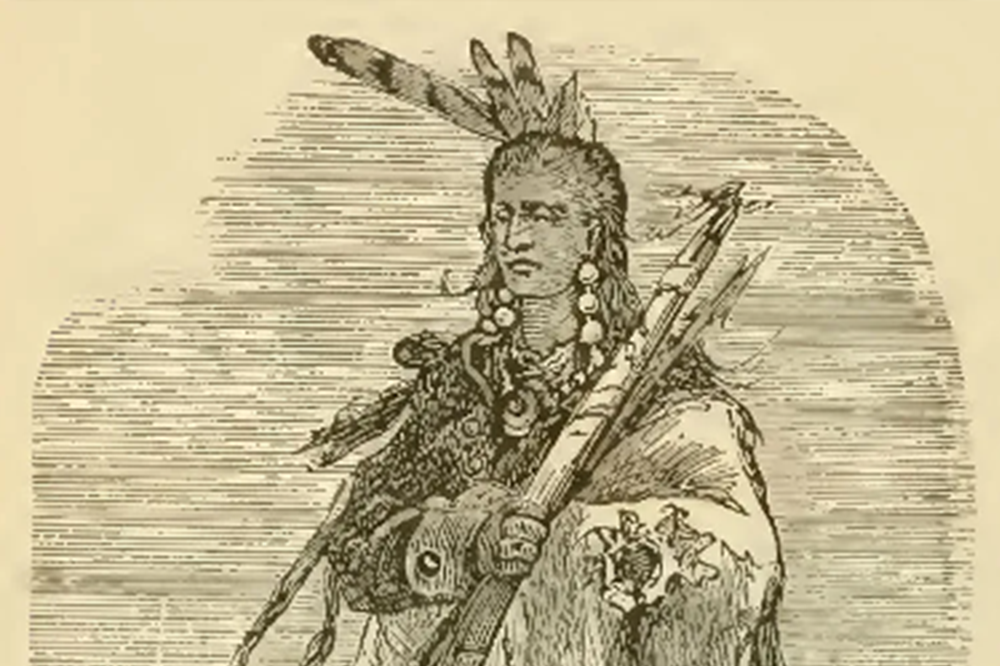
The Odawas were not alone in seeing their homelands being settled by English settlers in alarming numbers, and threatening their way of life. This was happening all over the territory between the Appalachian Mountains and the Mississippi River, with increasingly violent confrontations. What was unique about the Odawas was their leader, a man named Pontiac (or, Obwaandi’eyaag). Born between 1712 and 1725, the man the English called Pontiac was perhaps of mixed Indian blood, as some historians have speculated that his mother may have been Chippewa and his father Odawa. Whatever the case, Pontiac married in 1716 and he and his wife had three children. Over the next two decades, family life was set aside as tensions mounted with the English. Pontiac emerged as a warrior, and he soon became known to other tribes as a fearless leader. His notoriety caused the English to target Pontiac as an enemy who needed to be taken down. At the same time, the French, whose troops were also present in the Great Lakes area, became an ally of Pontiac. When the French & Indian War erupted in 1754 (part of the global “Seven Years’ War”), Pontiac fought alongside French troops, and therefore on the losing side of the war.
At the conclusion of the French & Indian War, the Odawas mistakenly thought peace would now prevail. On their side, the British made a fatal misstep by deciding to build another military garrison at Fort Sandusky, and to take other actions that were viewed as unfriendly towards the defeated tribes, if not openly hostile. Seeing the handwriting on the wall, Pontiac reached out to other tribes of the First Nations, seeking to form an alliance and to reclaim their ancestral lands– by force if necessary. In a meeting of Indian leaders he convened in April 1763, Pontiac is quoted as saying “we must all swear their destruction and wait no longer.” Showing his disdain for the white settlers who were invading his native lands, Pontiac labeled them “a proud, imperious, churlish, haughty Band.”
And so it was perhaps inevitable that Pontiac would rally his warriors and commence a frontier war against the well-trained and well-armed British army, and the defenseless settlers who had planted themselves there. The first attack targeted one of the most strategic garrisons of the British army: Fort Detroit itself. The attack evolved into a protracted siege, with Pontiac’s warriors now supplemented by hundreds of additional warriors from other tribes. Meanwhile, Pontiac sent messages to tribal leaders elsewhere in the Ohio Valley, which led to a series of battles, including an attack on Ft. Sandusky and the Battle of Bloody Run.
Over the next three years, Pontiac’s War expanded across the Ohio Territory, as did Pontiac’s name and reputation. Ultimately, on July 25, 1766, Pontiac sat down with his British counter-part, Sir William Johnson, who was the British Superintendent of Indian Affairs, and they negotiated a truce; perhaps not a lasting one, but a truce nonetheless.
The end of Pontiac’s War was the culmination of Pontiac’s rise to power, and over the ensuing years, his power rapidly faded, while resentments over his alleged arrogance increased. Finally, in May 1768 he advised the British that he was no longer in power. A year later, Pontiac was assassinated by an unnamed warrior of another tribe, the Peorias, who is said to have murdered Pontiac as an act of revenge for Pontiac’s alleged murder of the assailant’s uncle. Gruesomely, Pontiac was clubbed and stabbed to death. Some historians say that a retaliatory war against the Peorias then broke out, but other historians discount this story. Pontiac may or may not have been buried near today’s St. Louis, but no hard evidence exists to support this. Nevertheless, the Daughters of the American Revolution installed a plaque in honor of Pontiac in St. Louis in 1900.
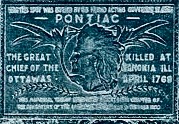
And so, today we honor the memory of Pontiac, a prominent Indian leader and warrior who fought for his people against the mightiest Empire in the world. He was murdered this day on April 20, 1769.