When people think of Highland warriors, they often imagine Scotland’s misty glens, tartan, and the Jacobite rebellions. Yet one of the final Highland charges in history took place not in the Highlands, but in North Carolina during the American Revolution.
In 1774, Flora Macdonald — the legendary woman who helped Bonnie Prince Charlie escape after Culloden — immigrated to the Cape Fear region with her husband, Allan Macdonald. They joined a thriving Gaelic-speaking community of Highland settlers who had crossed the Atlantic seeking opportunity while preserving their culture. When the colonies rebelled against Britain, the Macdonalds remained loyal to the Crown. Allan became second‑in‑command of a Highland Loyalist militia led by his cousin, Brigadier Donald Macdonald.
The British authorities instructed the Macdonalds to rally all Loyalist Highlanders to the royal standard at Cross Creek. Their appeal resonated deeply. Between 1,500 and 3,000 Highlanders — MacDonalds, MacLeods, Mackenzies, MacRaes, MacLeans, MacKays, and MacLachlans — assembled in full Highland fashion. They marched in tartan, spoke Gaelic, and kept step to the sound of bagpipes, carrying forward centuries of martial tradition.
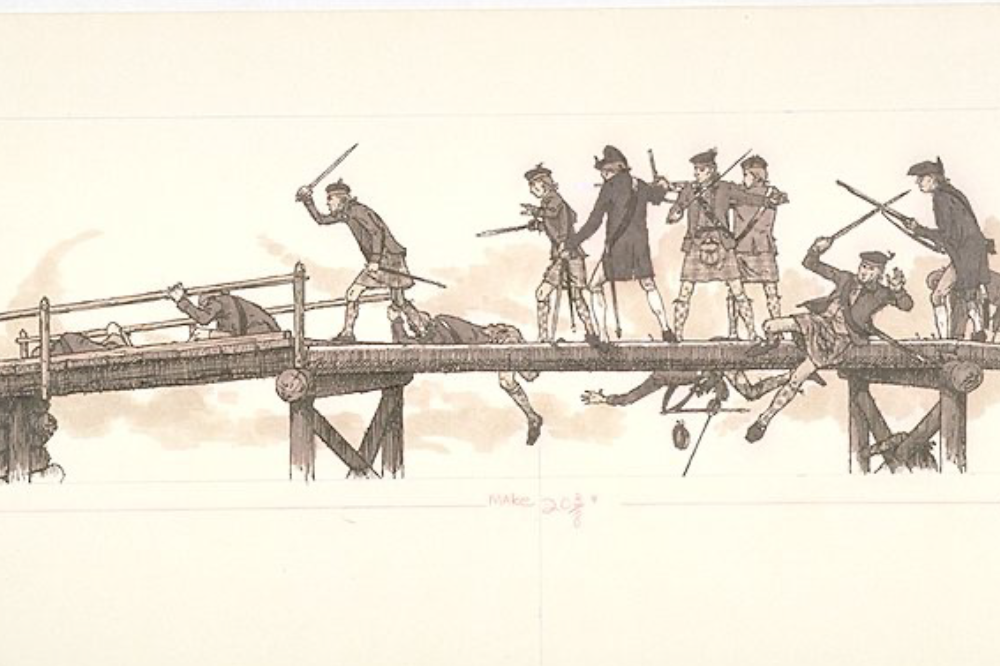
On February 27, 1776, this Highland force confronted an entrenched Patriot army at Moore’s Creek Bridge. Before the battle, Flora Macdonald offered a traditional Gaelic blessing to the men — a ritual that echoed generations of Highland warriors going off to war. As the Highlanders advanced across a partially dismantled bridge, Brigadier Donald Macdonald raised his claymore and shouted the Gaelic battle cry: “King George and Broadswords!” The pipes screamed, the clans surged forward, and the last Highland charge began.
It ended almost immediately.
The Patriots, well aware of the Highlanders’ fearsome reputation in close combat, had hidden artillery and muskets in the surrounding brush. As the Highlanders crowded onto the narrow bridge, American fire tore through their ranks. Donald Macdonald fell first, riddled with musket balls and swan shot. The Highlanders pushed to within feet of the Patriot line, but the charge collapsed under overwhelming firepower. A battlefield tactic that had carried Highland armies to victory for centuries was never used again.
Moore’s Creek marked the end of Highland warfare — but not the end of the Highland story in North America.
When the Revolution ended in 1783, most Loyalist Highlanders faced reprisals and were forced to flee once more. Many resettled in British North America, especially in Glengarry, Quebec, Nova Scotia, and Cape Breton — the latter so harsh it earned the nickname “Nova Scarcity.” A few, like Allan and Flora Macdonald, eventually returned to Scotland. But most remained in North America, where their descendants helped shape the emerging Canadian nation. Canada’s first two prime ministers — John A. Macdonald and Alexander Mackenzie — bore unmistakably Highland names.
Today, Highland games, Scottish festivals, and popular films have renewed interest in Gaelic culture. Yet the role of Highlanders in the American Revolution remains one of the most overlooked chapters in colonial history. The last Highland charge at Moore’s Creek stands as a powerful reminder of how far the Highland diaspora traveled — and how deeply their traditions shaped the early history of North America.