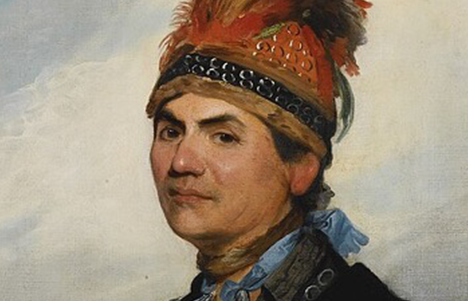
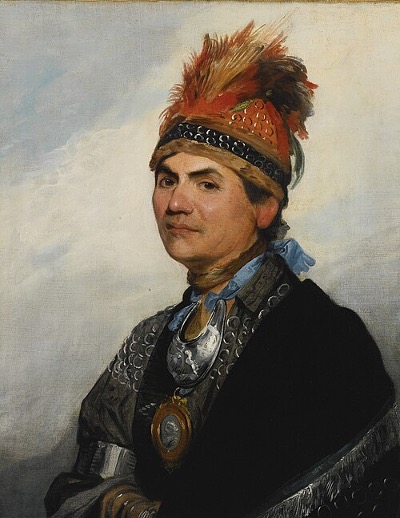
On November 24, 1807, one of the most famous Native-American warriors and political leaders of the 18th century died at the age of 64, after a life spent battling for the sovereignty of the Mohawk and Iroquois peoples, and fighting alongside the British Army against American “rebels” in the Revolutionary War.
Born in 1743, Joseph Brant’s Indian name was “Thayendanegea.” After his father died when he was a young boy, his mother Owandah (Margaret) became the wife of Brant Canagaranduncka, who had ties with a number of British and German business and political leaders in the area of upstate New York where Joseph grew up. His father’s relationships helped Joseph gain an education, and at a very early age Joseph spent time with a friend of his father, the British Superintendent of Indian Affairs, William Johnson. Under Johnson’s tutelage, Joseph was an observer at several meetings of Native-American and British leaders in the years leading up to the French & Indian Wars (1753-1763).
While still a teenager, Joseph became a warrior, and participated in several battles during the French & Indian War, fighting alongside British troops, most notably in the battle in 1760 in which the British Army seized Montreal from the French. From this he gained critical battlefield experience that he would later call upon when he went to war against Americans.
Joseph’s next major military endeavor was in 1764 in connection with Pontiac’s Rebellion, when he once again fought valiantly alongside British troops, but this time against many of his own people. Joseph was forced to take sides, and he sided with the British. After the Rebellion was suppressed, Joseph continued to live a somewhat English-style life: he was an adherent to the Anglican Church, he spoke fluent English, and he frequently served as an interpreter. By 1774, Joseph was identifiably “British,” and in the eyes of the American rebels, he was a hated “Loyalist.” When war broke out, Joseph moved to Canada, where he sought help from the British government to protect his people in exchange for his people’s support the British Army in the war effort. As part of this diplomacy, in November 1775 Joseph went to London, where he met with King George III, and was treated with tremendous respect. Joseph had become a political leader in his own right.
Joseph must have been convincing with King George, but he may have oversold the King on the degree to which he spoke for his own people. When Joseph returned to New York in mid-1776, he fought with the British Army in the Battle of Long Island. But Brant had yet to deliver the military support of his fellow Indian warriors. In fact, Brant initially made little headway in his efforts to recruit Indian soldiers to the cause, who had previously committed themselves to a policy of neutrality in the war. In an odd twist, however, Joseph was able to recruit white Loyalists to the cause, who became known as Brant’s Volunteers. It wasn’t until mid-1777 that the Six Nations ended their policy of neutrality, and most of the Six Nations’ warriors agreed to side with the British. They proceeded to fight alongside the British troops in the Siege of Fort Stanwix and the Battle of Oriskany in July 1777. These British victories came at a cost of a significant loss of life among the Indian forces, however, who had not bargained for that. In the meantime, many more American soldiers died in that battle.
Fierce fighting continued in 1778. Brant was heavily involved in the frontier wars in the Mohawk Valley in upstate New York, leading a number of attacks against American settlements, and otherwise engaging in highly successful “guerilla warfare” against the Americans, as well as against Indian tribes that had allied themselves with the rebels. In some cases, he was accused of leading attacks that he had not been involved in, but such was his reputation that he came to exemplify the “savage” Indian who thought nothing of committing massacres against American men, women and children. Yet a number of modern historians challenge the notion that Brant was a one-dimensional killer, and instead argue that he was sometimes compassionate in his dealings with his enemies. It is unarguable, however, that he was a warrior committed to defeating the American forces against whom he battled. In early 1779, he was made a Captain in the British Army. Later that year he was promoted to Colonel—but he was never told by his commanding officer, supposedly out of concern that the promotion would give offense to other Indian chiefs with whom the British were allied.
By mid-1779, General Washington had seen enough, and ordered General John Sullivan to mount an expedition to eradicate the threat that Brant and his forces posed. What came to be called the Sullivan Expedition was well planned and well executed, and Brant was roundly defeated by Sullivan’s troops at the Battle of Newton in August 1779. Brant survived, however, and he continued to attack American troops in multiple battles in 1780 to 1782, by which time, however, the British Army had been defeated at Yorktown, and the War was effectively winding down. In mid-1782, Brant was ordered to stand down from further hostilities, which enraged him—but without British support, Brant could not continue to fight. The subsequent Treaty of Paris did nothing to recognize the sacrifices Brant and his Indian warriors had made for the British war effort, and they were left abandoned and unprotected. The ultimate result, as we know, was that most of the Indian lands for which Brant had fought were taken over by the Americans, and formed into the Northwest Territory, a vast area to which many war veterans migrated, along with white settlers from New England and elsewhere.
After the war, Joseph continued to be a forceful leader for his people, and played a major role in negotiations with American political leaders over the complex issues arising from America’s western expansion. One outgrowth of those negotiations was the Treaty of Stanwix of 1784, a peace treaty by which certain Indian reservations were created, in exchange for the ceding of vast areas of former Indian land to the United States. Brant deplored the result, and he continued to work tirelessly to obtain better treatment—and better lands—for his people (many of whom had migrated to Canada after the war). He was able to reach an agreement that a large area of the Grand River Valley in Canada would be ceded to the Iroquois, and it was there that Brant build a house, and created the town of “Brant’s Town.” He is said to have lived “English-style” there. Some of the white soldiers of “Brant’s Volunteers” joined him at Brant’s Town as well.
In recognition of his personal contributions to the British war effort, in late 1785 Brant was granted a pension by the British government. Despite this, relations between Joseph and the British government soured over the next few years. In 1790, he found himself caught between England and America during the Northwest Indian War, serving as a negotiator between and among those two countries and the native tribes over how to resolve all the very complex territorial disputes that had arisen following the creation of the Northwest Territory. For his efforts, he was condemned by his own people for refusing to take up arms against their enemies. In 1792 George Washington invited him to travel to Philadelphia, where Brant was pushed hard to serve as a go-between with the hostile tribes (and perhaps receive substantial monetary rewards if he did). His efforts failed, and the Indian Wars continued—ending tragically with the Battle of Fallen Timbers in 1794.
Over the three decades we’ve described above, Joseph found time to marry three different women, and had several children. His third wife Catharine, whom he married in 1780, was of mixed-blood, with an Irish father and Indian mother. Both parents were political leaders in their own right, and Joseph gained significant political traction from his marriage to Catharine.
In the final decade of his life, Brant had largely withdrawn from the ongoing fight between his people and the U.S. government. In 1797 he openly declared that he would “never again take up the tomahawk against the United States.” He became embroiled in a series of disputes over his sales of lands along the Grand River, which came to a head in 1798, when the British Crown purchased 380,000 acres of Grand River lands from him. Brant intended to use the money to help his people, but more problems arose, and Brant was caught in the middle of a series of disputes over the disposition of his Grand River lands for the next several years.
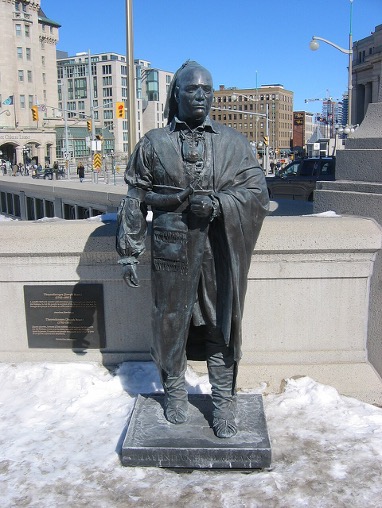
Joseph Brant died at home near Lake Ontario on November 24, 1807. He is remembered today with many buildings, streets and place names in Canada and the U.S. named in his honor, and a prominent statue of him can be found at the Valiants Memorial in Ottawa. He never achieved his dream of Native American independence, the preservation of Indian lands, or peaceful co-existence with white Americans. But his efforts will never be forgotten.