What modern historians call the “Indian Wars” most often is understood to refer to the late 19th century wars of the Great Plains, including major events like the Battle of Little Big Horn, the Battle of Wounded Knee, etc. But the history of “Indian Wars” extends back to the early 17th century, beginning with the infamous “Massacre of 1622” in Virginia, followed by many other major battles between white settlers and Native-Americans over the course of the next two centuries. Some of those wars have been long forgotten. A case in point is the Creek War of 1813-14, which culminated in the Battle of Horseshoe Bend in March 1814. While forgotten perhaps, this battle is consider to have led to the greatest number of Native-American battlefield deaths in American history, and led to the demise of the Creeks, a once proud Native-American nation.
What do we know about the Creek War, and about Horseshoe Bend? This was at first a civil war of sorts between two competing groups of Creek Indians, the “Upper” and “Lower” Creeks, who had long co-existed as the “Creek Confederacy.” The geographic scope of the Creek Confederacy was massive, covering much of today’s Alabama, Tennessee, and Georgia. The decline of the Creek Confederacy took place over a period of years in the first two decades of the 19th century, as the westward movement of white settlers increasingly encroached on Creek lands. The quest for new lands caused some Creeks to seek accommodation and assimilation, which we associate with Indians living in the “Lower Creek” region. By contrast, a faction of the Creek Confederacy, largely residing in the “Upper Creek” region, opposed assimilation, and rejected the ways of the white man. One major trigger for the internal strife between Upper and Lower Creeks was a series of cessions of large areas of land to the Americans in the last decade of the 18th century, much of it running along the western border of Georgia.
By the time of the outbreak of the War of 1812, radicalized “Upper Creeks” were ready to go to war to put a stop to any more western expansion. These warriors carried war clubs, often painted red, which led the white settlers to call them the “Red Sticks.” The name stuck, and today, stories about the Battle of Horseshoe Bend usually refer to the Indian combatants as the “Red Sticks.”
How did all of this relate to the War of 1812, if at all? As the war got underway, the main theaters of the war were Canada and the Chesapeake Bay, with the United States often defeated in battle or, in the case of Washington D.C., literally overrun by British troops (who proceeded to burn down the White House in 1814). Many U.S. government “war hawks” feared that the British would recruit the Creek Indians as allies in the war effort, and so state militias in Georgia, Alabama and Tennessee were mobilized. Over the period 1813-14, battle after battle between these militias and the Red Sticks was waged, with American troops largely unable to eradicate the threat of Indian attacks on innocent white settlers. In the process of these escalating wilderness battles, atrocities were committed on both sides, which only served to intensify the hatred between the warring parties (most notorious was the “Fort Mims Massacre,” which led to the deaths or capture of over 500 American soldiers and settlers).
While these battles were raging, American military commanders were pleading with the U.S. government to send troops and provisions to help the poorly-provisioned state militias continue to fight. But the U.S. War Department was feckless—it didn’t have the troops, or the money, to support the war effort, since the U.S. naval and military forces were busy fighting British troops elsewhere; President Madison chose to ignore the requests for help, telling the state governments that they were essentially on their own. And so, the state militias were left to wage war without adequate supplies of ammunition, food and clothing.
By the beginning of 1814, the Creek War had metastasized into a war of attrition. Enter Andrew Jackson, who was then a Major General in the Tennessee militia, and whose mission was to relentlessly take the battle to the Upper Creeks, where ever and whenever he could. While he himself was suffering from major wound received in previous battles, he led his troops into battle and imposed harsh discipline on his men, sometimes to the point of mutiny. Yet, he commanded respect from political leaders seeking to eliminate the “Indian problem” in the South, and he was given wide latitude to conduct military operations against the Red Sticks.
In January 1814, the War Department finally decided that it needed to provide Jackson with more support, and it ordered federal troops to travel west and join Jackson’s army (he was on the verge of seeing his army collapse as enlistments of his men expired and they proceeded to go home!). With this injection of thousands of well-trained and experienced troops, Jackson could now eradicate the Red Sticks forever—if he could find them.
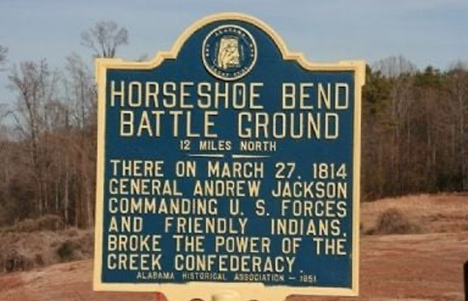
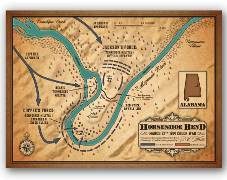
In March 1814, he found them: a large gathering of Red Stick warriors and their families, encamped on a peninsula of land on the Tallapoosa River known as “Horseshoe Bend.” As the map below shows, the Red Sticks had built a seemingly impregnable barricade around their encampment that was meant to withstand any attack by American troops. Even Andrew Jackson was impressed! His plan had been to bombard the barricade with cannon balls, but after several hours’ attempt, the barricade remained intact, and Jackson was flummoxed. But there was a fatal flaw in the Red Sticks’ fortifications: the land facing the river to the south was wide open, with no palisade, wall or other impediment to an attack from the rear. It was a friendly Cherokee Indian, Junaluska, who was fighting with Jackson’s army, who took the bold step of proposing that he swim across the river, capture some of the Red Sticks’ boats, and ferry American soldiers across the river to attack the Red Sticks from the rear. The strategy worked flawlessly, and the Americans overran the Red Sticks. What followed was a massacre: over 800 Red Stick warriors were killed, and hundreds were wounded or captured (not many of the latter). The leader of the Red Sticks, although gravely wounded, managed to escape, but his Red Stick army was crushed, and his Red Stick people were forced to flee for their lives.
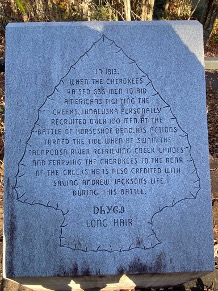
Andrew Jackson’s bold attack against the Red Sticks at Horseshoe Bend was a resounding success, and overnight he became a war hero back in Washington—the beginning of his rise to power and ultimately to his election to the Presidency of the United States. In the meantime, in his official reports, Jackson gave no real credit to Junaluska, whose tactical smarts were the driving force behind the American victory. Today, a monument pays tribute to Junaluska:
Why do we commemorate the Battle of Horseshoe Bend? Not for the “victory” itself, even though it effectively ended an otherwise costly and deadly war. We need to stop and take a moment to mourn the death of so many lives, on both sides of the conflict. Rightly or wrongly, the battle also led to the opening up of over 23 million acres of land to white settlement. That was the explicit result of the Treaty of Fort Jackson, signed on August 9, 1814, in which the Creeks ceded that amount of land in exchange for peace, and various other monetary consideration (including bribes, some historians say). The land cessions represented half of central Alabama and a large part of southern Georgia. Ironically, Junaluska’s people, the Cherokees, who had been strong allies of the Americans in the Creek War, were also forced to give up land as part of the Treaty—almost 2 million acres. One man who profited from the battle, and the resulting Treaty, was Andrew Jackson: he was promoted to Major General in the U.S. Army following execution of the Treaty. He went on to more fame and glory in the War of 1812, when he led troops to victory in the Battle of New Orleans in January 1815.