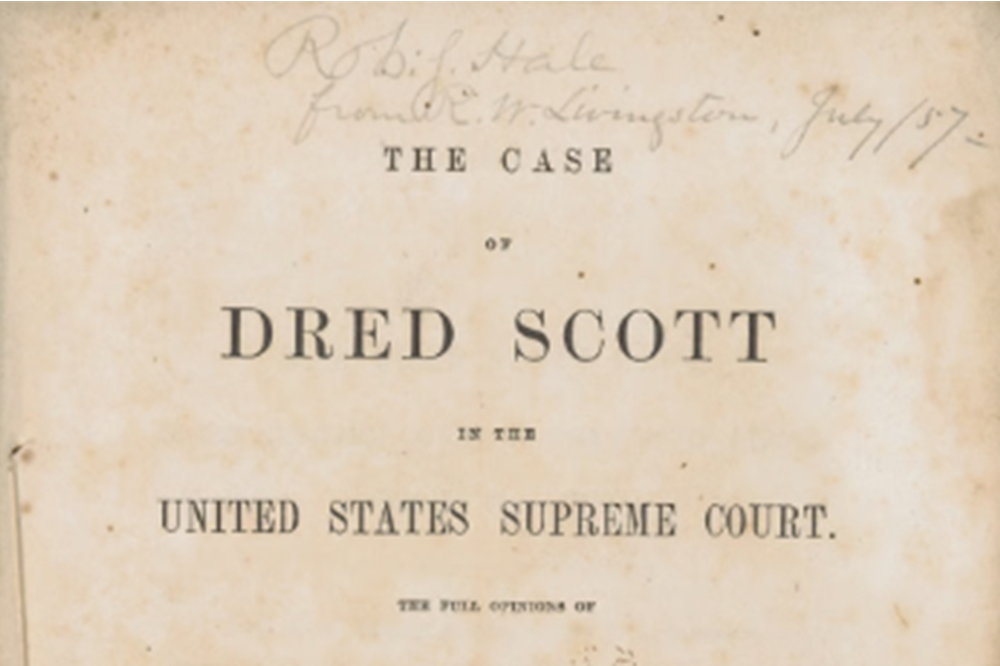
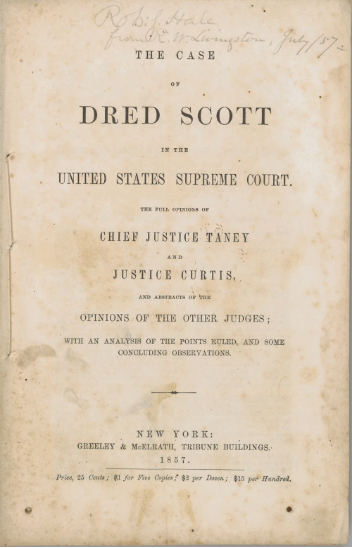
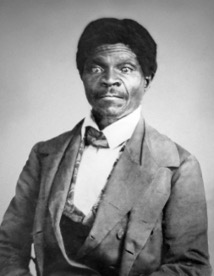
We’ve written several articles about the mounting tensions between the North and South during the first half of the 19th century, much of which turned on the question of whether the newly created western territories (by virtue of the Louisiana Purchase) would allow slavery, and whether new states admitted to the Union could allow slavery to exist within their borders. A driving force behind this debate was that the Southern “planters” who were heavily invested in cotton production using slave labor wanted to acquire and settle western lands and bring slaves with them. Naturally, the answer of many Northerners to the idea of allowing slavery anywhere outside of the existing Southern states—abolitionists in particular—was a resounding “no.” By the 1850’s, the demands of Southern slaveholders were loud and unyielding: slavery must be permitted, and any restriction on the movement of slaves into new territories was unconstitutional. Shockingly, on this day on March 6, 1857, the U.S. Supreme Court agreed, issuing a 7-2 decision against the petitioner, a black man by the name of Dred Scott.
Who was Dred Scott, what was his case about, and why has his name gone down in American history? He was a slave born in Virginia in about 1799, and was taken by his “master” Peter Blow to Alabama in 1818. Blow later moved to Missouri, where he sold Dred Scott to another slaveholder, Dr. John Emerson. Emerson then moved to the Wisconsin Territory, where slavery was prohibited under the terms of the “Missouri Compromise” of 1820. The Emerson family later returned to Missouri and was living in St. Louis in 1846, when Scott attempted to purchase his freedom. Mrs. Emerson (a widow by now) refused, and so Scott brought suit in the County Court in St. Louis in 1846. He lost the case in 1847, and he appealed. The case then entered a period of protracted appellate litigation, lasting until March 1852, when the Missouri Supreme Court issued a 2 to 1 decision holding that Dred Scott must remain a slave. The author of the Court’s opinion—Judge William Scott— acknowledged that for periods of time, Dred Scott had been taken by his master to states and territories where slavery was prohibited, and therefore in one sense Dred Scott had become free. But Judge Scott rejected the argument that “once free, always free”—when Dred Scott was taken back to Missouri, he reverted to slave status.
The tortured history of Scott’s court case did not end with the decision of the Missouri Supreme Court. The legal wrangling continued, and during this time Scott allegedly was sold to John Sanford, who became the named defendant in the case that ultimately found its way to the U.S. Supreme Court. Modern historians have questioned whether such a sale actually took place. Be that as it may, Dred Scott sued Sanford in federal court in 1853 seeking his freedom. A trial was held the following year, and Scott lost again. It was from this decision that Scott appealed all the way to the Supreme Court.
To say that the Supreme Court decision, issued on March 6, 1857, was controversial hardly does justice to the furor the decision triggered. The decision was a bombshell. The Court’s ruling, authored by Chief Justice Roger Taney, centered on the question whether a black slave could ever be entitled to citizenship under the U.S. Constitution. Sparing our readers the excruciating detail, Taney concluded that enslaved persons were never entitled to citizenship, on the frivolous theory that the Constitution’s use of the word “citizen” never contemplated enslaved persons being included within that definition. Taney argued that when the Constitution was enacted, blacks were a “subordinate and inferior class of beings who had been subjugated by the dominant race, and, whether emancipated or not, yet remained subject to their authority, and had no rights or privileges but such as those who held the power and the Government might choose to grant them.” Taney then proceeded to hold that the Missouri Compromise was itself unconstitutional—a ruling that many Northerners concluded went beyond the scope of the issues presented to the Court for decision, and therefore was non-binding.
After the ruling in Scott v. Sanford was released, the reaction was swift on both sides of the slavery debate. Southern slaveholders were elated, while Northern abolitionists were outraged. A year after the decision was handed down, the reaction was still so intense that the decision became a focal point of the famous debates between Abraham Lincoln and Stephen Douglas in 1858. It was left to one of the leaders of the anti-slavery movement, Frederick Douglass, to sum up the feelings of those who opposed slavery: he called the ruling a “scandalous tissue of lies.”
What became of Dred Scott? Miraculously, the son of Scott’s original master, Taylor Blow, freed him via “manumission” on May 26, 1857, just a few months after the court ruling. Scott did not have long to enjoy his freedom, however: he died of tuberculosis on November 7, 1858, just 18 months after finally achieving his freedom.