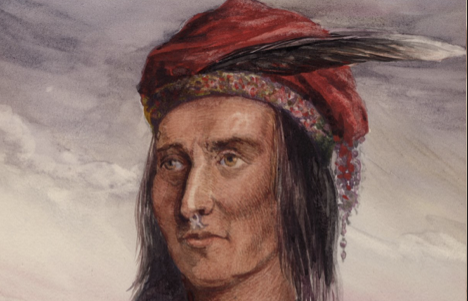
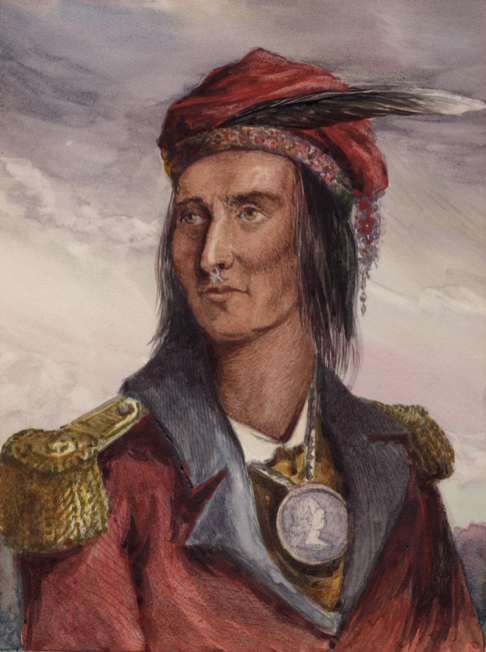
When people hear the name “Tecumseh,” most think of Civil War General William Tecumseh Sherman. Where did he get that name? Sherman’s middle name was taken from one of the greatest Native-American leaders of his time, Tecumseh, who died this day on October 5, 1813 at the age of about 45. Tecumseh was born and raised in what became the Ohio Territory, and was a member of the Shawnee tribe. Tecumseh’s father, Puckeshinwau, was a Shawnee chief, and was killed in the Battle of Point Pleasant in 1774. At the time of our Revolution, Tecumseh was not yet a warrior, but no doubt witnessed the war’s brutality: where Tecumseh and his mother were living was in the area that American General George Rogers Clark invaded and attacked Shawnee villages, killing men, women and children.
The treaty that ended the Revolution, the Treaty of Paris, awarded the United States all the lands north of the Ohio River, and suddenly the Americans were poised to occupy the Shawnee homelands, and dispossess them of their hunting grounds. While still a teenager, Tecumseh became a vocal opponent of America’s quest for land, and in the 1780’s he became a warrior. He moved to Tennessee, and joined with the Cherokees in raiding American settlements. He returned to Ohio, where he participated in the Northwest Indian War and other battles. He then went back to Tennessee to fight with his brother, Cheeseekau, who was killed in battle in 1792. That tragedy was followed two years later with the disastrous defeat of the Indians in the Battle of Fallen Timbers in Ohio. Tecumseh, stung by the defeat, joined his younger brother Lalawethika, who by the turn of the century had become known in the Indian community as the “Shawnee Prophet,” and who preached that Native-Americans should reject the white man’s ways. As the movement grew, so did the paranoia of white settlers. The Treaty of Fort Wayne in 1809 was a tipping point: many tribes agreed to sell their lands to the United States, but others were bitterly opposed. Tecumseh was among those who fiercely resisted the white man’s encroachments, and he emerged as a forceful and articulate spokesperson for his people. In 1810 he demanded that the treaty be rescinded, but future President William Henry Harrison, then-Governor of the Indiana Territory, stood firm.
The last few years of Tecumseh’s life were marked by continued warfare and diplomacy, to no avail for Tecumseh and his followers. In the War of 1812, Tecumseh fought with the British against America. In 1813, in the midst of the Battle of Lake Erie, British General Henry Proctor decided to abandon the fight, over the protest of Tecumseh, who is said to have pleaded with Proctor to stay the course: “our lives are in the hands of the Great Spirit. We are determined to defend our lands, and if it is his will, we wish to leave our bones upon them.” Vastly outnumbered, Tecumseh did not retreat. In the subsequent Battle of the Thames on October 5, 1813, he was killed by American troops, and his body was viciously mutilated. His final resting place remains unknown to this day. Following his death, his confederacy of warriors collapsed. After years of negotiations, efforts to create an Indian territory on which Tecumseh’s people could live failed. Instead, Congress passed the infamous Indian Removal Act of 1830, by which the government forced the tribes to move west, and abandon their homelands.
Today, Tecumseh is remembered by his people as a hero. Over more than two centuries after his death, Americans tend to mythologize him as a “noble warrior,” while historians continue to argue about who was the “real” Tecumseh. While that debate continues, this year the United States actually named as asteroid after him. Asteroids of no, we honor his memory this day.