This month we commemorate the anniversary of the convening of the first General Assembly at the Jamestowne Colony in August 1619, an event that historians point to as the very first representative government in North America. For an entire week, the Jamestowne representatives met in a wooden church built within the walls of Jamestowne Fort, and proceeded to write a long list of new laws to govern the affairs of the Colony. Founded in 1607, the Colony had already experienced many trials and tribulations, and a succession of Governors had mostly focused on how to just survive, and how to maintain the peace with neighboring Indian tribes. In August 1619, the Colony’s political leaders for the first time sought to create a legal framework that would restore law and order, and guide the colonists in their day-to-day lives.
The Records of the Virginia Company contain a detailed summary of the deliberations of the General Assembly in a document entitled “A Report of the Manner of Proceeding in the General Assembly at James City.” The Report offers telling insight into how the leaders of the Colony viewed the challenges ahead for the struggling settlement. The record of the first major session on August 2, 1619 had this preamble:
“Here begin the lawes drawen out of the Instructions given
by His Majesty’s Counsell of Virginia in England to my Lord De la Warre,
Captain Argall and Sir George Yeardley, Knight.”
This preamble set the stage for what was to come: the Virginia Company, which had the royal charter to establish and oversee the affairs of the Colony, had sent “Instructions” setting forth what needed to be done; a leadership team was to be formed, consisting of four men who figure prominently in the history of the Colony (including two Governors); and the Assembly was to write a body of laws to govern the day-to-day affairs of the Colony.
The Assembly wasted no time carrying out its task. At the top of the list of new laws were several dealing with the issue of relations with the Native Americans. The first law made clear that “no injury of oppression be brought by the English against the Indians whereby the present peace is disturbed.” The second law sought to address the problem that many colonists were not contributing towards the greater good. This law admonished that “if any man be found to live as an Idler or renagate, though a freedman, it shall be lawful for that Incorporaton or Plantation to which he belongeth to appoint him a Master to serve for wages, till he shewe apparent signs of amendment.” The third law dealt with the sin of gambling: it was a law “against gaming at dice and Cardes,” and the sanction was “that the winner of winners shall lose all his or their winninges and both winners and and loosers shall forfaite ten shillings a man.”
On and on the new laws went, covering such matters as “excesses in apparel,” drunkenness, the need for certain crops to be grown, etc. Today, it is difficult for us to understand how these small things, both individually and in the aggregate, had risen to such a level of concern that the General Assembly felt a need to establish laws addressing so many aspects of daily life.
One area of the Assembly’s work warrants further discussion. We know that it was just three years later that the Colony was devastated by the “Massacre of 1622,” in which scores of colonists were killed, homes burned, livestock slaughtered, and personal property stolen or destroyed. In 1619, the General Assembly was clearly apprehensive that while there was a temporary peace with the neighboring tribes, it was a fragile one, and violence could break out at any moment. Indeed, the Colony had engaged in warfare with the Powhatans and their allies earlier in the decade, in what was called the First Anglo-Powhatan War, which lasted from 1609 to 1614. Therefore, the Assembly devoted significant time to regulating various aspects of the colonists’ interactions with the Native-Americans. These new laws included the following prohibitions:
- Colonists were not to intermingle with the Indians, and Indians were only permitted to enter any white settlement in limited numbers, and only with the consent of the Governor.
- Colonists were prohibited from giving or selling arms or ammunition to the Indians, on pain of being hanged.
- No man could visit an Indian village without leave from the Governor, or the commander of the place where the man lived.
It was not for want of trying, then, that the temporary peace with the Indians fell apart just a few years later, leading to what was called the Second Anglo-Powhatan War, which lasted from 1622 to 1632. Under the leadership of then-Governor George Yeardley, who served from 1619 to 1621, the General Assembly had taken steps to enforce these new laws, while at the same time building fortifications to defend the colonists from new attacks. Those efforts ultimately proved futile.
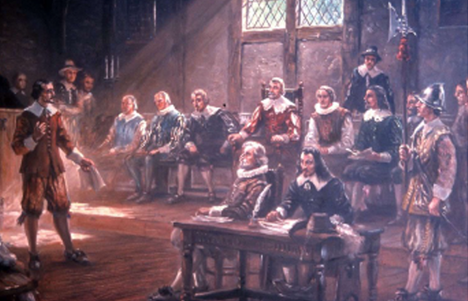
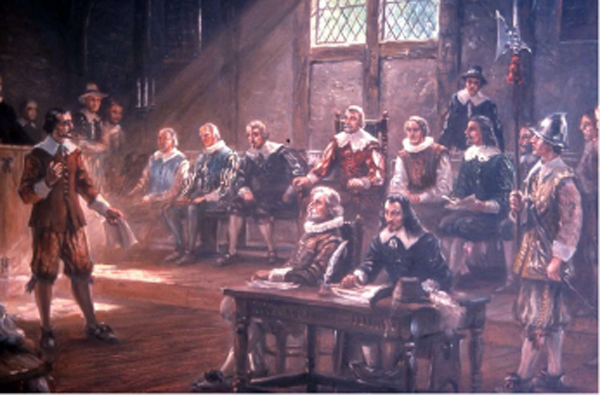
Another important source of information about the first meeting of the General Assembly can be found in the “Journals of the House of Burgesses, 1619-1658/59.” Reading the account of the first gathering of the Assemblyman (which was on July 30), one can visualize the meeting in a fair amount of detail. What follws is a description of the first few minutes of the meeting, presumably written by the clerk of the Assembly, John Twine:
“The most convenient place we could finde to sitt was the Quire [choir] of the Churche, were Sir George Yearldey the Giovernour being down in his accustomed place, those of the Counsel of Estate sat next him on both hands except only the Secretary then appointed Speaker, who sat right before him.
***
All the Burgesses took their places in the Quire, till a Prayer was said by Mr. Bucke, the Minister, that it would please God to guide us & santifie all our proceedings to his owne glory, and the good of his Plantation.
This vivid account of the first meeting reflects the dedication of these first members of the Assembly, and their commitment to improving the lives of the Jamestowne colonists. Without their efforts, we can only wonder what the ultimate fate of the Colony might have been.
Fast forward 400 years: in 2019, archaeologists at Jamestown Rediscovery discovered parts of the foundation of the 1619 church where the General Assembly first met. Today, visitors to Jamestowne can see the brick foundations of the early church through glass panels placed in the church’s floor. They can also sit in recreations of the church pews where the members of the Assembly sat.
And so today we commemorate the first General Assembly, and we honor the memory of the men of the Jamestowne Colony to govern the affairs of the firs4t permanent English settlement in North America.
***
Note: to learn more about the important archaeological work being done a the Jamestowne site, listen to AHP’s upcoming virtual lecture with guest speaker Michael Lavin, the Director of Collections and Conservation at Jamestown Rediscovery. The lecture will take place on September 13. For more information, and to register for the event, click here.