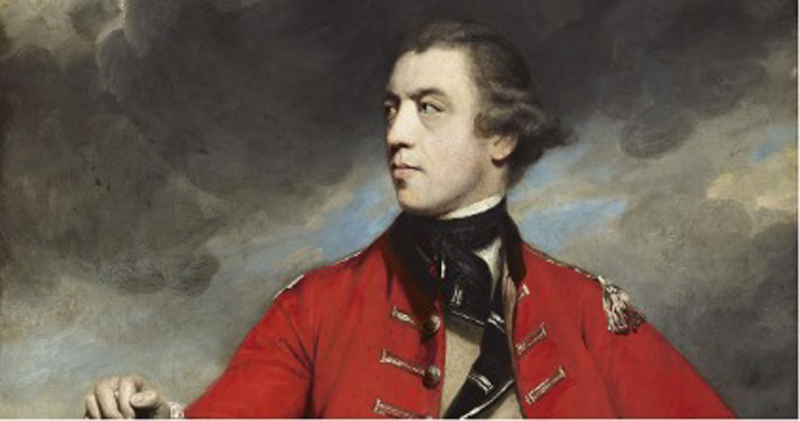
On this day in 1792, British General John Burgoyne died in London at the age of 70. Along with General Charles Cornwallis, he is one of the most famous generals to lead British troops against American forces in the Revolutionary War. He has gone down in history as the general who lost the battle that changed the course of history— the Battle of Saratoga, which took place in October 1777, and culminated in Burgoyne’s surrender of his army of over 6,000 soldiers.
Burgoyne’s first military service came at the young age of 15, when he purchased a commission in the King’s “Horse Guards.” Based in London, Burgoyne cut a dashing figure, and became known as “Gentleman Johnny.” He was no dilettante, however, as he was an accomplished playwright, and mingled with many of the important political figures in pre-War London. In 1745 he joined the “Royal Dragoons,” and was promoted to lieutenant that same year; two years later he became a captain. After the end of the War of the Austrian Succession, he and his wife spent several years in Europe. When war came again, Burgoyne rejoined the army, serving as a lt. colonel in the Seven Years War. After the conclusion of that conflict, he was elected to the House of Commons, where he served until the outbreak of the American Revolution.
When the Revolution commenced in 1775, Burgoyne, now a major general, went to Boston to help defend British troops during the Siege of Boston. A year later he participated in defending British troops during the Siege of Quebec, in which the British army & navy soundly defeated American troops (led by Benedict Arnold)`. But it was the Battle of Saratoga that proved his undoing. A number of strategic miscalculations along the way left Burgoyne exposed to American forces with no supply lines and no reinforcements when he engaged the enemy on the banks of the Hudson River. The Americans, led by General Horatio Gates (and, once again, Benedict Arnold!), out-maneuvered and overpowered the British troops, and the situation became hopeless. Burgoyne surrendered on October 17, 1777.
Following his humiliating defeat at Saratoga, Burgoyne returned to England, where he was reviled for his surrender of his troops. It took years for him to restore his good name. He returned to his military career in the 1780’s, but retired without fanfare a short time later. Although in seeming good health, he died suddenly on August 4, 1792. He is buried alongside many illustrious English political and military figures in Westminster Abbey. Modern historians give him credit for being a strong and dedicated leader of men. Yet, his surrender at the Battle of Saratoga endures as a game-changing moment in the history of the American Revolution.