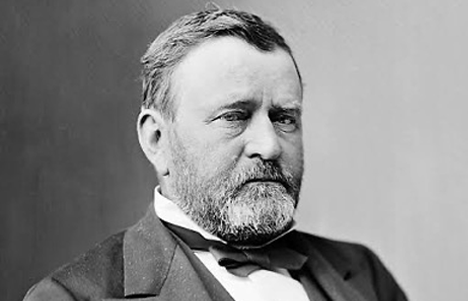
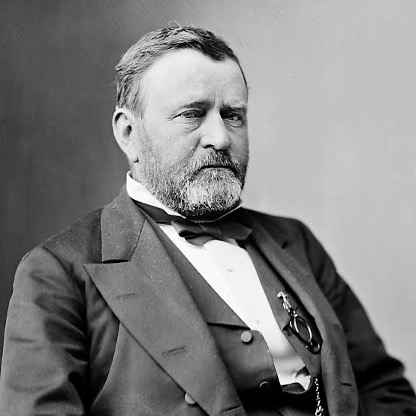
One of the greatest figures in American history is Ulysses S. Grant, the general who led the Union Army to victory in the Civil War, and who later served as a two-term president of the United States. We honor him today on the 140th anniversary of his death on July 23, 1885.
Grant came from humble beginnings, and was an unlikely candidate for greatness. He was born in Ohio in April 1822, and given the name Hiram Ulysses Grant (Ulysses having been a name drawn from a hat!). His parents, Jesse and Hannah Grant, were strong believers that their son should receive a formal education, so Ulysses attended various schools and academies to age 16.
It was then that with the help of a congressman from Ohio that Ulysses was accepted to West Point, and he began his military career. His academic performance at West Point was mediocre, and he graduated in 1843 in the lower ranks of his class. Yet, he formed important relationships at West Point that had a lasting impact, especially when Grant led the Union Army in battle, for he knew his adversary, Robert E. Lee, and other men who later served as officers in the Confederate Army. He also formed relationships with several other West Point classmates who would become his closest mentors and advisors during the Civil War (General Winfield Scott chief among them).
Grant and Slavery
Before discussing Grant’s military years—which extended over two decades—we should note one important fact about his civilian life before the Civil War. His father Jesse Grant was a fervent abolitionist, but ironically, it was Jesse from whom Grant acquired a slave named William Jones. This was in 1858, during a hiatus from Grant’s military service when Grant was working on his wife Julia Dent’s father’s plantation (Julia herself owned a slave named Dan). Historians have tarred and feathered Grant as a slaveholder, but it bears mention that in fact, Grant abhorred slavery, and after he acquired Jones, he freed him in March 1859. During and after the Civil War, the record is clear that Grant supported emancipation, even though he did not self-identify as an abolitionist (nor did his boss, Abraham Lincoln). The notion that Grant was an apologist for slavery is nonsense.
Grant’s Pre-Civil War Military Duties
Grant first met Julia Dent in 1844. They married in August 1848 in St. Louis, where Grant was serving in the 4th Infantry Regiment at Jefferson Barracks, the country’s largest military base in the West. Grant returned to his army duties shortly after the wedding. His first posting was in Detroit. He was then briefly transferred to a god-forsaken outpost in upstate New York, thence to Ft. Humboldt in California. It was at Fort Humboldt that Grant was first accused of drinking on the job, and rumors of him being a drunk persisted, and he was officially reprimanded for this, and he resigned his commission in July 1854.
Grant’s most impressive pre-Civil War service was his role in the Mexican-American War(1846), where he served with distinction, and where he gained critical battlefield experience. His official role was as a regimental quartermaster, and he did not hesitate to get involved in pitched battlefield action against the Mexican forces. His commanders took note of his battlefield exploits. Among the other Americans who distinguished themselves in that war was none other than Grant’s later adversary, Robert E. Lee.
The Civil War Years
Hundreds of books and articles have been published about Grant’s Civil War years, and we won’t attempt to summarize the history of his incomparable battlefield leadership and tactical brilliance. We recommend several books on the subject that have received widespread acclaim: Ronald C. White’s “American Ulysses;” H.W. Brand’s “The Man Who Saved the Union” and “The Last Campaign;” Ron Chernow’s “Grant;” and S.G. Gwynne’s “Hymns of the Republic” are all excellent reading.
What becomes clear from the histories that have been written is that Grant and Lincoln formed a close bond, and Lincoln quickly saw that Grant was the consummate warrior who would not shy from taking the battle to the enemy (in sharp contrast to the general Lincoln removed, George C. McClellan, a consummate procrastinator). It is also clear that Grant sought an end to the war that would heal the Union, and his surrender terms at Appomattox in April 1865 reflected that: he was generous in his negotiations with General Lee, and his accommodations allowed Lee and his Confederate troops to surrender with honor. Grant and Lincoln had put the country on a path of peace, but that effort was quickly shattered by Lincoln’s assassination later that month, and the subsequent chaos when Lincoln’s Vice President Andrew Johnsontook over as president.
Grant’s Presidency
During Grant’s eight years in office as our President (1869-1877), he accomplished many good things, especially in upholding the rights of freed black men, and reversing most of the pro-South compromises that President Johnson had struck with Southern political leaders, who still clung to their “states’ rights” attitudes, and who sought to continue the persecution of black people. Johnson’s policies served to fuel the fires of discrimination, and bolstered the Southern belief that the Confederacy was an honorable cause, and that the “Lost Cause” was to be sanctified (as some people still do today).
Despite the good deeds the Grant administration achieved, Grant’s presidency was marred by allegations of corruption and misconduct. He was under constant assault from his political enemies, and it is no wonder that he aged tremendously during those years of political conflict. After his second term ended in March 1877, he only lived another eight years, and died on July 23 1885 at the young age of 63. He had led a life of action, marked by perhaps the greatest military achievement in American history—the winning of the Civil War. He was feted everywhere, including during a world tour he and his wife took for two and a half years (1877-1879). The heartfelt reception Grant received in the capitols of Europe underscore his larger-than-life stature throughout the world. His public appearances drew thousands of people who gathered to pay their respects to the man.
Grant’s Illness and Death
Unbeknownst to the public, by 1884 Grant was suffering from throat cancer, caused no doubt by several decades of cigar smoking. The news of his illness finally became public in March 1885 thanks to a story in the New York Times. By then Grant was also impoverished from a series of business failures. Knowing that he was dying, and that his family might be left destitute, Grant took it upon himself to write his Memoirs, hoping that the proceeds from book sales would help support the family following his death. Grant’s effort succeeded beyond his wildest dreams: his Memoirs sold hundreds of thousands of copies, and the book became a best seller. After his death, Grant’s wife received the largest royalty payment of $450,000, the largest royalty in history up to that point. He did not live to see the public reaction to his book—he died five days after delivering the manuscript.
In the concluding section of Grant’s Memoir, he summed up what the Civil War meant to him, and acknowledged the widespread support he received from the American public as his cancer took hold of him. Knowing that he was about to die, Grant eloquently expressed himself as his Memoir was about to go to press:
“I feel that we are on the eve of a new era, when there is to be great harmony between the Federal and the Confederate. I cannot stay to be a living witness to the correctness of this prophecy, but I fee within me that it is to be so. The universally kind feeling expressed for me at a time when it was supposed that each day would prove to my last, seemed to me the beginning of the answer to ‘Let us have peace.’ “
Grant’s hope for the future was not to be. In the decades following his death on July 23, 1885, North and South continued to manifest the deepest animosities, and certainly did not demonstrate the “great harmony” Grant wished for on his deathbed.
The outpouring of grief following the announcement of Grant’s death was extraordinary. In the two days before his funeral in New York City, a quarter of a million people turned out to honor him as his funeral train traveled from West Point to New York City. During the funeral march itself in New York City, tens of thousands of former Civil War soldiers marched behind his casket, including Union Army Generals William Tecumseh Sherman and Philip Sheridan. Over 1.5 million people attended the funeral. His body was laid to rest in Riverside Park on the upper westside of New York. His tomb, still there, and still visited by thousands of citizens every year, is said to be the largest such mausoleum in North America.
And so today we honor the memory of Ulysses S. Grant, the man who is often said to have “Saved the Union,” and whose perseverance in the face of adversity is the stuff of legend.