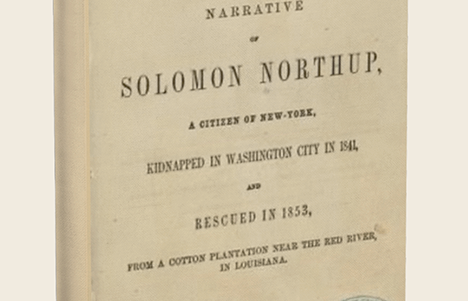
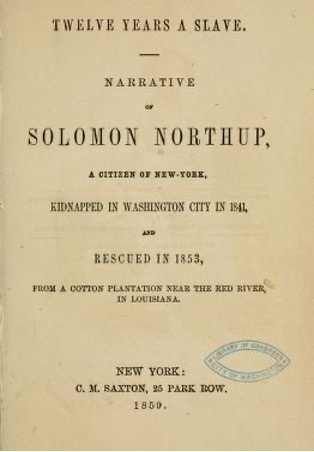
One of the most gut-wrenching personal accounts of the horrors of American slavery during the 19th century was a book written by Solomon Northrup, a free black man who was kidnapped and forced into slavery. The book, “Twelve Years a Slave,” is a vivid first-person narrative of Solomon’s long years of enslavement, and is a chilling indictment of the slave culture as it existed in America in the years before the Civil War.
Solomon was born on July 10, 1807/08 in Minerva, New York. His father was a freed slave and his mother a “free” woman of color—thus, he was born a free person. Solomon’s father passed away in 1829, the same year that Solomon married Anne Hampton, a woman of mixed race. In 1834 they moved to Saratoga Springs, where they had three children, two daughters and a son. Solomon was a hard-working young man who was a laborer in the farming, lumber and railroad industries, as well as a worker on various canal projects in the Lake Champlain area and Canada. During these years he became an accomplished fiddler, and he played frequently in the various villages where he worked—and earned enough money for he and his family to live a reasonably comfortable life. He graduated to playing in higher-class hotels in Saratoga Springs, where he gained a reputation and a following.
Everything went wrong in 1841. In that year, Solomon was approached by two men who offered to sponsor a few concert appearances for him as a violinist in New York City, which would pay handsomely. Solomon accepted the offer, and off they went. The two men who had persuaded him to go to New York then persuaded him to go with them to Washington D.C., where he would earn even more money performing as a violinist. Solomon again said yes. It was in Washington that Solomon was kidnapped, and held in chains in a house not far from the U.S. Capitol building. Solomon protested to his handlers that he was a free man, but he was beaten repeatedly and warned that he should never again claim that he was a free man. He ultimately was shipped with other enslaved persons from Washington to New Orleans, where he was sold into slavery to William Prince Ford, a preacher (!!) with a small farm in Northern Louisiana, Incredibly, Solomon had kind words for Ford in “Twelve Years a Slave,” writing that “there never was a more kind, noble, candid Christian man that William Ford,” while noting that Ford’s long years living in the South must have “blinded him to the inherent wrong at the bottom of the system of slavery.”
Solomon’s stay with Ford did not last long. Due to financial troubles, in 1842 Ford sold Solomon to John Tibaut, a carpenter, who was a cruel and violent man. He frequently whipped Solomon, and at one point decided to lynch him. Solomon’s life was saved when one of Ford’s men learned of the plan to lynch Solomon, and he chased Tibaut’s men off at gunpoint. After that, Tibaut farmed Solomon out as a hired hand to another planter, then sold him to Edwin Epps, who held Solomon in slavery for the next ten years. Epps, too, was a cruel master, and Solomon’s life must have been a living hell.
It was almost by accident that Solomon was able to free himself from slavery and return to his family. A visiting carpenter from Canada, Samuel Bass, revealed to Solomon that he was an abolitionist, and Solomon felt safe to tell Bass that he was actually a free black man being held captive by Epps. At great personal risk, Bass proceeded to send letters to Solomon’s family and friends to let them know what had happened. Ultimately word reach Solomon’s wife Anne, who hired lawyers and commence a legal action to free Solomon from his enslavement. In the meantime, Solomon had no knowledge of what Bass had done for him, or that any actions were being taken to free him. Ironically, one of the principal people who got involved in the effort to free Solomon was Henry Northrup, the son of Solomon’s father’s former slave master. It was Henry who ultimately found his way to Epps’ plantation, accompanied by a sheriff, and obtained Solomon’s freedom. It was on January 4, 1853 that Epps signed legal papers giving up any claims to Solomon, and Solomon was released—twelve years after being abducted in Washington D.C.
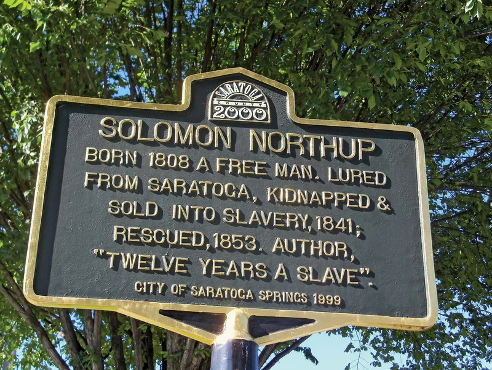
In the same year that Solomon regained his freedom, he wrote “Twelve Years a Slave.” The book sold 30,000 copies in the first three years after publication, and became a best-seller. In the meantime, Solomon brought charges against those who were complicit in his kidnapping, but none of them were found guilty. Solomon moved back to New York and worked as a carpenter for a time. By 1857, Solomon was no longer with his family, and he essentially disappeared from the records. There is speculation among historians that he was still living during the Civil War, and that he was active in the abolitionist movement in the North, but there is no hard evidence to corroborate that. His date of death is unknown. He is not forgotten, however. In 1999, the town of Saratoga Springs erected a beautiful marker honoring his memory.
And so today we, too, honor the memory of Solomon Northrup, a free black man, who was born this day on July 10, 1807/08.